Today’s interview is with Nabeel Qureshi, former Muslim and now Christian defender. He is director of Creed 2:6 ministries found at www.creed26.com. He talks about Creed2:6, his journey from Islam to Christianity, his interactions with the Muslim community and Muslim apologists, his response to critics of his conversion, the occurrence of visions and dreams from God to Muslims, the greatest challenges to sharing the Gospel with Muslims, the social consequences for leaving Islam, cultural vs. religious opposition, common errors to avoid, key factors to focus on, recommended resources on Islam, his personal message to those in Islam, and more. His full testimony is here. Video testimony here.
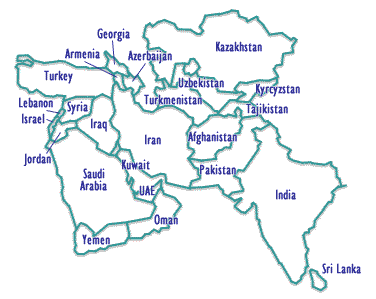
The revelation that the Iranian Revolutionary Guards Corps and its Quds Force had plotted to kill Saudi Arabia’s ambassador to the United States–by blowing him up as he dined at a Washington restaurant–is a stark reminder of the nature of the Tehran regime and its ambitions. But perhaps the most disturbing aspect of the story is that Iran’s thugs are developing a strategic partnership with Mexico’s most violent thugs: Los Zetas may only be the second-largest drug cartel in the Drug Enforcement Administration’s rankings, but they’re probably the most lethal. The gang is said to have formed around a platoon’s worth of deserters from Mexico’s special operations forces, and became the elite troops of another Mexican drug organization, the Gulf Cartel. The leader of that cartel got himself arrested, and the Zetas moved out on their own.
[…]The alliance with the Zetas is only the tip of the Iranian iceberg in Latin America. As Roger Noriega and Jose Cardenas have recently written, “Iran has made the Western Hemisphere a priority….The real game changer has been the alliance developed between Iran’s Mahmoud Ahmedinejad and Venezuela’s Hugo Chavez.” In addition to the Quds Force, Iran often operates through Hezbollah, which has established networks in the Lebanese communities that have long-standing enclaves in the trading and port cities of South America. In addition to Chavez, Iran has established closer ties to the Bolivian government of Evo Morales’s and Rafael Correa’s regime in Ecuador.
[…]We underestimate the Quds-Zeta partnership at our peril. The distinction between law enforcement and warfare is increasingly blurred; the Mexican government claims it had a hand in exposing the plot and it was a DEA agent who foiled the attack. While the Obama administration was right to bring charges against the operatives who plotted to kill the Saudi ambassador, this is a response to symptoms, not the disease. The larger problem is the maturing anti-America coalition governments and extremely rich, powerful, and violent groups; thinking of these organizations simply as criminals obscures their political interests–in keeping governments like Mexico’s or Colombia’s weak, in securing sanctuary, in access to the “international commons,” and the like. An appropriate response demands an integrated strategy. The biggest danger is not “militarizing” U.S. policy but in failing to address the fundamental security issues at stake.
The Obama administration’s lack of concern about border security is very disturbing, but they don’t dare to offend their open-borders constituency for a little thing like national security. Even so, the best defense might be a good offense – but is Obama willing to go on the offensive? Not so much. Instead, Obama seems to be resigned to letting Iran have nuclear weapons.
Excerpt:
Khamenei probably approved a strike in Washington because he no longer fears American military might. Iran’s advancing nuclear-weapons program has undoubtedly fortified his spine, as American presidents have called it “unacceptable” yet done nothing about it. And neither George W. Bush nor Barack Obama retaliated against Iran’s murderous missions in Iraq and Afghanistan.
President Obama has clearly shown he wants no part—or any Israeli part—in a preventive military strike against Iran’s nuclear sites. And Mr. Obama has pulled almost all U.S. troops out of Iraq and clearly wants to do the same in Afghanistan. Many Americans may view that as a blessing, but it is also clearly a sign that Washington no longer has the desire to maintain hegemony in the Middle East.
That’s an invitation to someone like Khamenei to push further, to attack both America and Iran’s most detested Middle Eastern rival, the virulently anti-Shiite Saudi Arabia. In the Islamic Republic’s conspiracy-laden world, the Saudis are part of the anti-Iranian American Arab realm, which is currently trying to down Iran’s close ally, Bashar al-Assad’s Syria, and squash the Shiites of Bahrain. Blowing up the Saudi ambassador in Washington would be an appealing counterstroke against the two foreign forces that Khamenei detests most.
The Obama administration will be tempted to respond against Iran with further unilateral and multilateral sanctions. More sanctions aren’t a bad idea—targeted sanctions against the Revolutionary Guards and the sale of gasoline made from Iranian crude can hurt Tehran financially. But they will not scare it. The White House needs to respond militarily to this outrage. If we don’t, we are asking for it.
The longer Obama leaves this, the worse the eventual war in the Middle East is going to be. We should at the very least be pursuing aggressive covert operations against Syrian and Iranian targets. I hope everyone remembers the slap on the wrist that Obama is giving Iran now, so that when we get attacked more and more, with more dangerous weapons, the correct people get the blame.
For starters, the Crusades to the East were in every way defensive wars. They were a direct response to Muslim aggression—an attempt to turn back or defend against Muslim conquests of Christian lands.
Christians in the eleventh century were not paranoid fanatics. Muslims really were gunning for them. While Muslims can be peaceful, Islam was born in war and grew the same way. From the time of Mohammed, the means of Muslim expansion was always the sword. Muslim thought divides the world into two spheres, the Abode of Islam and the Abode of War. Christianity—and for that matter any other non-Muslim religion—has no abode. Christians and Jews can be tolerated within a Muslim state under Muslim rule. But, in traditional Islam, Christian and Jewish states must be destroyed and their lands conquered. When Mohammed was waging war against Mecca in the seventh century, Christianity was the dominant religion of power and wealth. As the faith of the Roman Empire, it spanned the entire Mediterranean, including the Middle East, where it was born. The Christian world, therefore, was a prime target for the earliest caliphs, and it would remain so for Muslim leaders for the next thousand years.
With enormous energy, the warriors of Islam struck out against the Christians shortly after Mohammed’s death. They were extremely successful. Palestine, Syria, and Egypt—once the most heavily Christian areas in the world—quickly succumbed. By the eighth century, Muslim armies had conquered all of Christian North Africa and Spain. In the eleventh century, the Seljuk Turks conquered Asia Minor (modern Turkey), which had been Christian since the time of St. Paul. The old Roman Empire, known to modern historians as the Byzantine Empire, was reduced to little more than Greece. In desperation, the emperor in Constantinople sent word to the Christians of western Europe asking them to aid their brothers and sisters in the East.
That is what gave birth to the Crusades. They were not the brainchild of an ambitious pope or rapacious knights but a response to more than four centuries of conquests in which Muslims had already captured two-thirds of the old Christian world. At some point, Christianity as a faith and a culture had to defend itself or be subsumed by Islam. The Crusades were that defense.
Pope Urban II called upon the knights of Christendom to push back the conquests of Islam at the Council of Clermont in 1095. The response was tremendous. Many thousands of warriors took the vow of the cross and prepared for war. Why did they do it? The answer to that question has been badly misunderstood. In the wake of the Enlightenment, it was usually asserted that Crusaders were merely lacklands and ne’er-do-wells who took advantage of an opportunity to rob and pillage in a faraway land. The Crusaders’ expressed sentiments of piety, self-sacrifice, and love for God were obviously not to be taken seriously. They were only a front for darker designs.
During the past two decades, computer-assisted charter studies have demolished that contrivance. Scholars have discovered that crusading knights were generally wealthy men with plenty of their own land in Europe. Nevertheless, they willingly gave up everything to undertake the holy mission. Crusading was not cheap. Even wealthy lords could easily impoverish themselves and their families by joining a Crusade. They did so not because they expected material wealth (which many of them had already) but because they hoped to store up treasure where rust and moth could not corrupt. They were keenly aware of their sinfulness and eager to undertake the hardships of the Crusade as a penitential act of charity and love. Europe is littered with thousands of medieval charters attesting to these sentiments, charters in which these men still speak to us today if we will listen. Of course, they were not opposed to capturing booty if it could be had. But the truth is that the Crusades were notoriously bad for plunder. A few people got rich, but the vast majority returned with nothing.
Since this question comes up in apologetics, and even William Lane Craig screws it up by calling the Crusades evil, I thought it might be a good idea for us to have some background so that we would be able to set the record straight if it’s called into question. It’s important to know this because a lot of people appeal to the Crusades to take shots at Christianity and introduce a kind of moral equivalence that excuses real wars of aggression and real terrorism.
The article also includes some of the real mistakes made by some of the Crusaders, so be ready to own up to those.


 WINTERY KNIGHT