

Tag Archives: Irrationality

Stop telling women that God will give them husbands later if they delay marriage now

Man helping a woman with proper handgun marksmanship

Dalrock blogged a splendid post about people who claim that there is a shortage of “good men”. He says that if there really were a shortage of good men, then people who want women to actually get married would be telling women not to delay marriage, but to instead get serious about marrying early, when their ability to attract husband candidates is at its peak.

Dalrock writes:

We can see the same pattern in Dr. John Piper’s recent post Why Are Women More Eager Missionaries?*  Piper explains that missionary work has become a pink ghetto:

…the actual situation among most evangelical faith missions is that between 80–85% of all single missionaries are women. It is a rare thing, like two out of every ten, for a single man to make missions his life’s vocation, which results in the overall statistics being that one-third of those in evangelical world missions are married men, one-third are married women, and 80 percent of the last third are single women. Which means that something just less than two-thirds of the total missionary force are women.

Piper’s main concern with the post however is not that there aren’t enough single men doing missionary work, but that women who choose this field aren’t marrying as they would like.  Piper complains that the problem for husband hunting missionary women is really an exacerbated version of the same problem all Christian women have, and that is an overall lack of marriageable Christian men…

I’ll save you the quotation of Piper, but his reason why missionary women struggle to find husbands is – SHOCK! – that Christian men refuse to man up. I.e – Piper believes that women can’t find husbands because men are not ready and willing to marry.

More:

But if Piper actually believed… that there was a severe shortage of husband material men, he would focus his attention on helping the women reading navigate this incredibly difficult situation.  Overseas mission work may feel empowering for young women, but (according to Piper) single women going into the mission field are greatly handicapping their prospects in an already bleak field.  His advice to young women would be to choose which was truly more important to them, being a missionary or finding a husband.

If Piper really believed that there were a shortage of marriage-minded, marriage-capable Christian men, then Piper would be counseling women who genuinely want to marry to make marriage a priority when they are younger, prettier and more fertile. Some women say that they want to get married “some day”. But the hidden truth is often that they just want to delay marriage in order to have fun and thrills, until they get tired of it. And then they just expect a suitable man to show up right when they need one. But do men want to marry a 35-year-old woman when they are 40 as much as they want to marry a 23-year-old woman when they are 25?

More Dalrock:

Piper even tells a story which would be a perfect way to teach this lesson.  He describes a single woman named Gladys Aylward who went to a place where she found no marriageable men, and then blamed single men for not following her and proposing marriage:

“Miss Aylward talked to the Lord about her singleness. She was a no-nonsense woman in very direct and straightforward ways and she asked God to call a man from England, send him straight out to China, straight to where she was, and have him propose to me.” I can’t forget the next line. Elisabeth Elliot said, “With a look of even deeper intensity, she shook her little bony finger in my face and said, ‘Elisabeth, I believe God answers prayer. And he called him.’” And here there was a brief pause of intense whisper. She said, “‘He called him, and he never came.’”

Now, that experience, I would guess, is not unique to Gladys Aylward.

If Piper really believed that Christian husbands were scarce, he would be sharing this anecdote to warn young women of the foolishness of moving away from the pool of men they hope to choose a husband from and then expecting God to send the man of their choosing across the world to propose.  If we were in a culture of scarcity of good men, this would be the obvious lesson from this story.  But we live in an age with unshakable confidence that good men are not only available all around us, but will always be abundant.  If Piper believed that the husband Miss Aylward was praying for was surrounded by real life English women eager to win him as a husband, this story wouldn’t be complaining about why he didn’t drop everything, fly to China, and propose to a woman he had never met.  If Piper believed that the man was sought after as a husband in England, he would be pointing out the foolishness of Miss Aylward flying off to China and then wondering why a man she had never met didn’t show up to propose once she decided she wanted to marry.

Miss Aylward either needed to accept that being a missionary in a secular country meant not marrying, or she needed to focus on marriage first when she was attractive to men as a life partner. Many women are propositioned for sex after they hit their mid-30s, but few of them are asked to marry. This is because men need women more when they are just starting out in their careers than when they are established in their careers.

Many women have no appreciation of how investing in a husband early causes him to be loyal to her when she is older. Women think that a husband will show up when she is ready, and be loyal to her even though she was absent during the hardships of the first decade of his career. A woman can do a lot of good for a man when he is starting out in his career and trying to save money for a house. But when those years have passed, the man’s ability to work and save have been largely set – without anyone’s help. If he went through those years single, then he typically will have earned less and saved less than a married man, because he did it without a wife’s support. Men do better in their careers and finances when they have a wife’s support. Especially in the early career, which is more stressful because of the lack of work experience. If a woman wants a man to be faithful and loyal, then she needs to choose a man who needs her, and invest in him using her youth and beauty to support him during his critical 20s and early 30s. Men respond to support during the critical years with lifelong fidelity and loyalty.

By the way, for an explanation of why men prefer not to be missionaries, read this post on Deeper Strength blog.

And one last point. I have known 3 women missionaries, and many women who thought about becoming short-term missionaries. In every case the women had grown up as Christians, and then gone wild in their 20s with alcohol and promiscuity. And they saw missions work as a fun and thrilling way to “atone” for their wild past. Another reason for Christian men to be skeptical of women missionaries.
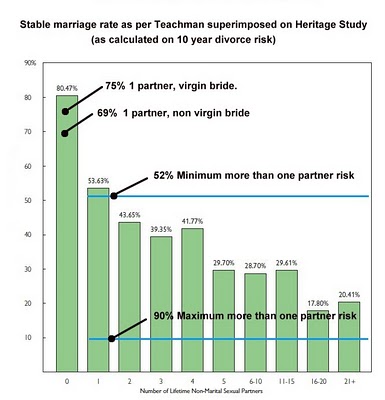
Women who delay marriage for casual sex surprised to be single in their mid-30s

Divorce risk and number of pre-marital sex partners

Dr. Mark Regnerus is a sociologist at the University of Texas at Austin. He has published books on the changing nature of relationships with Oxford University Press. His newest book argues that the Sexual Revolution has caused men to lose interest in marriage because women are now giving them sex for free, without them having to prove their husband credentials first. This causes men to be disinterested in the traditional ways of impressing a woman, namely, getting a job, moving out, being willing to commit, and being able to provide for children who may appear.

The Daily Signal provides a case study taken from Regnerus’ latest book “Cheap Sex”, which illustrates the problem.

Excerpt:

Sarah is 32 years old and recently moved to Texas from New York, looking for a new start—in more ways than one.

Brooklyn had grown too expensive for her hipster pocketbook. A relationship she had hoped would blossom and mature there had instead withered. So to Austin she came, hoping she could improve upon her modest $22,000 annual earnings the previous year.

Her most recent sexual partner—Daniel—was not actually a relationship per se. He was not the reason she moved. Rather, he was a 23-year-old American she had met in China four years before during a three-week language immersion program.

[…]When they first met, and slept together, Sarah was in a relationship with David, the man for which she had moved to, and then away from, New York. She ended up “cheating on him,” that is, David, several times.

[…]If you’re having trouble keeping times, dates, and boyfriends straight, it’s understandable. Sarah herself laughs at the drama of it all.

[…]Getting serious was never much of an option. He was 23, and she was 32: “We both knew … he was graduating from college and, you know, like we both, at least I knew it was never gonna work out. I think he kind of felt the same way.”

[…]When asked how rapidly her relationships tend to become sexual, Sarah replied, “the first or second date.” That account did not stand out from those of many other interviewees.

The numbers are on her side, too. In the 2014 Relationships in America survey, sex before the relationship begins was the modal—meaning the most common—point at which Americans report having first had sex in their current relationships.

Is her timing of sex intentional? No. “It just happens,” she reasoned.

[…]This, she claims, is the standard approach to dating among her peers, if not necessarily the most optimal: “I don’t think it’s unusual, but I think that for a lasting relationship, it’s not the best approach.”

[…]Three years later, now 35, Sarah continues to live in Austin and continues to find commitment elusive. She does not dislike her life, but it is not the one she envisioned a decade earlier.

Daniel is a musician, which doesn’t surprise me at all. A musician, student or other unemployed penniless bad boy will not make any demands on the woman, because he almost certainly has no plan for the future.  This is what many women today want: someone for right now who doesn’t want her to do anything  to prepare for marriage, e.g. – get a real job, stop the thrill-seeking, stop traveling the world. No matter what a woman says about marriage,  if her actions now show an interest in fun and thrills, then she doesn’t want marriage.

The typical woman’s plan for marriage is simply to imagine marriage happening later somehow, without her having to do anything that she doesn’t feel like doing right now. It would be like “planning” for your retirement by taking trips all over the world right now, while imagining living off the interest from a million dollars in savings at age 55. This problem is what happens when the culture tells women that they should not aspire to marriage, and should not measure men to see if they will make good husbands and fathers. If a woman cannot expect a man to be a man (protector, provider, moral and spiritual leader), then she will choose men on other criteria.

This is what women today want:

  • hot appearance
  • confident words about the future
  • empty resume
  • empty bank account
  • several years younger than they are
  • no firm convictions about morality
  • no firm convictions about theology
  • progressive political views, especially on abortion

Men who have no jobs and no money don’t lead women, and are much easier for women to manipulate. The problem with these men is – as any married woman knows – is that those men do not commit. Why not? Because they cannot afford to commit. Marriage, put simply, costs money. Starter houses cost a quarter million. Children cost a quarter million each, not counting college. Retirement costs a quarter million per spouse. And so on. But there is no one in this society telling women that they need to care about choosing men who are serious about the objective duties of the husband role.

Women love to believe that they can choose a hot, irresponsible bad boy who gives them feelings, and then magically mold him into a husband: able to work hard, save money, be self-controlled, faithful and good with children. Feelings determine the choice of man, and feelings tell them that the man can be magically transformed into a husband somehow. Perhaps by giving him premarital sex! That will make him responsible. After all, you can put out a fire with gasoline, right? This is the most common approach women today take to relationships: get drunk, have sex with hot bad boy, shack up with him, wait for him to propose marriage.

I frequently tell my female friends about women I know like the one in the article – many raised by two married parents in Christian homes. They have arts degrees, empty resumes, empty bank accounts, and histories of alcoholism, bulimia, promiscuity and/or divorce. My female friends give me the same advice: “YOU NEED TO LOWER YOUR STANDARDS OR YOU’LL NEVER GET MARRIED”. If that’s the best that they can do, then it’s no wonder that men are not interested in marriage.

If you want men to be interested in marriage, fix the root cause. The root cause of the marriage rate declining is not men. The root cause is feminism.

Stop telling women that God will give them husbands later if they delay marriage now

Man helping a woman with proper handgun marksmanship

Dalrock blogged a splendid post about people who claim that there is a shortage of “good men”. He says that if there really were a shortage of good men, then people who want women to actually get married would be telling women not to delay marriage, but to instead get serious about marrying early, when their ability to attract husband candidates is at its peak.

Dalrock writes:

We can see the same pattern in Dr. John Piper’s recent post Why Are Women More Eager Missionaries?*  Piper explains that missionary work has become a pink ghetto:

…the actual situation among most evangelical faith missions is that between 80–85% of all single missionaries are women. It is a rare thing, like two out of every ten, for a single man to make missions his life’s vocation, which results in the overall statistics being that one-third of those in evangelical world missions are married men, one-third are married women, and 80 percent of the last third are single women. Which means that something just less than two-thirds of the total missionary force are women.

Piper’s main concern with the post however is not that there aren’t enough single men doing missionary work, but that women who choose this field aren’t marrying as they would like.  Piper complains that the problem for husband hunting missionary women is really an exacerbated version of the same problem all Christian women have, and that is an overall lack of marriageable Christian men…

I’ll save you the quotation of Piper, but his reason why missionary women struggle to find husbands is – SHOCK! – that Christian men refuse to man up. I.e – Piper believes that women can’t find husbands because men are not ready and willing to marry.

More:

But if Piper actually believed… that there was a severe shortage of husband material men, he would focus his attention on helping the women reading navigate this incredibly difficult situation.  Overseas mission work may feel empowering for young women, but (according to Piper) single women going into the mission field are greatly handicapping their prospects in an already bleak field.  His advice to young women would be to choose which was truly more important to them, being a missionary or finding a husband.

If Piper really believed that there were a shortage of marriage-minded, marriage-capable Christian men, then Piper would be counseling women who genuinely want to marry to make marriage a priority when they are younger, prettier and more fertile. Some women say that they want to get married “some day”. But the hidden truth is often that they just want to delay marriage in order to have fun and thrills, until they get tired of it. And then they just expect a suitable man to show up right when they need one. But do men want to marry a 35-year-old woman when they are 40 as much as they want to marry a 23-year-old woman when they are 25?

More Dalrock:

Piper even tells a story which would be a perfect way to teach this lesson.  He describes a single woman named Gladys Aylward who went to a place where she found no marriageable men, and then blamed single men for not following her and proposing marriage:

“Miss Aylward talked to the Lord about her singleness. She was a no-nonsense woman in very direct and straightforward ways and she asked God to call a man from England, send him straight out to China, straight to where she was, and have him propose to me.” I can’t forget the next line. Elisabeth Elliot said, “With a look of even deeper intensity, she shook her little bony finger in my face and said, ‘Elisabeth, I believe God answers prayer. And he called him.’” And here there was a brief pause of intense whisper. She said, “‘He called him, and he never came.’”

Now, that experience, I would guess, is not unique to Gladys Aylward.

If Piper really believed that Christian husbands were scarce, he would be sharing this anecdote to warn young women of the foolishness of moving away from the pool of men they hope to choose a husband from and then expecting God to send the man of their choosing across the world to propose.  If we were in a culture of scarcity of good men, this would be the obvious lesson from this story.  But we live in an age with unshakable confidence that good men are not only available all around us, but will always be abundant.  If Piper believed that the husband Miss Aylward was praying for was surrounded by real life English women eager to win him as a husband, this story wouldn’t be complaining about why he didn’t drop everything, fly to China, and propose to a woman he had never met.  If Piper believed that the man was sought after as a husband in England, he would be pointing out the foolishness of Miss Aylward flying off to China and then wondering why a man she had never met didn’t show up to propose once she decided she wanted to marry.

Miss Aylward either needed to accept that being a missionary in a secular country meant not marrying, or she needed to focus on marriage first when she was attractive to men as a life partner. Many women are propositioned for sex after they hit their mid-30s, but few of them are asked to marry. This is because men need women more when they are just starting out in their careers than when they are established in their careers.

Many women have no appreciation of how investing in a husband early causes him to be loyal to her when she is older. Women think that a husband will show up when she is ready, and be loyal to her even though she was absent during the hardships of the first decade of his career. A woman can do a lot of good for a man when he is starting out in his career and trying to save money for a house. But when those years have passed, the man’s ability to work and save have been largely set – without anyone’s help. If he went through those years single, then he typically will have earned less and saved less than a married man, because he did it without a wife’s support. Men do better in their careers and finances when they have a wife’s support. Especially in the early career, which is more stressful because of the lack of work experience. If a woman wants a man to be faithful and loyal, then she needs to choose a man who needs her, and invest in him using her youth and beauty to support him during his critical 20s and early 30s. Men respond to support during the critical years with lifelong fidelity and loyalty.

By the way, for an explanation of why men prefer not to be missionaries, read this post on Deeper Strength blog.

And one last point. I have known 3 women missionaries, and many women who thought about becoming short-term missionaries. In every case the women had grown up as Christians, and then gone wild in their 20s with alcohol and promiscuity. And they saw missions work as a fun and thrilling way to “atone” for their wild past. Another reason for Christian men to be skeptical of women missionaries.