Standard & Poor’s may downgrade the long-term credit rating of the U.S. once again in less than three months after sending shockwaves through the bond and stock markets by stripping the nation of its top notch triple-A rating last week, according to an emergency Sunday night conference call for clients of Bank of America Merrill Lynch.
“We do expect further downgrades,” said Ethan Harris, North American economist, on the call. “We doubt the newly appointed bipartisan commission will come up with a credible long-term deficit reduction plan. Hence by November or December we would not be surprised to see S&P downgrade the debt again from AA-plus to AA.”
Harris said that the U.S. should have avoided the downgrade in the first place by meeting S&P’s demands of a $4 trillion deficit cut and a “demonstrating a sensible budget process.” What they got instead was a “deficit cut of $2.1 trillion and a budget process that’s been extremely chaotic,” said Harris.
[…]”If a disorderly Treasury market leads to the Fed embarking on QE3, repercussions for the dollar will be catastrophic,” said David Woo, head of global rates and currencies research, on the call. “Investors will be quick to conclude that U.S. monetary policy has been subjugated by fiscal policy and the Fed’s independence would be placed seriously into question.”
In the midst of a world embroiled in economic turmoil, a few nations have managed to do surprisingly well—among them, Estonia. After near economic collapse during the 2008–2009 financial crisis, the country has managed to successfully bounce backwith substantial GDP growth, a vibrant trade environment, and a notable budget surplus.
During the first quarter of this year, Estonia had the highest rate of growth in the EU and the biggest drop in unemployment. In July, its credit rating was raised by Fitch to A+, a reflection of substantial economic growth.
But how did Estonia get here? Estonia possesses a flexible, open economy and investment climate that encourages competition and economic growth. It remains one of the world’s freest economies, according to The Heritage Foundation’s Index of Economic Freedom. However, prudent fiscal policies have played the largest role in Estonia’s impressive economic performance, particularly in recent years. Still, the path to fiscal conservatism was not easy; it required a lot of rigorous, painful cutback involving 9 percent of GDP in fiscal adjustments and large cuts to nominal wages.
Notice that Estonia’s economic policies are tea party conservative policies, not socialist policies.
Meanwhile, the White House has yet to respond to our first credit downgrade.
Standard & Poor’s announced Friday night that it has downgraded the U.S. credit rating for the first time, dealing a symbolic blow to the world’s economic superpower in what was a sharply worded critique of the American political system.
Lowering the nation’s rating to one notch below AAA, the credit rating company said “political brinkmanship” in the debate over the debt had made the U.S. government’s ability to manage its finances “less stable, less effective and less predictable.” It said the bipartisan agreement reached this week to find at least $2.1 trillion in budget savings “fell short” of what was necessary to tame the nation’s debt over time and predicted that leaders would not be likely to achieve more savings in the future.
[…]The downgrade to AA+ will push the global financial markets into uncharted territory after a volatile week fueled by concerns over a worsening debt crisis in Europe and a faltering economy in the United States.The AAA rating has made the U.S. Treasury bond one of the world’s safest investments — and has helped the nation borrow at extraordinarily cheap rates to finance its government operations, including two wars and an expensive social safety net for retirees.
Treasury bonds have also been a stalwart of stability amid the economic upheaval of the past few years. The nation has had a AAA rating for 70 years.
Analysts say that, over time, the downgrade could push up borrowing costs for the U.S. government, costing taxpayers tens of billions of dollars a year. It could also drive up interest rates for consumers and companies seeking mortgages, credit cards and business loans.
A downgrade could also have a cascading series of effects on states and localities, including nearly all of those in the Washington metro area. These governments could lose their AAA credit ratings as well, potentially raising the cost of borrowing for schools, roads and parks.
Sen. Jim DeMint (R-S.C.) responded to the nation’s downgrade at the hands of Standard & Poor’s by calling for the resignation of Treasury Secretary Timothy Geithner.
Saying “enough is enough,” the Tea Party favorite pressured President Obama to remove his top economic official and adopt a new perspective.
“The President should demand that Secretary Geithner resign and immediately replace him with someone who will help Washington focus on balancing our budget and allowing the private sector to create jobs,” he said in a statement. “For months he opposed all efforts to reduce the debt in return for a debt ceiling increase. His opposition to serious spending and debt reforms has been reckless and now the American people will pay the price.”
After S&P put the nation’s rating on negative watch back in April, Geithner said there was “no risk” the US would be downgraded.
“No risk of that, no risk,” he said at the time in an interviewwith Fox Business Network.
Yes, there is no risk the same way that the 864 billion stimulus was supposed to keep unemployment below 8% – except that unemployment shot up over 10%.
I saw this status update from a friend on Facebook:
If you don’t understand the current financial crisis in our country, here’s a simplified explanation: “If the US Government was a family, they would be making $58,000 a year, they spend $75,000 a year, & have $327,000 in credit card debt. They are currently proposing BIG spending cuts to reduce their spending to $72,000 a year. These are the actual proportions of the federal budget & debt, reduced to a level that we can understand.” – Dave Ramsey
The Obama administration has had three one-and-a-half trillion dollar deficits in a row. That is nearly TEN TIMES the last Republican budget deficit in 2007. That was the last year that the Republicans held the House and Senate. The last year before Nancy Pelosi and Harry Reid came into power.
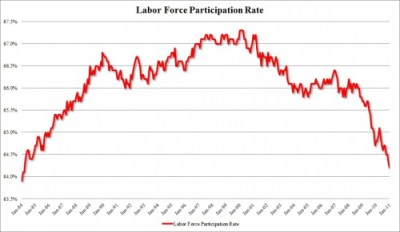
By now, everyone has heard that Marxist Obama has failed to create jobs again, so that the underemployment rate is at 19.2%. (Underemployment is even higher than employment because it takes into account people working part-time who want to work full-time but can’t). That means that 20% of the population either cannot find work, or cannot find full-time work. The labor force participation under Obama’s socialist regime is now at a 26-year low.
Excerpt:
At 64.2%, the labor force participation rate (as a percentage of the total civilian noninstitutional population) is now at a fresh 26 year low, the lowest since March 1984, and is the only reason why the unemployment rate dropped to 9% (labor force declined from 153,690 to 153,186). Those not in the Labor Force has increased from 83.9 million to 86.2 million, or 2.2 million in one year! As for the numerator in the fraction, the number of unemployed, it has plunged from 15 million to 13.9 million in two months! The only reason for this is due to the increasing disenchantment of those who completely fall off the BLS rolls and no longer even try to look for a job. Lastly, we won’t even show what the labor force is as a percentage of total population. It is a vertical plunge.
Canada’s job creation in January was more than four times the median forecast, pushing the Canadian dollar to its strongest level since May 2008 and adding to evidence the country’s economic recovery may be accelerating.
Employment rose by 69,200 and the labor force increased by 106,400, Statistics Canada said today in Ottawa. The jobless rate rose to 7.8 percent from December’s 7.6 percent, as more people sought work. Economists forecast 7.6 percent unemployment and job growth of 15,000, according to the median estimates of 25 and 26 economists surveyed by Bloomberg News.
“This adds confidence to the notion we are headed for a better year for growth and growth in the job market,” said Mark Chandler, head of Canadian currency and rates strategy at Royal Bank of Canada’s RBC Capital Markets unit in Toronto. “There isn’t a lot of slack in the labor market in Canada, certainly on a relative basis to other countries.”
Canadian policy makers have been dealing with the impact of a strong currency and a slowdown in growth of household and government spending that crimped the economic recovery in the second half of last year. Bank of Canada Governor Mark Carney stopped raising interest rates after September and Finance Minister Jim Flaherty scaled back plans to exit stimulus.
“It’s one of these reports that’s strong through and through – it’s hard to find any weakness,” said David Tulk, chief Canada macro strategist at Toronto-Dominion Bank’s TD Securities unit.
“The Bank of Canada would likely just see this as a step towards a stronger recovery, but not a point where they would need to respond,” he said. He predicts a July rate increase.
[…]The report restores Canada’s status as having regained all the jobs lost in the recession, after a Jan. 28 revision based on updated census data reduced Statistics Canada’s estimate of total employment.
The Canadian dollar gained 0.4 percent to 98.75 cents per U.S. dollar at 4:30 p.m. in New York from 99.11 cents yesterday, after earlier touching 98.32 cents, the strongest level since May 2008. The benchmark 10-year Canadian government bond yield increased four basis points to 3.46 percent, the highest since May.
[…]“Too many Canadians are still looking for work, the economic recovery is fragile,” Flaherty said today in response to a question in the House of Commons. “We need to continue with our job-creating, low-tax plan.”
Prime Minister Stephen Harper has said reductions in corporate taxes are the best way to boost employment.
[…]Wal-Mart Stores Inc., the world’s largest retailer, said Jan. 26 it will open 40 “supercenters” in Canada by the end of January 2012, creating 9,200 construction and store jobs.
Basically, the Canadians listened to Obama’s speeches, and then decided to do the EXACT OPPOSITE of what he said. They are drilling for more oil, lowering corporate taxes below 20%, (ours is 36%), cutting spending and raising interest rates to encourage people to spend less and invest more, which supports job creation. This is what Hayek would recommend. In order to create jobs, you need to cut corporate taxes to provide businesses with a profit motive. And you need to make sure that there is capital to borrow for risk-taking, which happens when interest rates are higher because people save more money by giving it to banks to lend to businesses. When a business sees that it can keep profits that it makes then that’s what they’ll do. That’s when they start expanding their businesses and taking risks – when there is money to be made. If you keep banning drilling, imposing health care costs and demonizing businesses in speeches, like Obama does, then they WON’T hire anyone.
I hope that all the young people who voted for the first MTV President are happy with their 18% youth unemployment rate. Ideas have consequences.
But the differences between Canada are even more pronounced. Recall that Canada is ONE TENTH the size of the United States, with one-tenth the population, one-tenth the GDP, and one-twentieth the national debt. A 700,000 increase in the number of jobs is really like a 700,000 increase when projected proportionally to the United States. Canada didn’t spend massive amounts of money on “stimulus” spending, because the prime minister is NOT a Keynesian. He’s a Hayekian, like me. He’s not following the socialist, academic playbook – he’s following the capitalist, real-world playbook. He doesn’t believe that lowering interest rates and wasting money of government public works projects is a way out of a recession. And he’s right.


 WINTERY KNIGHT