
Tag Archives: Inflation

Thomas Sowell: could a Cyprus-style confiscation of private savings happen here?

Thomas Sowell, an economist for the people

Surprise! It already is happening here. Thomas Sowell explains in the American Spectator.

Excerpt:

One of the big differences between the United States and Cyprus is that the U.S. government can simply print more money to get out of a financial crisis. But Cyprus cannot print more euros, which are controlled by international institutions.But could similar policies be imposed in other countries, including the United States?

Does that mean that Americans’ money is safe in banks? Yes and no.

The U.S. government is very unlikely to just seize money wholesale from people’s bank accounts, as is being done in Cyprus. But does that mean that your life savings are safe?

No. There are more sophisticated ways for governments to take what you have put aside for yourself and use it for whatever the politicians feel like using it for. If they do it slowly but steadily, they can take a big chunk of what you have sacrificed for years to save, before you are even aware, much less alarmed.

That is in fact already happening. When officials of the Federal Reserve System speak in vague and lofty terms about “quantitative easing,” what they are talking about is creating more money out of thin air, as the Federal Reserve is authorized to do — and has been doing in recent years, to the tune of tens of billions of dollars a month.

When the federal government spends far beyond the tax revenues it has, it gets the extra money by selling bonds. The Federal Reserve has become the biggest buyer of these bonds, since it costs them nothing to create more money.

This new money buys just as much as the money you sacrificed to save for years. More money in circulation, without a corresponding increase in output, means rising prices. Although the numbers in your bank book may remain the same, part of the purchasing power of your money is transferred to the government. Is that really different from what Cyprus has done?

I noticed that Brian Lilley had an article about whether Cyprus-style confiscations could happen in Canada. The short answer: yes – for amounts above $100,000 Canadian.
Five Guys franchise owner says Obamacare will force him to raise prices

Five Guys is my favorite place to go for a reasonably-priced cheeseburger. But the reasonable prices might be changing now.

Excerpt:

Business owners across America say they’re experiencing poor sales, holding back hiring, and planning layoffs because of “Obamacare,” or so says the Federal Reserve’s latest Beige Book (an overview of the business conditions in each of its 12 districts).

But in case you don’t trust the Beige Book’s anecdotal reporting, here’s something else to consider: Five Guys franchise holder Mike Ruffer said on Monday that the cost of The Patient Protection and Affordable Care Act, President Obama’s landmark healthcare bill, will force him to raise the price of burgers and hot dogs, according to the Washington Examiner’s Paul Bedard.

“He will need all the profits from at least one of his eight outlets just to cover his estimated added $60,000-a year in new Obamacare costs,” Bedard’s report notes.

“Any added costs are going to have to be passed on,” said Ruffer, who operates eight Five Guys in the Raleigh-Durham, N.C. area.

But wait! There’s more: Ruffer also said that he had to scrap plans to build three additional restaurants because he’s still waiting for after the Obama administration to explain all the rules and penalties involved in the healthcare bill.

[…]The report goes on to explain that Ruffner thought he’d be exempt from “Obamacare” because he built each restaurant as its own company. However, the healthcare law doesn’t recognize this distinction – so now he’s exploring whether laying off employees or cutting back hours will keep his franchise safe from “Obamacare.”

“He said that ‘scorched earth plan,’ however, would hurt his restaurants, so Ruffer is likely to either pay the fine or buy insurance,” the Washington Exmainer reports. “But spreading the costs over his basic menu of fries, drinks, burgers and hot dogs, could scare off customers, he worries. He said that the recent spike in gas prices cut into his profits since fewer people were stopping at his restaurants.”

“And the health care law isn’t only going to hit Ruffer. He’s quizzed his workers to ask if they understand that they will be fined if they don’t get health insurance. Just one of 20 workers were aware of the $95 tax penalty that rises to $695 by 2016,” the report adds.

The recent spike in gas prices is also caused in part by Obama’s blocking of American energy development. It as if everything he does hurts the individual consumer.

Maybe next time, people will turn off their televisions and hit the books before voting. In the meantime, the fairest way to decide which employees to lay off is to take a walk through parking lot and pick every employee with an Obama sticker on their car.

Let the grown-ups lead: Paul Ryan describes his proposal to balance the budget

Paul Ryan's Balanced Budget Proposal
Paul Ryan’s Balanced Budget Proposal

In the Wall Street Journal.

Excerpt:

America’s national debt is over $16 trillion. Yet Washington can’t figure out how to cut $85 billion—or just 2% of the federal budget—without resorting to arbitrary, across-the-board cuts. Clearly, the budget process is broken. In four of the past five years, the president has missed his budget deadline. Senate Democrats haven’t passed a budget in over 1,400 days. By refusing to tackle the drivers of the nation’s debt—or simply to write a budget—Washington lurches from crisis to crisis.

House Republicans have a plan to change course. On Tuesday, we’re introducing a budget that balances in 10 years—without raising taxes. How do we do it? We stop spending money the government doesn’t have. Historically, Americans have paid a little less than one-fifth of their income in taxes to the federal government each year. But the government has spent more.

So our budget matches spending with income. Under our proposal, the government spends no more than it collects in revenue—or 19.1% of gross domestic product each year. As a result, we’ll spend $4.6 trillion less over the next decade.

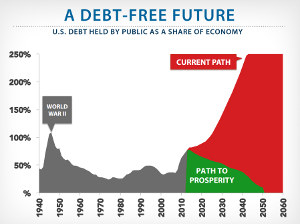
Our opponents will shout austerity, but let’s put this in perspective. On the current path, we’ll spend $46 trillion over the next 10 years. Under our proposal, we’ll spend $41 trillion. On the current path, spending will increase by 5% each year. Under our proposal, it will increase by 3.4%. Because the U.S. economy will grow faster than spending, the budget will balance by 2023, and debt held by the public will drop to just over half the size of the economy.

Yet the most important question isn’t how we balance the budget. It’s why. A budget is a means to an end, and the end isn’t a neat and tidy spreadsheet. It’s the well-being of all Americans. By giving families stability and protecting them from tax hikes, our budget will promote a healthier economy and help create jobs. Most important, our budget will reignite the American Dream, the idea that anyone can make it in this country.

The truth is, the nation’s debt is a sign of overreach. Government is trying to do too much, and when government does too much, it doesn’t do anything well. So a balanced budget is a reasonable goal, because it returns government to its proper limits and focus. By curbing government’s overreach, our budget will give families the space they need to thrive.

Since Obama was elected, he’s added over $5.5 trillion to the national debt. This is not sustainable. We cannot continue to pass on enormous levels of debt to our children so that 30-year-old students can have free condoms bought for them. It is immoral to spend trillions of dollars and then pass the bill to the next generation. Democrats like to talk about helping the children, but really they just want to force them to pay for their wasteful spending. It’s got to stop.