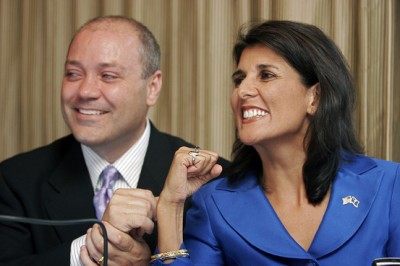
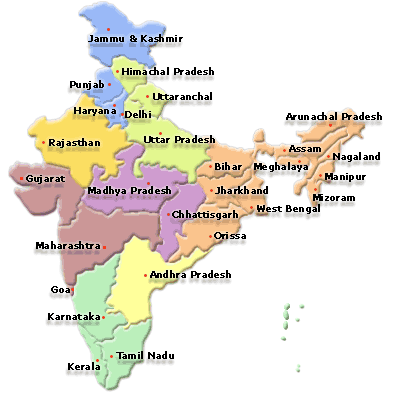
Parents of both Nikki Randhawa Haley, who on Tuesday won the governor’s election in South Carolina, and Bobby Jindal, the other Indian American governor of Lousiana, were born to immigrants from Punjab. Nikki Haley is the first woman and the second person of Indian origin after Bobby Jindal to become governor in the US. Jindal won the top job in Louisiana state in 2007.
[…]”I don’t do anything halfway – I’m in this race to win,” Nikki had told IANS in July taking time off her busy campaign for raising money.
“I am confident that come November, the people of South Carolina will send me to the Governor’s Mansion.
“When they (voters) do, I will immediately get to work to give them progress that makes them proud.”
Asked whether her Sikh background will matter in the race, she had said,”What matters most in South Carolina – and I imagine elsewhere in the country – is not the personalities of the candidates but the message they carry.
“Our message of bringing good government back to the people of this state, creating jobs by reforming our tax code so it’s flatter and fairer, and reminding government of the value of a dollar resonates with all the people of this state.
“I am very proud of my background and how I was raised. Just as in 2004 (when her opponents had raised the issue of background) I will hold my head up high and focus on what I can do for the people of this state.”
It seems to me that the Indian culture of hard work and family is a natural fit with conservative ideals.
From the Times of India, a good economics article from Swaminathan S Anklesaria Aiyar. (H/T Shalini)
Excerpt:
Politicians and activists constantly propose new rights — the right to work, to education, and now to food. The word “rights” is being twisted to mean entitlements, and there is a big difference.
Rights are freedoms from oppression by the state or by society (through ethnicity, religion and gender). These rights do not entail government handouts. Entitlements, however, are welfare measures entailing government handouts. Rights are not limited by budget constraints, but entitlements are. So, rights are universal but entitlements are not.
[…]US economists calculate that three welfare measures — social security (for the aged), Medicare (for the aged) and Medicaid (for the poor)—will triple from 7% of GDP to 20% in the next decade, swallowing up virtually all federal tax revenue. Jagadeesh Gokhale of the Cato Institute calculates that, including social security, the US is headed for a national debt that’s 500% of GDP, and Europe of 434%.
Some much for entitlement spending. He then explains the origin of human rights in Britain, America and France, and then says this:
These three countries spearheaded the concept of fundamental rights. In all three, rights were about freedoms, not entitlements
In subsequent centuries, people said this was not enough, and proposed entitlements — which some called second-generation rights. Marxists declared that rights to free speech, elections and personal freedom were bourgeois illusions that did not empower the poor. So Lenin proposed a dictatorship of the proletariat that took away all basic freedoms, and instead offered the right to food, shelter and work. Mind you, nobody could sue Lenin for poor provision. Nobody could throw out Mao for the Great Leap Forward that killed 30 million people. Nobody could topple Stalin for murdering four to six million peasants in the Ukraine.
The communist experience shows that giving welfare rights priority over basic freedoms is the road to serfdom. And the capitalist welfare state now shows that entitlements, although desirable and inevitable in democracies, must be limited and targeted at the needy, so that they do not hog all spending or bankrupt governments.
It’s amazing. He’s more American than the Democrats, because he actually understands America. Thanks so much for finding this article, Shalini!
By the way, if you want to learn what the end-game is for the Democrats, you can read “The Road to Serfdom” by the Nobel Prize-winning economist F.A. Hayek, which Swami alluded to in his article.
Consider this article from the Philadelphia Bulletin.
Excerpt:
In 2007, the School Choice Campaign, a New Delhi-based education think tank, designed, funded, and implemented a pilot school choice program in the city. The program randomly selected students to be offered a school tuition voucher, which was taken up by 63 percent of students selected. The money could be used at any qualifying private school.
India’s teacher unions have fought the privately funded program tooth-and-nail. “They fight vouchers [because] they will enable students to leave the malfunctioning government schools and make the teachers redundant,” says Jan S. Rao, director of the School Choice Campaign in Delhi. “It is already happening in urban areas. In Delhi there are schools with more teachers than students, since the students have left.”
Oxford economist Francis Teal examined the effect of teacher unions on academic performance in India for a 2008 study. “We thus have in this data clear evidence that unions raise cost and reduce student achievement,” he bluntly states.
[…]For leaders of India’s education choice movement, the success of this trial is only the beginning. They will not be satisfied, says Dr. Parth J. Shah, president of India’s Centre for Civil Society, until “the Delhi government immediately adopts funding all new government schools on a per-pupil basis through vouchers.” That is already the national strategy in Sweden and Chile.
If I ever go totally crazy and just do whatever I want to do, then I’m moving to Chile. Just to see what it would be like. I’d like to move to India, but I’m told that there are a lot of mosquitoes, and the roads aren’t good. But that could change.
What about Louisiana?
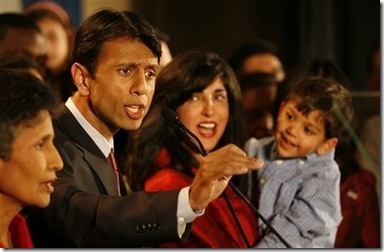
Bobby and Supriya Jindal
Well, Louisiana has an Indian-American Republican Governor – his name is Bobby Jindal, and he is very enthusiastic about education reform. What has he done to make education reform work better?
The charter environment thrives in New Orleans. Louisiana state law places no cap on the number of schools that can operate, and it provides for adequate funding of both charters and authorizers. The Louisiana Charter School Start-Up fund also provides zero-interest loans for charter schools to use for facilities-an element of charter funding that many states ignore. New Orleans leads the country in its percentage of students in charters at 57 percent.
That’s right – Louisiana is number one in education reform!
And there’s more:
Every city that receives a D or an F in this analysis is in a collective-bargaining state. Meanwhile, two-thirds of the top nine scorers (cities receiving a B) are located in right-to-work states. All of the cities located in right-to-work states included in this study received a B or C, and none received a D or F.
Right-to-work means that a teacher can work without having to join a union! And that means that they can be fired if they can’t perform – but if they can perform, then they make more money! So they have an incentive to work harder and to make their students learn more – there is no safe job for them if they underperform.
Is South Carolina next? South Carolina has an Indian-American Republican Nikki Haley running for governor, so they’re probably next for major education reforms. I’m being silly, but you have to wonder… is there something about the Indian culture that makes them take education more seriously?

 WINTERY KNIGHT