
Tag Archives: Illegal Immigration

George Will says that Ted Cruz is the candidate to rally around

Republican Senate candidate Ted Cruz

Kay Bailey Hutchinson has retired from the Senate, and George Will thinks that Republican candidate Ted Cruz is the man to replace her.

Excerpt:

For a conservative Texan seeking national office, it could hardly get better than this: In a recent 48-hour span, Ted Cruz, a candidate for next year’s Republican Senate nomination for the seat being vacated by Republican Kay Bailey Hutchison, was endorsed by the Club for Growth PAC, FreedomWorks PAC, talk-radio host Mark Levin and Erick Erickson of RedState.com.

For conservatives seeking reinforcements for Washington’s too-limited number of limited-government constitutionalists, it can hardly get better than this: Before he earned a Harvard law degree magna cum laude (and helped found the Harvard Latino Law Review) and clerked for Chief Justice William Rehnquist, Cruz’s senior thesis at Princeton — his thesis adviser was professor Robert George, one of contemporary conservatism’s intellectual pinups — was on the Constitution’s Ninth and 10th amendments. Then as now, Cruz argued that these amendments, properly construed, would buttress the principle that powers not enumerated are not possessed by the federal government.

Robbie George??? Robbie George??? Holy snouts! That guy is one of the top academic pro-lifers. Every Christian apologist knows about Robbie George. It’s the law! Well, it isn’t. But it should be!

I continue:

At age 14, Cruz’s father fought with rebels (including Fidel Castro) against Cuba’s dictator, Fulgencio Batista. Captured and tortured, at 18 he escaped to America with $100 sewn in his underwear. He graduated from the University of Texas and met his wife — like him, a mathematician — with whom he founded a small business processing seismic data for the oil industry.

By the time Ted Cruz was 13, he was winning speech contests sponsored by a Houston free-enterprise group that gave contestants assigned readings by Frederic Bastiat, Friedrich Hayek and Ludwig von Mises. In his early teens he traveled around Texas and out of state giving speeches. At Princeton, he finished first in the 1992 U.S. National Debate Championship and North American Debate Championship.

As Texas’s solicitor general from 2003 to 2008, Cruz submitted 70 briefs to the U.S. Supreme Court, and he has, so far, argued nine cases there. He favors school choice and personal investment accounts for a portion of individuals’ Social Security taxes. He supports the latter idea with a bow to the late Daniel Patrick Moynihan, who said such accounts enable the doorman to build wealth the way the people in the penthouse do.

Regarding immigration, Cruz, 40, demands secure borders and opposes amnesty for illegal immigrants but echoes Ronald Reagan’s praise of legal immigrants as “Americans by choice,” people who are “crazy enough” to risk everything in the fundamentally entrepreneurial act of immigrating.

He is a hard-core Republican. He has Republican experiences: legal immigrant, fought communism, studied something that required actual work, founded a small business, etc. This is the prototypical Republican!

You can find out more about him on his positions page. I was interested in his stance on social issues, in particular.

Excerpt:

Ted Cruz has fought to protect innocent human life. He played a leading role in several important cases, including defense of the partial-birth abortion ban, parental consent laws, and prohibiting state funds from going to abortion. These cases have all been part of the ongoing effort to ensure that every child in America  receives the protection and respect he or she deserves.

  • Authored an amicus brief for 13 states, successfully defending the federal Partial Birth Abortion Ban Act. The ban was upheld 5-4 before the U.S. Supreme Court;
  • Authored an amicus brief for 18 states, successfully defending the New Hampshire parental notification law. The law was upheld 9-0 before the U.S. Supreme Court [note: this brief was awarded the Best Brief Award from the National Association of Attorneys General for U.S. Supreme Court briefs written in 2005-06];
  • Successfully defended Texas’s Rider 8, which prohibits state funds for groups that provide abortions, winning unanimously before the Fifth Circuit court of appeals.

Ted Cruz has worked hard in defense of traditional marriage, including his intervention in a case protecting Texas marriage laws. In addition, he has fought on the federal level to defend marriage between one man and one woman as the fundamental building block of society.

  • When a Beaumont state court granted a divorce to two homosexual men who had gotten a civil union in Vermont, Cruz, under the leadership of Attorney General Greg Abbott, intervened in defense of the marriage laws of the State of Texas, which successfully led to the court judgment being vacated;
  • Worked with Attorney General Abbott to send a letter to Congress in support of the federal Defense of Marriage Act.

He has lots of nice actions related to lots of conservative policies on that page. What a resume! Energy production, voter fraud prevention, border security, legal firearm ownership – you name it, this guy has been fighting for conservative principles. Like Michele Bachmann, (and unlike RINO Mitt Romney), he has actually tried to do pro-life and pro-marriage things. We don’t just have to take his word for it, he has the actions to prove his words. Just look at the list of issues on his page!

It’s so funny, because on that page, he says this: “You say you believe in these principles. Show me. When have you fought for conservative principles and what have you accomplished?” This is exactly the question we should be asking of any political candidate. Show. Me. The. Record.
What House Republicans should push: a national voter ID law

Here’s an article from the Wall Street Journal.

Excerpt:

On Thursday, the Wisconsin legislature sent a bill requiring photographic identification for voting to Gov. Scott Walker’s desk. This follows the enactment of an even stricter law in Kansas a few weeks ago.

Drafted by my office, Kansas’s Secure and Fair Elections Act combined three elements: (1) a requirement that voters present photo IDs when they vote in person; (2) a requirement that absentee voters present a full driver’s license number and have their signatures verified; and (3) a proof of citizenship requirement for all newly registered voters. Although a few states, including Georgia, Indiana and Arizona, have enacted one or two of these reforms, Kansas is the only state to enact all three.

Other states are moving in the same direction. The Texas legislature sent a photo-ID bill to Gov. Rick Perry’s desk last Monday. And next year Missouri voters will get a chance to vote on a photo-ID requirement.

Immediately after the Kansas law was signed in April, critics cried foul. They argued that voter fraud isn’t significant enough to warrant such steps, that large numbers of Americans don’t possess photo IDs, and that such laws will depress turnout among the poor and among minorities. They are wrong on all three counts.

[…]My office already has found 67 aliens illegally registered to vote in Kansas, but when the total number is calculated, it will likely be in the hundreds. In Colorado, the Secretary of State’s office recently identified 11,805 aliens illegally registered to vote in the state, of whom 4,947 cast a ballot in the 2010 elections.

[…]According to the 2010 census, there are 2,126,179 Kansans of voting age. According to the Kansas Department of Motor Vehicles, 2,156,446 Kansans already have a driver’s license or a non-driver ID. In other words, there are more photo IDs in circulation than there are eligible voters. The notion that there are hundreds of thousands of voters in Kansas (or any other state) without photo IDs is a myth.

Carrying a photo ID has become a part of American life. You can’t cash a check, board a plane, or even buy full-strength Sudafed over the counter without one. That’s why it’s not unreasonable to require one in order to protect our most important privilege of citizenship. But just in case any person lacks a photo ID, Kansas’s law provides a free state ID to anyone who needs one. Other states have included similar provisions in their photo-ID laws.

Some opponents of election security laws also declare that they are part of a sinister plot to depress voter registration and turnout, especially among minority voters who are more likely to vote Democrat. Here too the facts do not support the claim. Georgia’s photo ID requirement was in place for both the 2008 and 2010 elections, when turnout among minority voters was higher than average. Likewise, Arizona’s proof-of-citizenship requirement for registration has not impeded minority voters from registering.

This should pushed by Republicans right alongside a national right-to-work law and a national voucher program. I would love to see an opt-out of Social Security as well. We need that voter ID law to be in place before the 2012 presidential election.

This post was linked by:

http://reader.creativeminorityreport.com/2011/05/national-voter-id-law.html

New study finds that immigration costs Canada up to $23 billion a year

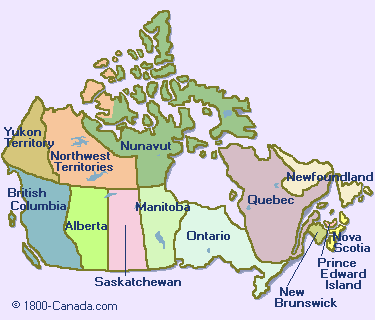
Map of Canada
Map of Canada

Story in the National Post. (H/T Andrew)

Excerpt:

Newcomers to the country generally make less money and chip in less in taxes than the national average.And allowing 250,000 immigrants into the country annually is costing us all billions of dollars each and every year, according to a study by the Fraser Institute.

The study, dubbed Immigration and the Canadian Welfare State, sharply criticizes Canada’s current immigration system, using earnings and other figures from the 2005-06 fiscal year reported by 844,476 people in the 2006 Census.

It claims the group as a whole earned on average about $10,000 more and paid about $2,500 more in income taxes annually than those within the sampling who had settled in Canada in the previous 18 years.

The study also found immigrants typically pay a little over $6,000 less in property and sales taxes than the national average.

That means the approximately 3.9 million immigrants who settled in Canada between 1987 and 2004 are shortchanging federal government coffers by between $16.3 billion and $23.6 billion annually, depending on how many of those newcomers have moved back home, emigrated elsewhere or died, the study said.

[…]The study also takes on the notion that immigrants are helping the country by taking menial jobs that most Canadians don’t want.”Immigrants do fill jobs that Canadians don’t want and thus benefit the economy but, in the absence of immigration, these jobs would pay higher wages and would be filled by Canadians or eliminated by the application of labour-saving technology,” the study states.

“Under these conditions, poverty in Canada would be reduced substantially.”

As for changes, the study suggests annual immigration numbers should be increased or decreased, depending largely on “market forces.”

The study also recommends Canada be more selective, allowing only newcomers who have employment lined up, offering them citizenship only if they hang onto their job for a set number of years and deporting those who lose their jobs.

Canada has a welfare state with single-payer health care, public housing, welfare payment and free public schools. So, people who cannot pull their own weight can rely on all of these goodies provided by the working Canadians. Because of these generous benefits, Canada has a lot of people who would like to move there from poor countries. And they can’t possibly take them all in because it is costing the working Canadians billions of dollars. But there is a way for them to allow more immigration – they just have to stop all of their government handouts. If there were no handouts then everyone could come to Canada freely, because they would go home again unless they held on to their job and pulled their own weight. They could even bring their families once they had worked hard enough to support them – but those family members would not be eligible to get money from the government.

So what do we as Americans learn from this? Well, we need to make sure that the people who come here are selected on the basis of their skills, their education, their ability to pay their own way. We need to have a big fence to keep illegal immigrants out, and we need to have a huge gate to allow skilled legal immigrants in. And they can even bring their families with them – as long as they don’t get a dime of taxpayer money in cash or through social programs – they should have to pay for everything they use, including schools and health care. And they should not be eligible for a dime of government money until they get their green cards after years of demonstrated hard work and clean living.