
Kathy Shaidle at Five Feet of Fury linked to this editorial which explains how the battle for free speech was won up in the frozen North.
Excerpt:
Justice Minister Rob Nicholson had voiced support for the legislation. So had the Prime Minister. The result, then, was never in doubt: at 9:35 p.m. on June 6, by a vote of 153-136, Parliament got Canada’s human rights bureaucrats out of the business of policing speech on the Internet. There was a scattering of applause, and handshakes for Storseth (the bill requires the rubber stamp of Senate approval). “To be honest, it’s all a blur,” says the three-term MP, laughing. But if the passage of Bill C-304 represents a fundamental shift in Canadian culture, you’d never have known it that night. Members dealt with a few housekeeping matters, then waded through a supply bill. Finally, one by one, they trickled out into the cool Ottawa night.
The effect of killing Section 13 will be debated for years among anti-racist groups and civil libertarians. But it is undoubtedly a turning point. Since 1999, Canadians who felt aggrieved by material transmitted online have been encouraged to seek redress under federal human rights law, which targeted material “likely to expose a person or persons to hatred or contempt” based on grounds of discrimination like race, religion or sexual orientation. Storseth’s bill repeals the provision outright, leaving the Criminal Code as the primary bulwark against the dissemination of hate propaganda by electronic means.
With it will go one of the most divisive disputes to grip the country since the introduction of the Charter of Rights itself—a contest of values that over the past five years has pitted Canadians’ desire to protect minorities from discrimination against the bedrock principle of free speech. Mainstream media outlets, most notably Maclean’s, have been hauled before commissions to answer for their published content. The commissions themselves have come under fire for allowing their processes to be used as a bludgeon against legitimate expression, tailored as they are to encourage complainants to come forward. Meantime, a Saskatchewan law similar to Section 13 has become the subject of a Supreme Court challenge that could invalidate hate-speech provisions in most provincial human rights codes. By year’s end, it is conceivable that no human rights commission in the country will be in the business of adjudicating published material.
And here’s a must-read cri-de-coeur from free speech hero Mark Steyn in Maclean’s magazine. (H/T Binks the Web Elf)
Excerpt:
Operationally, Section 13 was stinkingly corrupt. There are some 34 million Canadians, yet just one individual citizen had his name on almost every Section 13 prosecution of the last decade. Just as Matthew Hopkins appointed himself England’s Witchfinder General in 1645 and went around the country turning in raven-tressed crones for the bounty of a pound per witch, so Richard Warman appointed himself Canada’s Hatefinder General and went around turning in shaven-headed tattooed losers in their mums’ basements for far more lucrative bounties of tens of thousands of dollars. He filed his complaints as a supposedly “offended” and “damaged” private citizen while an employee of Her Majesty’s Government. And, in fairness to Matthew Hopkins, he didn’t personally put on a pointy black hat and ride around on a broomstick. Whereas Mr. Warman joined Stormfront and other “white supremacist” websites and posted copious amounts of hate speech of his own, describing, for example, Jewish members of cabinet as “scum” and gays as a “cancer.” That’s how “hateful” Canada is: there’s so little “hate” out there that the country’s most famous Internet Nazi is a taxpayer-funded civil servant.
For Warman, there was little risk: you paid his costs, and the dice were loaded. After Hosni Mubarak was “re-elected” with 97.1 per cent of the vote, he was said to be furious with his officials for stealing too much of the election and making him look like one of those crude ham-fisted dictator-for-life types like Saddam and Kim Il-Sung. So next time round his officials arranged for him to “win” with a mere 96.3 per cent of the vote. Canada’s “human rights” commissars had no such squeamishness: until the tenacious Marc Lemire won his landmark victory in 2009, Section 13 prosecutions had a three-decade 100 per cent conviction rate even the Soviets might envy.
That wasn’t even the most basic affront. Until Maclean’s intervened in 2008, Lemire’s Section 13 trial was scheduled to be held in secret. I couldn’t quite believe this when I chanced to happen upon the “judge’s” rationale, and I suggested en passant that we should get Maclean’s estimable QC Julian Porter to file a whatchamacallit, a brief or motion or whatever, referencing precedents and other jurisprudential-type stuff, and put a rocket up these totalitarian buggers by treating their dank outhouse of pseudo-justice as a real courtroom subject to real law. Secret trials are for Beijing and Tehran, yet in the name of “human rights” they were introduced to Ottawa.
The line that sums up my objection to the racket was formulated by the Toronto blogger Kathy Shaidle: “You’re too stupid to tell me what to think.” In recent days, the last lonely defenders of the Canadian thought police have all volunteered to demonstrate Miss Shaidle’s proposition. The Opposition [NDP] critic for “public safety,” Randall Garrison, bemoaned the demise of the commissars’ “power to educate Canadians.” “We do have a serious problem,” said Garrison. “If you take away the power to take [websites] down, it’s not clear they have any mandate to even talk to people about it and educate them about it.”
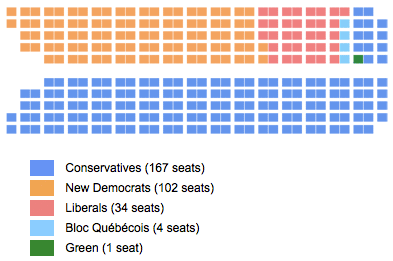
The Conservatives held up their end of the deal once they got their majority, didn’t they? Everyone who said they were not going to do anything with their majority should hang their heads in shame, now. They can’t do everything, but they can certainly do some things.
This is a lesson for us down here. If you love your country, then get out and vote in November! And make sure your friends vote, too – you should be convincing them to vote by giving them the facts about Obama’s catastrophic failures even now.
Related posts
- Canadian conservatives pass bill to repeal Section 13 speech code
- Youtube reverses decision to ban video critical of gay activism in Canada
- Alberta judge rules that it is legal to disagree with homosexuality
- Conservative MP’s bill to repeal Section 13 moves to committee
- Conservative MP introduces bill to abolish Section 13 speech code
- Ezra Levant on the new Sun News television network
- What happens when same-sex marriage conflicts with religious liberty?
- Human Rights Tribunal finds Catholic school board guilty of discrimination
- Saskatchewan planning to abolish its Human Rights Tribunal
- In Canada, Blazing Cat Fur is being sued for linking to Mark Steyn
- Canadian Human Rights Commissions continue war on Christians
- Video of Ezra Levant and Mark Steyn testifying against Canadian HRCs
- The Conservative Party takes up free speech in British Columbia
- The Conservative Party takes up free speech in Ontario
- Video of Ezra Levant discussing free speech on the Michael Coren show
- Video interview with Ezra Levant by the libertarian Fraser Institute
 WINTERY KNIGHT