Tag Archives: Hugo Chavez

Obama’s buddy Chavez nationalizes an American company

CBS News: Chavez orders expropriation (nationalization) of American company Owens-Illinois. (H/T ECM)

Excerpt:

Venezuelan President Hugo Chavez on Monday ordered the expropriation of U.S.-based glass maker Owens-Illinois Inc.’s unit in the South American country.

Chavez announced plans to expropriate the company in a televised speech, saying it operates in western Trujillo state.

The leftist leader criticized the company’s practices in the country, saying it had been “taking away the money of Venezuelans” and exploiting local people. Chavez did not detail his complaints about the company.

There was no immediate reaction from the company, based in Perrysburg, Ohio.

Owens-Illinois also has operations throughout Latin America in Colombia, Brazil, Peru, Ecuador and the Caribbean, focusing on the manufacture of glass containers.

It was unclear how the government would handle compensation for the company’s assets in Venezuela.

Chavez has nationalized or expropriated a wide range of companies, including cement makers, retail stores and steel mills, while seeking to lead Venezuela toward a socialist system.

He said in his speech that more expropriations are planned.

“There’s another list around here,” Chavez said, but added that he would save additional announcements for later.

Here’s the Republican response to Hugo Chavez’s latest anti-American aggression.

Excerpt:

Republican U.S. Rep. Connie Mack targeted Venezuelan leader Hugo Chavez on Tuesday — and ripped into the Obama administration for not standing up to him.

Mack, the ranking Republican on the House Subcommittee on the Western Hemisphere, noted that Chavez was continuing a world tour to push his country’s oil exportation.

[…]“While Chavez reaches out to nations across the world to explore and refine Venezuelan oil, what is the Obama administration doing?” demanded Mack, who is rumored to be running for the U.S. Senate in 2012. “The administration is failing to protect U.S. national security interests by ignoring the fact that we currently rely upon Venezuela for approximately 10 percent of U.S. oil imports. Instead of strengthening oil reserves or working with important U.S. allies such as Canada – which is well-poised to increase the flow of crude oil to our refineries – the Obama administration has not made it a priority.

“What’s more, as the administration sits idly by, Chavez continues his quest to nationalize key private-sector industries,” continued Mack. “During his trip to Belarus, Chavez announced the nationalization of two gold mines in Venezuela, and just yesterday Chavez announced the expropriation of the local affiliate of U.S.-based glassmaker Owens Illinois. Chavez acknowledged that his government has “a list with more names” of companies in Venezuela that will be expropriated.

“The Obama administration must get serious about dealing with the inherent threat that Chavez poses to our nation and the region,” concluded Mack. “We must take a hard look at our current energy portfolio and invest in energy projects with countries that respect international legal standards. And finally, for the security of our economy and the free market, Congress must support the pending free-trade agreements by passing them without delay.”

Where is Obama? Shouldn’t he be saying something about this?

Hey Obama! I can nationalize more private corporations than you can!

Oh. I guess they are having some sort of communist competition or something. Maybe trying to see whose country can hit 20% unemployment first?

Related posts

Colombia’s war on terrorism and Chile’s war on poverty

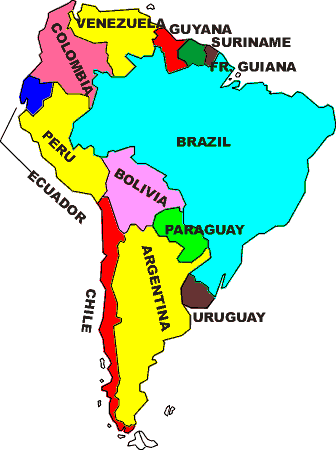
Map of South America

A magnificent column about Colombia’s war on FARC.

Excerpt:

When Juan Manuel Santos came into office as Colombia’s president and emphasized economic issues over the fight against terrorist guerrillas, he was suspected of going soft on those he had combated as minister of defense under the previous administration. Little did his critics know that he was planning the “coup de grace” against the Revolutionary Armed Forces of Colombia (FARC).

The devastating Sept. 22 attack on FARC headquarters in Colombia’s central Meta province all but signifies the end of the five-decade-old conflict. It will take a little while for the official end to be declared, but this war is pretty much over.

[…]For decades, politicians, academics, human rights activists and journalists on both sides of the Atlantic failed to see that there was nothing romantic, “bien-pensant” or Robin Hoodesque about an organization that killed, maimed, kidnapped and extorted for a totalitarian objective.

Colombia’s solitude was such that even the U.S. began to lose faith in its ally a couple of years ago, refusing to approve a free-trade agreement that Bogota had negotiated at a major political cost.

Colombians did not give up and continued to reclaim territory for civilian rule. Much like the defeat of Venezuela’s Cuba-inspired terrorist guerrillas in the 1960s, Colombia’s victory against FARC is the result of civilians awakening to the evil of totalitarian terror.

We get to hear about spectacular military feats, but how many outside Colombia realize that peasants, factory workers, teachers, students and others joined the struggle to defeat FARC, beautifully symbolized by the hundreds of thousands who took to the streets inside Colombia and around the world in 2008 to clamor for the end of terror?

There are still many challenges ahead. The lesson in courage and perseverance that Colombians have given us suggests they are ready to meet them.

I wish that we could sign a free trade deal with them like Canada’s conservative government. Canada is led by a conservative business-friendly economist, and they are very supportive of capitalist democracies like Colombia. Stephen Harper is Canada’s prime minister. He has economics degrees from the University of Calgary. Like Santos, he is very, very tough on terrorism – favoring increased defense spending to protect Canadian interests abroad. And guess what? Canada also has a free trade agreement with another South American country – Chile.

And Chile is also doing very well, even after the massive earthquake.

Excerpt:

Chile’s peso rose to a 27-month high after a report showed the country’s industrial growth accelerated to the fastest since 2006.

The peso appreciated 0.2 percent to 485.23 per U.S. dollar at 11:43 a.m. New York time, from 486.17 yesterday. The currency touched 483.61, the strongest since June 11, 2008. The peso has risen 13 percent during the quarter and 3.6 percent this month.

Chile’s economy is accelerating after the fifth-largest earthquake in a century struck in February, delaying its recovery from a 2009 recession.

“Retail sales grew and industrial production was better than expected,” said Roberto Melzi, a strategist at Barclays Capital in New York.

Retail sales expanded 13 percent in August from a year earlier, and industrial output grew 6.9 percent, the National Statistics Institute said in Santiago. That’s the most since January 2006. Industrial production shrank 17 percent after the 8.8-magnitude Feb. 27 earthquake and its accompanying tsunami, which caused damage worth more than a sixth of Chile’s gross domestic product.

Chile and Colombia are my two favorite South American countries. Both are led by conservative business-friendly economists. Chile’s president Sebastián Piñerahas a Masters and a Ph.D in economics from Harvard, and is successful in the private sector. The Colombian President Juan Manuel Santos specializes in business and economics, with graduate degrees from Harvard and the London School of Economics.

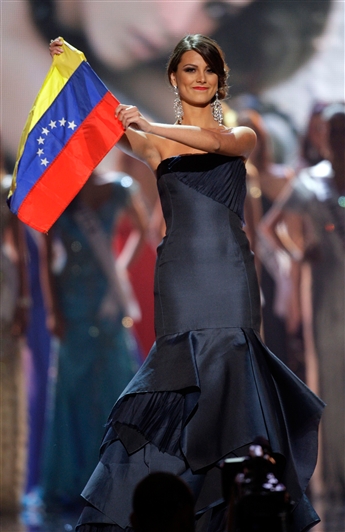
Venezuela Miss Universe candidate Stefania Fernandez does a brave thing

Waving the OLD Venezuela flag

Story here from Investors Business Daily.

Excerpt:

Quick, what’s the murder capital of the world: Kabul? Juarez? Try Caracas, Venezuela, a city whose dictator, Hugo Chavez, has made murder a means of extending his control.

The silent protest at Monday night’s Miss Universe Pageant in Las Vegas was invisible to nearly everyone — except Venezuelans. On her final catwalk, the ranking Miss Universe, Stefania Fernandez, suddenly whipped out a Venezuelan flag in a patriotic but protocol-breaking gesture.

Fernandez waved her flag for the same reason Americans waved theirs after 9/11 — to convey resolution amid distress. Her flag had seven stars, significant because Chavez had arbitrarily added an eighth, making any use of a difficult-to-find seven-star banner an act of defiance.

Fernandez’s countrymen went wild with joy on bulletin boards and Facebook, showing just how worried they are about their country. Their greatest fear is violent crime.

She is so beautiful. And she looks pretty, too!

I love it when women are brave and defiant in opposition to big government socialism. And I love that dress. Big white/black shapes or patterns are my favorite – with a black top and white bottom being my favorite of all. I wish I could send her white roses, because she deserves some.

For the ladies, here’s Marco Rubio being interviewed on Fox News by Liz Cheney.

And Marco Rubio’s new ad – I love this ad because it reminds me of MY FAMILY!:

See, I’m being fair!

Related posts