Yes America, there is a wealth gap. Seven of the top ten wealthiest members in Congress are Democrats.
The results are based on a new study released today by the non-partisan Center for Responsive Politics. The Center did an analysis of the financial statements filed by members of Congress for 2010 income and net worth.
This revelation of extreme wealth by Democratic politicians is completely contrary to the public image of the Democratic Party. President Obama has castigated “millionaires and billionaires,” suggesting they are evil people, largely Republican or conservative. The issue of the Democratic Party as the millionaire party has not yet made it into the mainstream media. But the facts are indisputable. Democratic members of Congress tend to be wealthier than their Republican counterparts.
According to the Center, 36 Senate Democrats and 30 Senate Republicans reported an average net worth in excess of $1 million in 2010. The median estimated net worth among members of the Senate Democrats was $2.58 million. Senate Republican median net worth was $2.43 million.
And, the wealthy Democrats tend to inherit their money. Republicans tend to earn it.
Senators John Kerry (D-MA), Jay Rockefeller (D-WV) and House Minority Leader Nancy Pelosi (D-CA) all came by their fortunes through marriage or inheritance. Senator Kerry, who was born into wealth, has listed his net worth as high as $281 million, while his wife Teresa is estimated to be worth $1 billion. Ms. Heinz did not earn her wealth either. She inherited the money from her husband Senator John Heinz, who died in an airplane crash.
Senator Rockefeller, representing dirt poor West Virginia, inherited his fortune from his family. He is reported to be worth $136 million.
While the economy continued to tank in 2010, Rep. Pelosi reported her own wealth to grow by 62%. Pelosi’s husband, Paul, is a financier. They own a multi-million dollar vineyard and a number of million dollar homes. They have a net worth of $196 million.
[…]Among those who actually got their money by earning it, Republicans were in the slight majority. Rep. Darrell Issa (R-CA), a self-made millionaire earned his wealth by creating the Viper car security system. He is estimated to be worth more than $700 million. Sen. Jim Risch (R-Idaho) started as a rancher and attorney. His wealth is cited as $88 million.
Rep. Vernon Buchanan (R-FL), one of only three Republicans to make the top ten earned his money through real estate and car dealerships. He is estimated to be worth over $323 million.
Much has been made about Senator Bob Corker (R-TN) being the wealthiest Republican in the U.S. Senate. But he is ranked only number 14 because there are so many wealthier Democrats ahead of him. He doesn’t make the Top Ten. He worked as a construction superintendent. Then started his own company. Today he is worth $107 million.
[…]The issue of politics and money has been a complicated one. President Barack Obama brought in far more money from Wall Street in his 2008 campaign than his Republican opponent Sen. John McCain (R-AZ). Obama raked in $1 million from Goldman Sachs employees that year. While his numbers are lower this year, the President has attracted $15.2 million from the financial services industry that he attacks so frequently.
Many Democrats run institutions on Wall Street. Jamie Dimon, the CEO of J.P. Morgan has been a long-time Democratic supporter. So too has Goldman Sachs Chairman and Chief Executive Officer Lloyd C. Blankfein.
Have you heard about “The Forgotten 15“? Here’s a news article by the Washington Times that explains it.
Excerpt:
Last week, the House passed a strongly bipartisan bill which would prevent a job-killing 3 percent withholding tax on all government contractors from going into effect. Even though the White House supports the measure, Mr. Reid, a Nevada Democrat, has chosen instead to bring another “small bite” from the president’s failed American Jobs Act to the floor. He wants to hike taxes on business owners so he can blow $60 billion in more stimulus for bike paths, choo-choo trains and bus stops.
Mr. Reid can’t even round up all the Democrats behind his partisan plan, but he continues to drag his feet on items that could pass because the last thing he wants to do is adopt legislation that gives the GOP the chance to take some credit with the public.
The Senate has not been this inactive in at least a quarter-century. As of Tuesday, the Senate had held 194 votes for the year, 54 fewer than at this time last year.
The intransigence has real-world implications. In March, the House passed a strongly bipartisan bill which would have stopped a court order from imposing duplicate and expensive regulations on farmers and ranchers. The Senate never brought the bill up for a vote, and on Monday a key deadline passed, allowing new regulations on pesticide applications to go into effect. That’s bad for jobs.
House Republican leaders want the public to know that they aren’t to blame for the stalemate on Capitol Hill. Speaker John A. Boehner produced a card listing the “forgotten 15” jobs bills that have passed the House but not the Senate. The Ohio Republican gave the card to members, telling them to carry it with them, hold it up at events at home, and flash it during interviews to remind Americans that Republicans are doing everything they can to address the employment situation.
The Democratic strategy is to set up Republicans as a foil for their 2012 re-election bids. Even though the congressional approval rating is down in the single-digits, Mr. Reid wants to draw a distinction between his party and the GOP by only bringing up bills that Republicans will oppose so his caucus can send out accusatory press releases.
The messaging is carefully crafted to fit with Mr. Obama’s latest campaign trail slogans about how “we can’t wait” for Congress to act. He showed his true motives on Tuesday when the president invited congressional Democrats to the White House to ostensibly talk about the jobs agenda. He has no plans to invite Republicans over to chat.
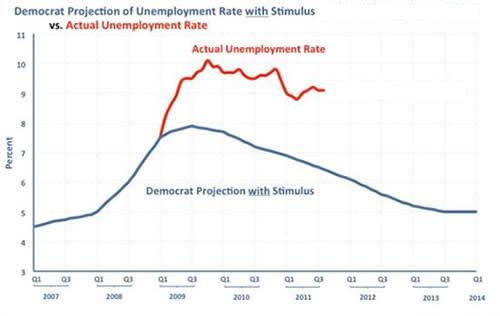
Projected vs Actual Unemployment With Stimulus 2011
Back in 2007, when the Republicans controlled the House and Senate, the unemployment rate was near 4%. FOUR PERCENT. And we had a deficit of $160 billion – NOT 1.6 TRILLION.
Campaigning for another failed stimulus and more job destroying taxes, President Obama has repeatedly—and falsely—asserted that “Congress isn’t willing to move” legislation to facilitate job growth. While the president plays politics, House Republicans have been working and approving legislation to promote economic growth and job creation. The House has approved more than 15 bills that, if enacted, would immediately help to grow the economy without more failed stimulus spending. These bills are currently stalled in the Democrat-controlled Senate and the president has not encouraged the Senate to act.
Here is a sample:
4) H.R. 1230—Restarting American Offshore Leasing Now Act: H.R. 1230 would require the Department of the Interior (DOI) to auction offshore oil and gas leases in the Central and Western Gulf of Mexico, as well as in an area off the coast of Virginia. The bill would help to reduce energy prices and promote job creation by expediting offshore oil and natural gas exploration in the Gulf of Mexico and the Virginia coast.
6) H.R. 1231—Reversing President Obama’s Offshore Moratorium Act: H.R. 1231 would require that each five-year offshore oil and gas leasing program offer leasing in the areas with the most prospective oil and gas resources, and would establish a domestic oil and natural gas production goal. The bill would essentially lift the President’s ban on new offshore drilling by requiring the Administration to move forward on American energy production in areas estimated to contain the most oil and natural gas resources.
7) H.R. 2021—The Jobs and Energy Permitting Act of 2011: H.R. 2021 would eliminate needless permitting delays that have stalled important energy production opportunities off the coast of Alaska. The bill would also eliminate the permitting back-and-forth that occurs between the EPA and its Environmental Appeals Board. Rather than having exploration air permits repeatedly approved and rescinded by the agency and its review board, the EPA will be required to take final action – granting or denying a permit—within six months.
10) H.R. 1938— North American-Made Energy Security Act: H.R. 1938 would direct the President, acting through the Secretary of Energy, to coordinate with all federal agencies responsible for an aspect of the President’s National Interest Determination and Presidential Permit decision regarding construction and operation of Keystone XL, to ensure that all necessary actions are taken on an expedited schedule. The bill would promote job creation and energy security by ending the needless delay of the construction and operation of the Keystone XL pipeline.
16) H.R. 2433—Veterans Opportunity to Work Act: H.R. 2433 would create or modify programs that provide employment and training services to veterans and service members separating from active duty. The bill would also make changes to programs that offer home loan guarantees, ambulance services, and pension payments to qualifying individuals. Among other things, the bill would provide up to 12 months of Veterans Retraining Assistance to no more than 100,000 unemployed veterans that enter education or training programs at community colleges or technical schools to prepare them for employment in an occupational field that is determined by Department of Labor to have significant employment opportunities.
17) H.R. 674—To amend the Internal Revenue Code of 1986 to repeal the imposition of 3 percent withholding on certain payments made to vendors by government entities: H.R. 674 would permanently repeal the imposition of 3 percent withholding on certain payments made to vendors by government entities. Currently, the imposition of the 3 percent withholding is set to take effect on January 1, 2013. If the 3 percent withholding tax were implemented as scheduled, government entities would be required to withhold 3 percent of payments to persons providing property or services to the government. For example, on an invoice for $20,000 the government would pay the business $19,400 and withhold $600 as a preemptive tax. These added costs would almost certainly translate into fewer private-sector jobs and higher costs for the government and taxpayers.
They are actually up to 17 jobs bills now.
And finally, I have to post this funny John Boehner clip:
We need more of that Mr. Boehner. I think that was a good opportunity to say “freaking” as well. Because he should be pissed off with this Solyndra-bailout President.
The House next week will take a vote to raise the debt ceiling and pass a balanced budget amendment, House Republican leaders said today.
The plan is unlikely to go anywhere, since a balanced budget amendment would likely fail in the Democrat-led Senate, but GOP leaders nevertheless called it a serious plan to raise the debt ceiling. They said President Obama and Democrats have failed to come up with an equally serious plan.
“We asked the president to lead,” House Speaker John Boehner said in a press conference today. “We asked him to put forward a plan — not a speech, a real plan — and he hasn’t. We will.”
The “cut, cap and balance” proposal would make raising the debt ceiling contingent on Congress sending a balanced budget amendment to the states. It would also cap government spending at 18 percent of Gross Domestic Product over the next 10 years.
The plan would raise the debt ceiling by $2.4 trillion, since that is the increase requested by the president. However, the plan would actually make even more in spending cuts — as much as $111 billion in 2012 alone.
[…]Boehner said the House would vote on the “cut, cap and balance” plan and then decide how to proceed from there.”I don’t want to preclude any chance of coming to an agreement, but [Democrats have] been unwilling to put a real plan on the table,” Boehner said. “Without serious spending cuts or real reform to entitlement programs, this problem is not going to be solved.”
That’s what the Republicans would do if they were in control. The balanced budget amendment would cap spending at 18% of GDP, so that we would never have a debt crisis ever again. That’s the right solution, except that the Democrats cannot give up the idea of buying votes with the money they steal from job creators. They just can control their addiction to spending.
While President Obama has recently professed a newfound — and vague — desire to cut government spending, it’s useful to recall what the President has actually done since taking office in 2009. The President signed into law a massive spending spree that plunged us deeper into debt, and failed to deliver on its promise to create jobs.
24% Increase in Base Spending. Non-defense discretionary spending grew by 24% for the first two years of the Obama Administration, adding $734 billion in spending over the next 10 years.
Record Government Spending. The Federal government will spend $3.6 trillion this year, 24% of gross domestic product (GDP) and the highest burden on the economy since World War II. Spending has historically averaged a little over 20% of GDP.
President’s Budget Makes Matter Worse. According to CBO, the President’s budget never spends less than 23% of GDP and by the end of the decade rises to 24% of GDP. His budget’s failure to address the drivers of our debt threatens the health and retirement security of America’s seniors, and the economic security of all Americans. The President’s budget seeks to spend $46 trillion in government spending over the next decade, and has subsequently fought against House Republican efforts to restrain his spending appetite down to $43.5 trillion.

 WINTERY KNIGHT