Tag Archives: History

Finally! Details about Michael Licona’s new Oxford University Press book

Investigation in progress

Here’s a new interview between Sean McDowell and Michael Licona about his new book. The new book is coming out in 2016, and it’s going to be published by Oxford University Press – probably the top academic press on the planet.

I found the interview on Sean McDowell’s blog.

It says:

Michael Licona is one of the world’s leading experts on the historical evidence for resurrection. I use his book The Resurrection of Jesus in my Master’s Level course atBiola. For the past few years, Dr. Licona has been working on some cutting-edge research related to Gospel contradictions. His research is both fascinating and groundbreaking. He answers a few of my questions:

SEAN MCDOWELL: Mike, what got you interested in the question of Gospel contradictions?

MIKE LICONA: Back in 2008 and 2009 I was publicly debating Bart Ehrman on the resurrection. He brought up Gospel contradictions as one of his major objections to the Gospels. I have noticed that this genuinely bothers many Evangelical Christians. As a result, I decided to look into it in more depth. I wasn’t so much concerned about resolving them, because I understood that if Jesus rose from the dead, Christianity is true, regardless of any errors that might be present in the Bible. So, even if there are contradictions in the Gospels, it wouldn’t negate the truth of Christianity. But it does bother a lot of Evangelicals, so that’s what got me interested in the topic. And to be honest, it did make me question the historical reliability of the Gospels.

MCDOWELL: What makes your approach to Gospel contradictions unique?

LICONA: Most approaches involve trying to harmonize various passages to see if all the details can fit together. This can be a legitimate practice. But many times it can go way too far. Both Richard Burridge and more recently Craig Keener have shown that the Gospels belong to the genre of “ancient biography.” If this is correct, it would be plausible that we would see the same amount of flexibility in the Gospels as we observe in other ancient biographies. So, I wanted to learn what those flexibilities were. By carefully reading ancient biographies written around the same time as the Gospels and comparing how they tell the same stories differently, I began to recognize that some of the differences resulted from compositional devices. Then when I went to the Gospels, I could see that the authors were probably employing the same compositional devices as other ancient biographers; specifically Plutarch. I began to realize that the differences across the Gospels are not so much contradictions but the result of compositional devices that were the standard practice in historical writing of that day.

So, this analysis of the genre of “ancient biography” might give us some useful tools for resolving passages that seem to be in conflict. For some reason, non-Christians want to ignore the main body of accepted facts about the historical Jesus, and focus on these minor details that seems to be in conflict. So I guess we need a book that explains them, and no one better than Mike Licona to do it.

On the other hand… I was actually talking about this with my best friends from my home town over the Christmas holidays. Before we broke out the Pandemic boardgame and the “Keep Talking and No One Explodes” computer game, Jen and Andrew wanted to know what was the most common thing that I was seeing from non-Christians. The most common thing I am seeing is that non-Christians are woefully out of touch with knowledge related to the worldview of Christian theism that are accepted by the broad spectrum of scholars.

To illustrate, I quoted from atheists who admit to the creation event, to the fine-tuning, to the problem of the origin of life, to the problem of the Cambrian explosion, to early dating of the gospels, early dating of the Pauline letters, minimal facts about the life of Jesus, and even minimal facts for an argument for the resurrection. I told Andrew and Jen the skeptics I encounter are intellectually dishonest. They don’t accept the things that mainstream atheist scholars accept about science and historical Jesus and philosophy of religion. And yet they feel comfortable about being on the fringe, because they justify their fringe view by pointing to nitpicky details like apparent Bible contradictions. I.e. – they point to disagreement about one or two angels at the discovery of the empty tomb, and they turn that minor point into support for their fringe view that the gospels were made up completely in the second and third centuries.

So, I guess we do have to be ready to respond to this nitpicking, and Licona’s book will help with that. But I also think that we need to be ready to haul skeptics back to reality. There is a lot we can know about science, philosophy and the historical Jesus that supports Christian theism, and we should disagreements about details get people away from those main points that scholars across the board accept.
What do ancient non-Christian sources tell us about the historical Jesus?

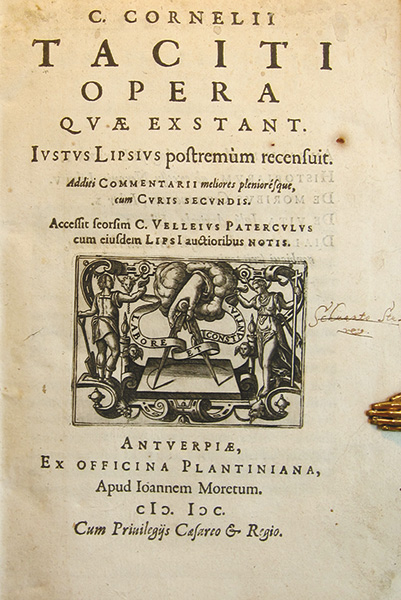
The Annals, by Roman historian Tacitus

This article from Biblical Archaeology covers all the non-Christian historical sources that discuss Jesus.

About the author:

Lawrence Mykytiuk is associate professor of library science and the history librarian at Purdue University. He holds a Ph.D. in Hebrew and Semitic Studies and is the author of the book Identifying Biblical Persons in Northwest Semitic Inscriptions of 1200–539 B.C.E. (Atlanta: Society of Biblical Literature, 2004).

Here are the major sections:

  • Roman historian Tacitus
  • Jewish historian Josephus
  • Greek satirist Lucian of Samosata
  • Platonist philosopher Celsus
  • Roman governor Pliny the Younger
  • Roman historian Suetonius
  • Roman prisoner Mara bar Serapion

And this useful excerpt captures the broad facts about Jesus that we get from just the first two sources:

We can learn quite a bit about Jesus from Tacitus and Josephus, two famous historians who were not Christian. Almost all the following statements about Jesus, which are asserted in the New Testament, are corroborated or confirmed by the relevant passages in Tacitus and Josephus. These independent historical sources—one a non-Christian Roman and the other Jewish—confirm what we are told in the Gospels:31

1. He existed as a man. The historian Josephus grew up in a priestly family in first-century Palestine and wrote only decades after Jesus’ death. Jesus’ known associates, such as Jesus’ brother James, were his contemporaries. The historical and cultural context was second nature to Josephus. “If any Jewish writer were ever in a position to know about the non-existence of Jesus, it would have been Josephus. His implicit affirmation of the existence of Jesus has been, and still is, the most significant obstacle for those who argue that the extra-Biblical evidence is not probative on this point,” Robert Van Voorst observes.32 And Tacitus was careful enough not to report real executions of nonexistent people.

2. His personal name was Jesus, as Josephus informs us.

3. He was called Christos in Greek, which is a translation of the Hebrew word Messiah, both of which mean “anointed” or “(the) anointed one,” as Josephus states and Tacitus implies, unaware, by reporting, as Romans thought, that his name was Christus.

4. He had a brother named James (Jacob), as Josephus reports.

5. He won over both Jews and “Greeks” (i.e., Gentiles of Hellenistic culture), according to Josephus, although it is anachronistic to say that they were “many” at the end of his life. Large growth
in the number of Jesus’ actual followers came only after his death.

6. Jewish leaders of the day expressed unfavorable opinions about him, at least according to some versions of the Testimonium Flavianum.

7. Pilate rendered the decision that he should be executed, as both Tacitus and Josephus state.

8. His execution was specifically by crucifixion, according to Josephus.

9. He was executed during Pontius Pilate’s governorship over Judea (26–36 C.E.), as Josephus implies and Tacitus states, adding that it was during Tiberius’s reign.

Some of Jesus’ followers did not abandon their personal loyalty to him even after his crucifixion but submitted to his teaching. They believed that Jesus later appeared to them alive in accordance with prophecies, most likely those found in the Hebrew Bible. A well-attested link between Jesus and Christians is that Christ, as a term used to identify Jesus, became the basis of the term used to identify his followers: Christians. The Christian movement began in Judea, according to Tacitus. Josephus observes that it continued during the first century. Tacitus deplores the fact that during the second century it had spread as far as Rome.

I remember reading the 1996 book by Gary Habermas entitled “The Historical Jesus: Ancient Evidence for the Life of Christ“. This book is a little before the time of most of you young Christian apologists, but back before the time of Lee Strobel and J. Warner Wallace, this is the stuff we all read. Anyway, in the book he makes a list of all that can be known about Jesus from external sources. And fortunately for you, you don’t have to buy the book because you can read chapter 9 of it right on his web site.

From Tacitus he gets this:

From this report we can learn several facts, both explicit and implicit, concerning Christ and the Christians who lived in Rome in the 60s A.D. Chronologically, we may ascertain the following information.

(1) Christians were named for their founder, Christus (from the Latin), (2) who was put to death by the Roman procurator Pontius Pilatus (also Latin), (3) during the reign of emperor Tiberius (14 37 A.D.). (4) His death ended the “superstition” for a short time, (5) but it broke out again, (6) especially in Judaea, where the teaching had its origin.

(7) His followers carried his doctrine to Rome. (8) When the great fire destroyed a large part of the city during the reign of Nero (54 68 A.D.), the emperor placed the blame on the Christians who lived in Rome. (9) Tacitus reports that this group was hated for their abominations. (10) These Christians were arrested after pleading guilty, (11) and many were convicted for “hatred for mankind.” (12) They were mocked and (13) then tortured, including being “nailed to crosses” or burnt to death. (14) Because of these actions, the people had compassion on the Christians. (15) Tacitus therefore concluded that such punishments were not for the public good but were simply “to glut one man’s cruelty.”

And from Josephus he gets this:

(1) Jesus was known as a wise and virtuous man, one recognized for his good conduct. (2) He had many disciples, both Jews and Gentiles. (3) Pilate condemned him to die, (4) with crucifixion explicitly being mentioned as the mode. (5) The disciples reported that Jesus had risen from the dead and (6) that he had appeared to them on the third day after his crucifixion. (7) Consequently, the disciples continued to proclaim his teachings. (8) Perhaps Jesus was the Messiah concerning whom the Old Testament prophets spoke and predicted wonders. We would add here two facts from Josephus’ earlier quotation as well. (9) Jesus was the brother of James and (10) was called the messiah by some.

So when you are reading the New Testament, these facts are the framework that you read within. It’s a good starting point when dealing with people who have never looked into who Jesus was and what he taught and what his followers believed about him, right from the start.

Mike Licona lectures on historical methods and the New Testament

Here’s a quick overview of Michael Licona’s latest book on the resurrection, entitled “The Resurrection of Jesus“.

60 minutes of lecture, 20 minutes of Q&A.

Summary:

  • Dr. Licona’s background and education
  • The definition of history and philosophy of history
  • Postmodern approaches to history
  • Historical bedrock: facts that are historically demonstrable
  • Historical criterion 1: Explanatory scope
  • Historical criterion 2: Explanatory power
  • Historical criterion 3: Plausibility
  • Historical criterion 4: Ad Hoc / Speculation / non-evidenced assumptions
  • Inference to the best explanation
  • Investigating miracle claims: is it possible? How?
  • Objection of James D.G. Dunn
  • Objection of Bart Ehrman
  • New Testament sources: Gospels and Paul’s letters
  • The Gnostic gospels: are they good sources?
  • The minimal facts
  • The hallucination hypothesis
  • The best explanation

While watching this lecture, it struck what good preparation it was for understanding debates. This lecture is more about historical methods, but if you’re interested in Mike’s minimal facts case for the resurrection, here’s a video on that:

This is the case he uses in his debates with Richard Carrier, Dale Allison, Bart Ehrman, etc.

Mike Licona’s ministry is here: Risen Jesus.

If you are looking for a good book to read on the resurrection of Jesus, the best introductory book on the resurrection is “The Case for the Resurrection of Jesus” and the best comprehensive book is “The Resurrection of Jesus“.