
Tag Archives: History

Frank Turek on the criterion of embarrassment

Here’s the video. (H/T Chris S.)

The criterion of embarrassment is just one of the historical criteria used to select the parts of a piece of ancient literature that is likely to be historical. Other things in the source may have happened, but we can’t know them as history. If significant parts of a text are historical, it is possible to accept it as historical until there are specific reasons to say that some part of it is NOT historical.

Here is William Lane Craig’s list of criteria for a saying or event to be historical:

  1. Historical congruence: S fits in with known historical facts concerning the context in which S is said to have occurred.
  2. Independent, early attestation: S appears in multiple sources which are near to the time at which S is alleged to have occurred and which depend neither upon each other nor a common source.
  3. Embarrassment: S is awkward or counter-productive for the persons who serve as the source of information for S.
  4. Dissimilarity: S is unlike antecedent Jewish thought-forms and/or unlike subsequent Christian thought-forms.
  5. Semitisms: traces in the narrative of Aramaic or Hebrew linguistic forms.
  6. Coherence: S is consistent with already established facts about Jesus.

The criteria is the same for liberals and conservatives although some weight one criteria more than others. E.g. – moderate liberal E.P. Sanders likes embarrassment and multiple attestation, liberals John Dominic Crossan and Marcus Borg like multiple attestation and early attestation, moderate Dale Allison likes embarrassment and dissimilarity, conservative N.T. Wright likes dissimilarity. Craig likes all of them and uses them all.

If you want to see these criteria used in a debate, watch this debate between William Lane Craig and James Crossley.

This is the best debate on the historical Jesus that I have ever seen.

If someone is asking you whether they should accept the Bible in all by making a faith commitment, then you tell them about the historical criteria, and you show them a debate. Show them a list of sayings or events that are considered to be indisputable. (That list is by the naturalist E. P. Sanders). And show them a fact that even William Lane Craig hesitates to defend. That way, you are not asking them to swallow a camel of inerrancy before they can read the Bible. Give them the criteria and show them how to use it. Talk about the dating of the sources. Be a scholar. Let them read the text as an interested skeptic.
Do “tax cuts for the rich” have a track record of creating jobs?

Can complaining about “the rich” create more jobs than passing across-the-board tax cuts?

Let’s see what the record shows.

Excerpt:

Why do we seem so helpless in solving our current mess? A big reason is the shocking lack of basic economic literacy among many of our political leaders. Case in point: Ohio Democratic Sen. Sherrod Brown.

Brown ripped into GOP Rep. Eric Cantor, saying he “either failed English class or failed logic class or failed history class because these tax cuts for the rich that Bush did twice … resulted in very little economic growth. We saw only 1 million jobs created in the Bush years, 22 million created in the Clinton years, when we reached a balanced budget with a fairer tax system.”

This is false. From 2002, the last year before the cuts, to 2007, the last year before the financial meltdown, the real economy expanded by $1.77 trillion, or 15.2%. “Very little” growth? Jobs increased by 7.77 million, business investment surged 38%, and personal net worth soared 56%. Brown is wrong on every point.

Yes, gross domestic product did fall sharply in 2008 as the financial meltdown hit. But no reputable economist maintains the financial panic was a result of the Bush tax cuts.

No, the declines in the economy are to be blamed on Nancy Pelosi and Harry Reid, who were running the House and Senate starting in January 2007. It was their ballgame from that point on.

More:

Laughably, Brown talks about how “we” reached a balanced budget during the Clinton years. What do you mean “we,” senator? Since budgets are written and passed by Congress, and only approved by the president, Brown must know that it was Republicans who balanced the budget — not Democrats.

That’s right, a GOP-led Congress controlled the spending that led to the surpluses of the late 1990s. It also proposed welfare reform and pushed through cap-gains tax cuts that helped the economy boom. To his credit, President Clinton signed these initiatives into law — but only after much political arm-twisting.

[…]He went on to say: “There is no real history illustrating that these tax cuts for the rich result in jobs. It’s extending unemployment benefits that creates economic activity that creates jobs, not giving a millionaire an extra … $30,000 in tax cuts they likely won’t spend.”

“No real history”? Taxes were cut on high-income earners in the 1920s (Coolidge), 1960s (Kennedy), 1980s (Reagan) and again in the 2000s (Bush). These cuts benefited the rich and everyone else. In all these cases, jobs boomed after tax cuts. In fact, history shows that the best way to boost jobs is to cut taxes on the rich.

Democrats don’t know how to create jobs. They think that taxing and regulating businesses causes businesses to create jobs. It’s like if government walked up to a runner at the start line, stole his sneakers (taxes) and put a backpack full of dirt (regulations) on his back, and then told him to run faster. Having less money after taxes = fewer jobs. Spending more time complying with regulation = less time for running your business = fewer jobs. The Democrat policies make no sense, except to people with limited real life experience working in the private sector or running a business of their own.

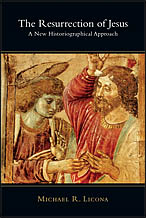
Why we work: to buy Mike Licona’s new resurrection book

Mike's new book on the resurrection

And what a big book it is! 718 pages!

Here are the details from Brian Auten:

Michael Licona, Research Professor of New Testament at Southern Evangelical Seminary, has just released a monumental new book: The Resurrection of Jesus: A New Historiographical Approach.

From the publisher:

Could there be any new and promising approach to the question of the historicity of Jesus’ resurrection? Yes, answers Michael Licona. And he convincingly points us to a significant deficiency in approaching this question: our historiographical orientation and practice. He then carefully and effectively applies his principles and methods to the question of Jesus’ resurrection.

This book is sure to become required reading for anyone exploring this field, as Michael Licona has made an extremely significant contribution to scholarship in this area.

Pick it up today.

The book is $27 dollars on Amazon, but you probably won’t need another book on the resurrection. I try not to buy books by people who haven’t debated anyone on the other side, but that won’t be a problem with Licona. He’s debated everybody on the other side – like Bart Ehrman, Richard Carrier and Shabir Ally. He’s battle-tested.

I took a look at the endorsements, and I recognize tons of historians.

Here’s one:

“Licona has tackled his subject energetically, with near-obsessive thoroughness. He concludes that if one approaches the sources without an a priori commitment to the impossibility of resurrection, the ‘Resurrection Hypothesis’ is the interpretation that most adequately accounts for the evidence. Thus, the book boldly challenges the naturalistic presuppositions of post-Enlightenment historical criticism. At the very least, Licona has shown that the usual naturalistic explanations of the resurrection tradition are, on the whole, weak, speculative and often tendentious. “I am not aware of any scholar who has previously offered such a thorough and fair-minded account of the historiographical prolegomena to the resurrection question. Furthermore, Licona’s discussion of the ‘bedrock’ historical evidence is appropriately nuanced and carefully modulated, not claiming more than can be supported by the consensus findings of qualified scholars. This lends credibility to his conclusions. Licona has presented a fair and vigorous case for his position. No doubt many readers will be unconvinced by his arguments, but no one can accuse him of naivet? or of ignoring counterarguments. “This study spans fields that are too rarely brought into conversation: New Testament studies and historiographical theory. Licona is to be commended for this undertaking and for producing a study that has both wide range and significant depth.”

—Richard B. Hays, George Washington Ivey Professor of New Testament and dean, Duke Divinity School

If you’re looking for a book on the resurrection, this might be a good one. Seems like it will cover everything.

UPDATE: Wow, big Mike Licona post up at Reason to Stand. Lots of Mike Licona videos.