Tag Archives: Historical Jesus

What are the historical arguments for the empty tomb story?

I wanted to go over this article by William Lane Craig which includes a discussion of the empty tomb, along with the other minimal facts that support the resurrection.

The word resurrection means bodily resurrection

The concept of resurrection in use among the first converts to Christianity was a Jewish concept of resurrection. And that concept of resurrection is unequivocally in favor of a bodily resurrection. The body (soma) that went into the grave is the body (soma) that came out.

Craig explains what this means with respect to the fast start of Christian belief:

For a first century Jew the idea that a man might be raised from the dead while his body remained in the tomb was simply a contradiction in terms. In the words of E. E. Ellis, “It is very unlikely that the earliest Palestinian Christians could conceive of any distinction between resurrection and physical, ‘grave emptying’ resurrection. To them an anastasis without an empty grave would have been about as meaningful as a square circle.”

And:

Even if the disciples had believed in the resurrection of Jesus, it is doubtful they would have generated any following. So long as the body was interred in the tomb, a Christian movement founded on belief in the resurrection of the dead man would have been an impossible folly.

It’s significant that the belief in the resurrection started off in the city where the tomb was located. Anyone, such as the Romans or Jewish high priests, who wanted to nip the movement in the bud could easily have produced the body to end it all. They did not do so, because they could not do so, although they had every reason to do so.

There are multiple early, eyewitness sources for the empty tomb

Paul’s early creed from 1 Corinthians 15:3-7, dated to within 5 years of the crucifixion, implies the empty tomb.

Craig writes:

In the formula cited by Paul the expression “he was raised” following the phrase “he was buried” implies the empty tomb. A first century Jew could not think otherwise. As E. L. Bode observes, the notion of the occurrence of a spiritual resurrection while the body remained in the tomb is a peculiarity of modern theology. For the Jews it was the remains of the man in the tomb which were raised; hence, they carefully preserved the bones of the dead in ossuaries until the eschatological resurrection. There can be no doubt that both Paul and the early Christian formula he cites pre-suppose the existence of the empty tomb.

The dating of the resurrection as having occurred “on the third day” implies the empty tomb. The date specified for the resurrection would have been the date that the tomb was discovered to be empty.

The phrase “on the third day” probably points to the discovery of the empty tomb. Very briefly summarized, the point is that since no one actually witnessed the resurrection of Jesus, how did Christians come to date it “on the third day?” The most probable answer is that they did so because this was the day of the discovery of the empty tomb by Jesus’ women followers. Hence, the resurrection itself came to be dated on that day. Thus, in the old Christian formula quoted by Paul we have extremely early evidence for the existence of Jesus’ empty tomb.

A few quotes from atheist historians not from Dr. Craig’s article: (thanks to Eric of Ratio Christi OSU)

Michael Goulder (Atheist NT Prof. at Birmingham) “…it goes back at least to what Paul was taught when he was converted, a couple of years after the crucifixion.” [“The Baseless Fabric of a Vision,” in Gavin D’Costa, editor, Resurrection Reconsidered (Oxford, 1996), 48.]

Gerd Lüdemann (Atheist Prof of NT at Göttingen): “…the elements in the tradition are to be dated to the first two years after the crucifixion of Jesus…not later than three years… the formation of the appearance traditions mentioned in I Cor.15.3-8 falls into the time between 30 and 33 CE.” [The Resurrection of Jesus, trans. by Bowden (Fortress, 1994), 171-72.]

Robert Funk (Non-Christian scholar, founder of the Jesus Seminar): “…The conviction that Jesus had risen from the dead had already taken root by the time Paul was converted about 33 C.E. On the assumption that Jesus died about 30 C.E., the time for development was thus two or three years at most.” [Roy W. Hoover, and the Jesus Seminar, The Acts of Jesus, 466.]

The early pre-Markan burial narrative mentions the empty tomb. This source pre-dates Mark, the earliest gospel. The source has been dated by some scholars to the 40s. For example, the atheist scholar James Crossley dates Mark some time in the 40s. (See the debate below)

The empty tomb story is part of the pre-Markan passion story and is therefore very old. The empty tomb story was probably the end of Mark’s passion source. As Mark is the earliest of our gospels, this source is therefore itself quite old. In fact the commentator R. Pesch contends that it is an incredibly early source. He produces two lines of evidence for this conclusion:

(a) Paul’s account of the Last Supper in 1 Cor. 11:23-5 presupposes the Markan account. Since Paul’s own traditions are themselves very old, the Markan source must be yet older.

(b) The pre-Markan passion story never refers to the high priest by name. It is as when I say “The President is hosting a dinner at the White House” and everyone knows whom I am speaking of because it is the man currently in office. Similarly the pre-Markan passion story refers to the “high priest” as if he were still in power. Since Caiaphas held office from AD 18-37, this means at the latest the pre-Markan source must come from within seven years after Jesus’ death. This source thus goes back to within the first few years of the Jerusalem fellowship and is therefore an ancient and reliable source of historical information.

So we are dealing with very early sources for the empty tomb.

Lack of legendary embellishments

The empty tomb narrative in the gospels lacks legendary embellishments, unlike later 2nd century forgeries that originated outside of Jerusalem.

The eyewitness testimony of the women

This is the evidence that has been the most convincing to skeptics, and to me as well.

The tomb was probably discovered empty by women. To understand this point one has to recall two facts about the role of women in Jewish society.

(a) Woman occupied a low rung on the Jewish social ladder. This is evident in such rabbinic expressions as “Sooner let the words of the law be burnt than delivered to women” and “Happy is he whose children are male, but woe to him whose children are female.”

(b) The testimony of women was regarded as so worthless that they were not even permitted to serve as legal witnesses in a court of law. In light of these facts, how remarkable must it seem that it is women who are the discoverers of Jesus’ empty tomb. Any later legend would certainly have made the male disciples to discover the empty tomb. The fact that women, whose testimony was worthless, rather than men, are the chief witnesses to the empty tomb is most plausibly accounted for by the fact that, like it or not, they were the discoverers of the empty tomb and the gospels accurately record this.

The earliest response from the Jewish high priests assumes the empty tomb

This report from Matthew 28 fulfills the criteria of enemy attestation, although Matthew is not the earliest source we have. Oh, well.

In Matthew 28, we find the Christian attempt to refute the earliest Jewish polemic against the resurrection. That polemic asserted that the disciples stole away the body. The Christians responded to this by reciting the story of the guard at the tomb, and the polemic in turn charged that the guard fell asleep. Now the noteworthy feature of this whole dispute is not the historicity of the guards but rather the presupposition of both parties that the body was missing. The earliest Jewish response to the proclamation of the resurrection was an attempt to explain away the empty tomb. Thus, the evidence of the adversaries of the disciples provides evidence in support of the empty tomb.

Note how careful Craig is not to imply that the guard tradition is historical, because we can’t prove the guard as a “minimal fact”, since it doesn’t pass the standard historical criteria.

See it used in a debate

You can see the arguments made and defended from criticism in this debate with the atheist scholar James Crossley.

This my favorite resurrection debate.

New paper from Michael Licona on historical methods and miracle claims

Sherlock Holmes and John Watson
Sherlock Holmes and John Watson about to do some historical inquiry

I hope that all my readers know who Michael Licona is!

The PDF of his new paper is here. It was just published in the Journal for the Study of the Historical Jesus. It talks about how the pre-suppositions of ancient historians can mess with their ability to investigate the past.

Here’s the abstract:

Most biblical scholars and historians hold that the investigation of a miracle report lies outside of the rights of historians acting within their professional capacity. In this essay, I challenge this position and argue to the contrary. A definition of history should not a priori exclude the possibility of investigating miracle claims, since doing so may restrict historians to an inaccurate assessment of the past. Professional historians outside of the community of biblical scholars acknowledge the frequent absence of a consensus; this largely results from conflicting horizons among historians. If this is the present state among professionals engaged in the study of non-religious history, it will be even more so with historians of Jesus. Finally, even if some historians cannot bring themselves to grant divine causation, they, in principle, can render a verdict on the event itself without rendering a verdict on its cause.

Here’s a bit that I found interesting:

It is clear that the horizon of atheist New Testament scholar Gerd Lüdemann is a driving force behind his historical conclusions when he a priori rules out the  historicity of the ascension of Jesus reported in Acts 1.9–11 ‘because there is no  such heaven to which Jesus may have been carried’. Ontological naturalism similarly guides James Tabor.

He writes:

Women do not get pregnant without a male—ever. So Jesus had a human father… Dead bodies don’t rise… So, if the tomb was empty the historical  conclusion is simple—Jesus’ body was moved by someone and likely  reburied in another location.

Not so obvious is Geza Vermes in his 2008 volume The Resurrection: History and Myth. With hardly a comment, Vermes simply dismisses both ‘the out-of-hand rejection of the inveterate skeptic’ and the hypothesis that Jesus rose from the dead since it can only be made from ‘the blind faith of the fundamentalist believer’.

I thought these were interesting because Ludemann and Vermes still agree with some of the minimal facts in a case for the resurrection case, such as Craig, Habermas or Licona might make. Ludemann gives you the post-mortem “visions” of Jesus, and Vermes gives you the empty tomb – yet both are naturalists, as you can see. They both rule out miracle as an explanation of the minimal facts a priori, but they both allow for useful minimal facts because the historical case is there to support them. Isn’t that interesting?

So what would you call a detective who ruled out some causes of death but not others, before looking at the evidence?

More:

Second, methodological naturalism may handicap historians, preventing them in some cases from providing a fuller and more accurate account of the past. Molecular biologist Michael Behe provides a relevant challenge to this approach in his discipline. He writes:

Imagine a room in which a body lies crushed, flat as a pancake. A dozen detectives crawl around, examining the floor with magnifying glasses for any clues to the identity of the perpetrator. In the middle of the room, next to the body, stands a large, grey elephant. The detectives carefully avoid bumping into the pachyderm’s legs as they crawl, and never even glance at it. Over time the detectives get frustrated with their lack of progress but resolutely press on, looking even more closely at the floor. You see, textbooks say detectives must ‘get their man’, so they never consider elephants.

In context, Behe is contending that when scientists limit their considerations exclusively to unguided natural causes they will forever keep themselves from discovering the actual cause if a Designer of some sort was responsible. A similar admonition may be issued to historians who a priori exclude a non-human agent as the cause behind a past event. Those who do so could actually be placing themselves in a position where they cannot appraise history accurately.

The rest of the paper discusses two options for historians who want to resolve this problem.

So, I’m impressed that Mike Licona reads Mike Behe (that quote is from “Darwin’s Black Box”). Pretty cool that he reads across disciplines, and that he reads people who disagree with him. We one-dollar apologists all need to be like that.

Back to his paper. I see this presupposition of naturalism come up in debates on the historical Jesus, where the naturalist will just assume naturalism and then proceed to do history – even at a time where we have so many scientific arguments to undermine naturalism. It’s a bad philosophical view, and we shouldn’t let it influence how we do history.

If you run into these historians who are committed to naturalism, it might be worth it to make them defend it. You ask them – do you believe in naturalism? If they say yes, ask them for scientific evidence for naturalism. And when they finish not giving you any, then you can go on a long monologue on the origin of the universe, the fine-tuning, the origin of life, the Cambrian explosion, the habitability (galactic and stellar), and so on. Then tell them to stop bring their blind religious faith into their historical investigations.

Did the city of Nazareth exist at the time of the birth of Jesus?

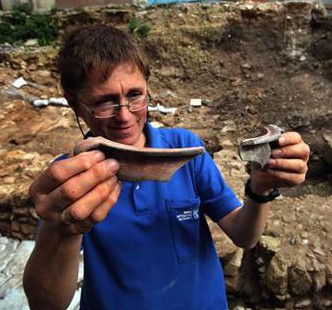
Israeli archaeologist Yardena Alexandre inspects Roman 1st-century pottery found from the city of Nazareth.

I was discussing a recent debate that a friend attended between an atheist musician named Dan Barker and a Christian with a doctorate in New Testament Studies named Justin Bass.

According to my friend’s report, the atheist questioned the existence of Nazareth, and then went on from there to assert that everything we know about Jesus is legendary.

This is what the atheist’s argument sounds like:

  1. If the New Testament contains reliable history about Jesus, then Nazareth must exist.
  2. Nazareth does not exist.
  3. Therefore, the New Testaments does not contain reliable history about Jesus. (M.T. 1,2)

I was able to find a web site where an atheist was making the claim that Nazareth did not exist at the time of Jesus. So this is not completely outside the realm of mainstream atheism. I doubled checked with two more people who attended the debate that Barker indeed made an argument like the one above.

Two things to say about this 3-step argument. First off, when speaking to atheists, Christians only care about making a case for the resurrection. This is for two reasons. One, our goal is to disprove atheism, and the historical argument for the resurrection is the most evidenced miracle claim in the New Testament. Nazareth is not part of that core of minimal facts about the resurrection of Jesus. Second, it’s possible to be a Christian by accepting a core of Christian dogma (e.g. – the Apostle’s Creed), while remaining agnostic or even skeptical of other things in the Bible. Nazareth is not part of that core of minimal facts that must be affirmed in order to become a Christian.

The problem I have with atheists is that they pick and choose from the Bible according to their own agenda. Every Christian has read basic books on the resurrection by people like Lee Strobel, Michael Licona, William Lane Craig, J. Warner Wallace and so on. This is like table stakes for living a Christian life. We all know how to make a case based off of minimal facts for the resurrection. When Christians get into debates about Jesus, we want to make a case for the core of historical knowledge about him, minimal facts that almost no one disagrees with. But many atheists aren’t like that. They want to pick and choose a few verses out of the Old Testament and the New Testament that they personally find distasteful to them, and then deny the minimal facts about Jesus on that basis. I don’t think that it makes sense to deny evidence for widely-accepted facts by bringing up minor problems that are irrelevant to the well-attested core facts.

But it’s worse than that – we actually DO know that Nazareth existed, and we know it not from some fundamentalist preacher, but from atheist Bart Ehrman.

Ehrman writes in his book:

One supposedly legendary feature of the Gospels commonly discussed by mythicists is that the alleged hometown of Jesus, Nazareth did not exist but is itself a myth. The logic of this argument, which is sometimes advanced with considerable vehemence and force, appears to be that if Christians made up Jesus’ hometown, they probably made him up as well.  I could dispose of this argument fairly easily by pointing out that it is irrelevant.  If Jesus existed, as the evidence suggests, but Nazareth did not, as this assertion claims, then he merely came from somewhere else.  Whether Barack Obama was born in the U.S. or not (for what it is worth, he was) is irrelevant to the question of whether he was born.

Since, however, this argument is so widely favored among mythicists, I want to give it a further look and deeper exploration.  The most recent critic to dispute the existence of Nazareth is René Salm, who has devoted an entire book to the question, called The Myth of Nazareth.  Salm sees this issue as highly significant and relevant to the question of the historicity of Jesus: “Upon that determination [i.e., the existence of Nazareth] depends a great deal, perhaps even the entire edifice of Christendom.”

So that seems like a fair representation of the argument I outlined above.

Bart’s response is long, but here’s part of it:

There are numerous compelling pieces of archaeological evidence that in fact Nazareth did exist in Jesus’ day, and that like other villages and towns in that part of Galilee, it was built on the hillside, near where the later rock-cut kokh tombs were built.  For one thing, archaeologists have excavated a farm connected with the village, and it dates to the time of Jesus.  Salm disputes the finding of the archaeologists who did the excavation (it needs to be remembered, he himself is not an archaeologist but is simply basing his views on what the real archaeologists – all of whom disagree with him — have to say).  For one thing, when archaeologist Yardena Alexandre indicated that 165 coins were found in this excavation, she specified in the report that some of them were late, from the fourteenth or fifteenth centuries.  This suits Salm’s purposes just fine.  But as it turns out, there were among the coins some that date to the Hellenistic, Hasmonean, and early Roman period, that is, the days of Jesus.  Salm objected that this was not in Alexandre’s report, but Alexandre has verbally confirmed (to me personally) that in fact it is the case: there were coins in the collection that date to the time prior to the Jewish uprising.

Aalm also claims that the pottery found on the site that is dated to the time of Jesus is not really from this period, even though he is not an expert on pottery.  Two archaeologists who reply to Salm’s protestations say the following:  “Salm’s personal evaluation of the pottery … reveals his lack of expertise in the area as well as his lack of serious research in the sources.”  They go on to state: “By ignoring or dismissing solid ceramic, numismatic [that is, coins], and literary evidence for Nazareth’s existence during the Late Hellenisitic and Early Roman period, it would appear that the analysis which René Salm includes in his review, and his recent book must, in itself, be relegated to the realm of ‘myth.’”

Read Bart’s whole excerpt from his book in his post.

I did a quick double check on the archaeologist Ehrman mentioned, and found an Associated Press story about another archaelogical discovery made by archaeologists in Nazareth. This time, it’s not the coins, but pottery fragments. The date range on the pottery is 100 before Jesus’ birth to 100 years after Jesus’ birth.

Even though Ehrman is an atheist, I think that he understands how to do history. You can’t be a credentialed historian and throw out the early proclamation of Jesus’ resurrection because of doubts about Old Testament violence. You can’t be a credentialed historian and throw out the conversions of Paul and James because you don’t know whether there was one angel or two angels at the empty tomb. Denying the core facts about Jesus by bringing up concerns about peripheral issues is not a responsible way to investigate the historical Jesus.

One final point. This happens when discussing scientific evidence with atheists, too. I was discussing the scientific evidence for the origin of the universe and the cosmic fine-tuning with an atheist – mentioning names, dates and places related to the discoveries – and she cut me off with “Am I going to Hell?”