
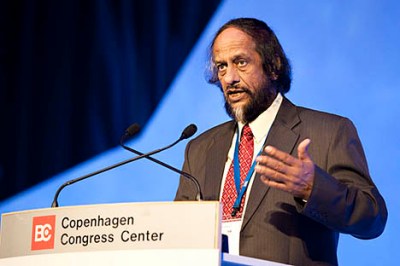
Here’s an article from the BBC about the IPCC’s latest shenanigans. (H/T Neil Simpson‘s latest round-up)
Excerpt:
But the flood gates really opened after the IPCC had to withdraw its claim that the Himalayan glaciers would likely all have melted by 2035, maybe even sooner.
This turned out to have no basis in scientific fact, even though everything the IPCC produces is meant to be rigorously peer-reviewed, but simply an error recycled by the [World Wildlife Fund], which the IPCC swallowed whole….
Then at the weekend another howler was exposed. The IPCC 2007 report claimed that global warming was leading to an increase in extreme weather, such as hurricanes and floods. Like its claims about the glaciers, this was also based on an unpublished report which had not been subject to scientific scrutiny — indeed several experts warned the IPCC not to rely on it.
Now after Climate-gate, Glacier-gate and Hurricane-gate — how many “gates” can one report contain? — comes Amazon-gate. The IPCC claimed that up to 40 percent of the Amazonian forests were risk from global warming and would likely be replaced by “tropical savannas” if temperatures continued to rise.
This claim is backed up by a scientific-looking reference but on closer investigation turns out to be yet another non-peer reviewed piece of work from the WWF. Indeed the two authors are not even scientists or specialists on the Amazon: one is an Australian policy analyst, the other a freelance journalist for the Guardian and a green activist.
Got that? The United Nations’ Intergovernmental Panel on Climate Change is publicizing conclusions that are designed to re-organize our entire way of life, and their evidence for this is not rooted in any repeatable scientific study.
More details are emerging
Consider this article from the UK Daily Mail. (H/T Secondhand Smoke)
Excerpt:
The scientist behind the bogus claim in a Nobel Prize-winning UN report that Himalayan glaciers will have melted by 2035 last night admitted it was included purely to put political pressure on world leaders. Dr Murari Lal also said he was well aware the statement, in the 2007 report by the Intergovernmental Panel on Climate Change (IPCC), did not rest on peer-reviewed scientific research. In an interview with The Mail on Sunday, Dr Lal, the co-ordinating lead author of the report’s chapter on Asia, said: ‘It related to several countries in this region and their water sources. We thought that if we can highlight it, it will impact policy-makers and politicians and encourage them to take some concrete action. ‘It had importance for the region, so we thought we should put it in.’
And this one from the Vancouver Sun. (H/T Secondhand Smoke)
Excerpt:
In the 1970s, nearly 600 Canadian weather stations fed surface temperature readings into a global database assembled by the U.S. National Oceanic and Atmospheric Administration (NOAA). Today, NOAA only collects data from 35 stations across Canada. Worse, only one station — at Eureka on Ellesmere Island — is now used by NOAA as a temperature gauge for all Canadian territory above the Arctic Circle.
The Canadian government, meanwhile, operates 1,400 surface weather stations across the country, and more than 100 above the Arctic Circle, according to Environment Canada. Yet as American researchers Joseph D’Aleo, a meteorologist, and E. Michael Smith, a computer programmer, point out in a study published on the website of the Science and Public Policy Institute, NOAA uses “just one thermometer [for measuring] everything north of latitude 65 degrees.”
Is that science?
What counts as knowledge?
Plato, in his dialogue Theatetus, says that knowledge is justified, true belief. And one of the ways you know that you are justified in your belief is by listening to the best arguments from the best scholars who disagree with you.
The American Spectator writes:
Yep, this is the “scientific consensus” that Al Gore based his post-VP life upon; the imagined groundswell that so many politicians used to justify government growth; the nonexistent evidence that journalists cited to justify their alarmism activism. It’s the two words that every global warmist (whether lying or deceived themselves) threw in the face of skeptics in an attempt to intimidate. Didn’t work!
No wonder why hardly any of them wanted to debate and those who did got slaughtered. We tried to explain that the “consensus” was an illusion. You — yes, I’m talking about you, Society of Environmental Journalists — would have none of it.
If you can’t make a case against your own point of view by citing the best scholars on the other side respectfully, then you don’t have knowledge. You just have an opinion. Even scientism, empiricism and naturalism need to be justified in order to be counted as knowledge. You don’t have to agree with those opposing scholars, you just have to understand them, and you have to not hate them, and you have to not believe nonsense about their motives just because you hate them so much. The job of journalists and educators is to present EVERY claim to knowledge as a conflict between opposing views, regardless of whether it’s global warming, abortion, same-sex marriage, or Darwinism.
For my Christian readers, this epistemology comes straight from the Bible in Proverbs 18:17:
17 The first to present his case seems right, till another comes forward and questions him.
For God’s sake, please read that verse and think about it. Apply it to your lives. Find someone who disagrees with you and talk to them about why they believe what they believe. It’s OK to think you’re right, it’s OK to think you have the truth. But it’s not OK to be ignorant and dismissive of the best case against your view.
 WINTERY KNIGHT