Tag Archives: Health-care

How the ADF kept nurses who wouldn’t perform abortions from being fired

In 2011, a story came out about New Jersey nurses being forced to perform abortions (or be fired). I blogged about it, but we didn’t really know the details. Well, now the details have emerged and the case has finally been decided. Here’s a press release from the heroic Alliance Defending Freedom, which protected the nurses involved from violating their consciences.

Excerpt:

Promoted from that team to a supervisory position over all the nurses, the new assistant manager announced that – since she and others had to help with abortions – she saw no reason why every nurse shouldn’t help. Hospital officials agreed, and passed a new, mandatory policy to make it so. The assistant manager quickly set up a training program that would give each nurse on the unit hands-on experience in how to assist with and clean up after abortions.

“As long as you work here,” she told the 12 nurses who openly protested, “you’re going to have to do it. If you don’t, you’re going to be fired or transferred out.”

“We were all shocked,” Fe says. “All these years I’ve been a nurse, I was never told to help kill children.”

But the managers remained adamant. Hospital administrators supported them.

[…]”Our jobs were hanging by a string,” Beryl says. “We were like, ‘All right. If they’re going to fire all 12 of us, fine. But this is against what we believe God wants us to do.’ We didn’t come into this profession to do [abortions]. We told them we weren’t comfortable with it and didn’t feel they should force us. And if that meant our jobs, well… God was going to provide.”

When even their own union declined to help them, Fe wrote a letter to hospital officials saying that she and her coworkers would not participate in abortions. She passed it around for the other nurses; 15 signed it. She gave the letter to her manager, who took it to the director of nursing.. Response was swift. A meeting was called for the next day, with each of the signing nurses, the labor board, a union official, the managers, and “an expert on ethics” scheduled to be on hand.

I think so often in this world today, Christians are on the defensive when it comes to acting on their convictions. My expectation is that we will never win when we do the right thing. The other side is so strong, and we have so few conservative Christians who are intentional about studying well, earning well, and reaching positions of influence. But sometimes we do win, because there are still some Christians left who have paid the price to get the education and training that allows them to do something when the freedoms of Christians are threatened.

This time, it was the Alliance Defending Freedom lawyers who saved the day:

The day of that announcement, Pastor Terry Smith, of Life Christian Church in West Orange, New Jersey, returned from a trip. A staff member told him that one of his parishioners – Fe – had called, shared what was happening at the hospital, and asked for advice. The pastor immediately phoned Len Deo, president of the New Jersey Family Policy Council.

“I’ll be all over this,” said Deo, who hung up and called Alliance Defending Freedom. Shortly afterward, staff attorney Matt Bowman was on the phone with a local allied attorney, Demetrios Stratis, enlisting him to help defend the nurses. The two immediately called Fe.

[…]Amid all the tension, threats, and growing media coverage, the judge in the case stunned everyone by suddenly announcing, in a preliminary hearing, that a settlement had been reached.

“We had gotten everything [the 12 nurses] requested,” Stratis says. “We’d gotten the hospital to agree not to force them to perform these abortions. There would be no retaliatory measures against them, and they could feel free and sleep at night, knowing that the next day they would not have to be trained on the abortion process or help a woman kill an innocent child.”

“I was crying – really crying,” says Lorna, who heard the news from one of the other nurses. “And very thankful. The next day, I went to work, and all of us were hugging and very happy.”

“Before, I used to think that some prayers won’t be answered,” Fe says. “Sometimes, I’d feel very hopeless. But with this case, I saw how the Lord moves… providing the resources, the people who would help us out. It just strengthened my faith. I really thank God for Alliance Defending Freedom.”

Where does this desire to force people to commit murder come from? Well, it comes from the political left. In fact, the Obama administration actively opposes conscience protections for medical workers, and actively opposes conscience protections for military chaplains. This is to say nothing about the HHS mandate, which forces entire organizations and businesses to subsidize abortion-causing drugs.

I think that Christians need to be thoughtful, calculating and realistic about how we are going to deal with threats like this. Although some of us may prefer to study things that are easier, and do jobs that are comfortable, there is a real need for more of us to study hard things and do hard jobs. We need people with the right degrees in the right fields, and we need people who are good at earning and saving money. The truth is that this is the way the world works, and wisdom requires that we do what we have to do (not what we like to do) in order to be ready for the the challenges we are likely to face. The other side is certainly doing their job of getting the degrees and the money that they will use against us.
In North Dakota, 35,000 lose their health care plan, but only 30 sign up for Obamacare

I know that Obama talked a lot about wanting to help people without insurance find insurance, but so far all he done is make a lot of people lost their insurance (and more to come in 2014!).

Here’s a story from ABC News.

Excerpt:

More than 35,000 customers in North Dakota face discontinued health coverage because their plans are being scrapped due to new requirements under the Affordable Care Act.

The three major health insurers in North Dakota were asked to report to state regulators their enrollment figures and cancellations resulting from the health reform act, commonly known as Obamacare.

The state’s largest health insurer, Blue Cross Blue Shield of North Dakota, covers about 31,600 members – 17,000 in small groups and 14,600 individuals – whose insurance plans are being discontinued.

That combined figure represents 8 percent of the North Dakota Blues’ 400,000 membership total.

[…]The total number of North Dakota residents who must switch coverage is 35,585, according to the tally by the state Insurance Department.

“You have almost 36,000 North Dakotans who either are or will be losing their health insurance policies, and this is after they and all Americans have been told they will be able to keep their health insurance,” Insurance Commissioner Adam Hamm said Friday.

The premiums are all going up because Obamacare mandates new coverages, which people did not have on their old plans. They didn’t have those coverages because they didn’t need them. For example, people who weren’t addicted to drugs didn’t request treatments for drug addiction. But now we all have to pay for it, whether we use it or not. That makes prices go up!

More:

Under the new requirements, deductibles for individuals or small groups are generally capped at $2,000, with an exception allowing caps of up to $5,000 for individuals and $3,000 for small groups.

Total out-of-pocket expenses now cannot exceed $6,350 for an individual or $12,700 for a family.

Nationally, estimates of the percentage of policies that will be discontinued under the new coverage requirements have ranged from 40 percent to 67 percent, Krystopolski said.

In most cases, plans failed to meet the new requirements because they did not cover maternity care or because the deductibles were too high, she said.

So how many of those 35,585 people that the Democrats kicked out of their insurance plans have found new ones on the Obamacare exchanges?

Almost none:

Besides collecting information on cancellations, Hamm’s office asked the three major health insurers to report the number of enrollments under the new health insurance marketplace provided by the Affordable Care Act.

As of Friday, the three insurers have logged 30 enrollments covering 37 people, a number Hamm called “concerning.”

Remember that these figures only represent the effects of the individual mandate. Things are going to get a lot worse when the employer mandate takes effect in 2014. For those of us with health care through our employers, our day is coming.

American health care: does it cause poor life-expectancy and high infant mortality?

Probably one of the best health care policy experts writing today is Avik Roy, who writes for Forbes magazine.

Here is his latest column, which I think is useful for helping us all get better at debating health care policy. (H/T Matt from Well Spent Journey)

Excerpt:

It’s one of the most oft-repeated justifications for socialized medicine: Americans spend more money than other developed countries on health care, but don’t live as long. If we would just hop on the European health-care bandwagon, we’d live longer and healthier lives. The only problem is it’s not true.

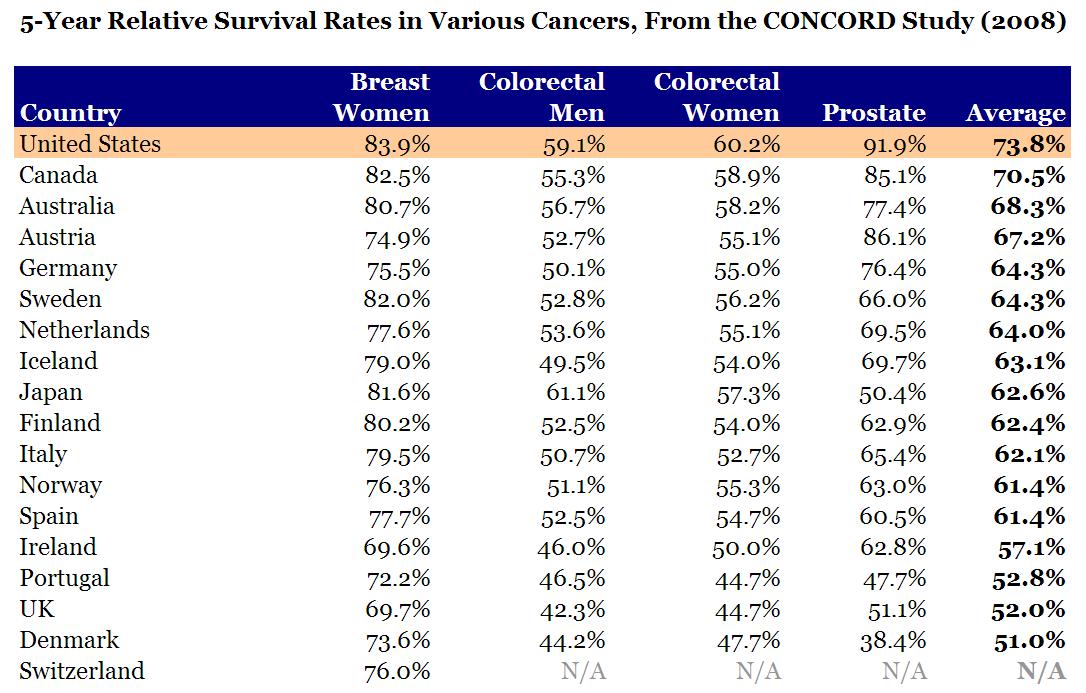
[…]If you really want to measure health outcomes, the best way to do it is at the point of medical intervention. If you have a heart attack, how long do you live in the U.S. vs. another country? If you’re diagnosed with breast cancer? In 2008, a group of investigators conducted a worldwide study of cancer survival rates, called CONCORD. They looked at 5-year survival rates for breast cancer, colon and rectal cancer, and prostate cancer. I compiled their data for the U.S., Canada, Australia, Japan, and western Europe. Guess who came out number one?

Here is the raw data:

Health care outcomes
Health care outcomes by country and type of treatment

Click here to see the larger graph.

So, what explains this?

The article continues:

Another point worth making is that people die for other reasons than health. For example, people die because of car accidents and violent crime. A few years back, Robert Ohsfeldt of Texas A&M and John Schneider of the University of Iowa asked the obvious question: what happens if you remove deaths from fatal injuries from the life expectancy tables? Among the 29 members of the OECD, the U.S. vaults from 19th place to…you guessed it…first. Japan, on the same adjustment, drops from first to ninth.

It’s great that the Japanese eat more sushi than we do, and that they settle their arguments more peaceably. But these things don’t have anything to do with socialized medicine.

Finally, U.S. life-expectancy statistics are skewed by the fact that the U.S. doesn’t have one health-care system, but three: Medicaid, Medicare, and private insurance. (A fourth, the Obamacare exchanges, is supposed to go into effect in 2014.) As I have noted in the past, health outcomes for those on government-sponsored insurance are worse than for those on private insurance.

To my knowledge, no one has attempted to segregate U.S. life-expectancy figures by insurance status. But based on the data we have, it’s highly likely that those on private insurance have the best life expectancy, with Medicare patients in the middle, and the uninsured and Medicaid at the bottom.

I know that my readers who like to dig deep into economics and policy will love the links at the bottom of the article:

For further reading on the topic of life expectancy, here are some recommendations. Harvard economist Greg Mankiw discusses some of the confounding factors with life expectancy statistics, citing this NBER study by June and Dave O’Neill comparing the U.S. and Canada. (Mankiw calls the misuse of U.S. life expectancy stats “schlocky.”) Chicago economist Gary Becker makes note of the CONCORD study in this blog post. In 2009, Sam Preston and Jessica Ho of the University of Pennsylvania published a lengthy analysis of life expectancy statistics, concluding that “the low longevity ranking of the United States is not likely to be a result of a poorly functioning health care system.”

The funniest thing I have found when talking to people from countries with socialized health care systems, like Canada and the UK, is that they are woefully uninformed about American health care. They literally do not know about free emergency room care, which is free for anyone regardless of insurance – including illegal aliens. They do not know about our expensive Medicaid program, which helps people who cannot afford health insurance. And our very very expensive Medicare program, which provides health care to the elderly – including prescription drugs. I get the feeling that foreign critics of American health care are getting their views from amateur documentaries produced by uneducated Hollywood propagandists, or maybe from TV shows on the Comedy Channel. They certainly are not getting their information from peer-reviewed studies by credentialed scholars from top universities, like the ones cited above.

I have literally spoken to Canadians who think that people in the USA without insurance do not get treatment and just die in the streets from stab wounds. They don’t know about the emergency room rule, or about charity care, or about Medicaid and Medicare. There is a lot of ignorance up there – wilful ignorance, in some cases. And keep in mind that the average Canadian household is paying over $11,000 a year for this substandard health care! They are paying more for less, and that’s not surprising since a large chunk of the taxes that are collected for health care go to overpaid unionized bureaucrats. Naturally, when their left-wing politicians need treatment, the first place they go is to the United States, where they pay out of pocket for the better health care. But that doesn’t stop them from denouncing American health care when they are talking to voters.

Higher infant mortality rates?

One of the other common arguments you hear from uninformed people outside the USA is the higher infant mortality rates argument.

Here’s an article by Stanford University professor Scott Atlas to explain why the argument fails.

Excerpt:

Virtually every national and international agency involved in statistical assessments of health status, health care, and economic development uses the infant-mortality rate — the number of infants per 1,000 live births who die before reaching the age of one — as a fundamental indicator. America’s high infant-mortality rate has been repeatedly put forth as evidence “proving” the substandard performance of the U.S. health-care system.

[…]n a 2008 study, Joy Lawn estimated that a full three-fourths of the world’s neonatal deaths are counted only through highly unreliable five-yearly retrospective household surveys, instead of being reported at the time by hospitals and health-care professionals, as in the United States. Moreover, the most premature babies — those with the highest likelihood of dying — are the least likely to be recorded in infant and neonatal mortality statistics in other countries. Compounding that difficulty, in other countries the underreporting is greatest for deaths that occur very soon after birth.

[…]The United States strictly adheres to the WHO definition of live birth (any infant “irrespective of the duration of the pregnancy, which . . . breathes or shows any other evidence of life . . . whether or not the umbilical cord has been cut or the placenta is attached”) and uses a strictly implemented linked birth and infant-death data set. On the contrary, many other nations, including highly developed countries in Western Europe, use far less strict definitions, all of which underreport the live births of more fragile infants who soon die. As a consequence, they falsely report more favorable neonatal- and infant-mortality rates.

[…]Neonatal deaths are mainly associated with prematurity and low birth weight. Therefore the fact that the percentage of preterm births in the U.S. is far higher than that in all other OECD countries — 65 percent higher than in Britain, and more than double the rate in Ireland, Finland, and Greece — further undermines the validity of neonatal-mortality comparisons.

You can listen to a podcast with Dr. Atlas here, from the Library of Economics web site.

If you want to read more about how American health care compares with health care in socialized systems, read this article by Stanford University professor of medicine Dr. Scott Atlas. And you can get his book “In Excellent Health: Setting the Record Straight on America’s Health Care” from Amazon.