Tag Archives: Health-care

Canadian Liberal Party introduces bill to legalize euthanasia

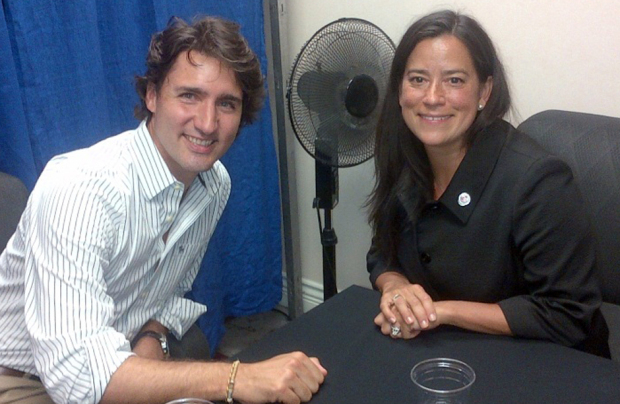
Jody Wilson-Raybould, Minister of Justice and Attorney General of Canada
Jody Wilson-Raybould, Minister of Justice and Attorney General of Canada (right)

Life Site News has a story about Canada’s new assisted suicide bill:

The Liberal government’s euthanasia bill introduced Thursday will not protect vulnerable Canadians or the conscience rights of physicians, say anti-euthanasia activists.

While Justice Minister Jody Wilson-Raybould’s Bill C-14 is more restrictive than the legislative framework the special joint parliamentary committee recommended in its February 2016 report, it essentially provides “a perfect cover for acts of murder, absolutely,” says Alex Schadenberg, executive director of the Euthanasia Prevention Coalition.

The draft legislation restricts eligibility for euthanasia and assisted suicide to competent patients 18 years of age and older who have “an incurable serious and incurable illness, disease or disability” which “causes them enduring physical or psychological suffering that is intolerable to them and that cannot be relieved under conditions,” who are in “an advanced state of decline in capability” and whose “natural death is reasonably foreseeable.”

The legislation mandates that a patient request assisted suicide or voluntary euthanasia in writing, and that this request be approved by two independent medical practitioners, or nurse practitioners.

It mandates a 15-day waiting period after the request is approved, but that period can be waived if the two medical practitioners deem the patient’s condition will deteriorate before that time is up.

[…]Schadenberg says the bill “does not provide effective oversight in the law,” because while it calls for two independent physicians or nurse practitioners to approve a request for euthanasia,  “this is the system where the doctor or nurse practitioner who does the act also does the reporting.”

The legislation also provides “legal immunity for anyone, anyone who does anything at a person’s request, under Sections 241.3, 241.5,” he said.

[…][W]hile the bill acknowledges conscience rights in its preamble, it “provides no protection for conscientious objectors,” according to Albertos Polizogopoulos, a constitutional lawyer for Canadian Physicians for Life.

Canadian doctors are already forced to perform abortions against their conscience, so this last point is no great surprise.

In a country that has single payer health care, all medical care is paid for by the federal government. You pay into the system your whole life (at an average of 42% of your income, in Canada) and then at the end, you get in line and hope that the government will treat you. It is extremely convenient for the government to kill off patients who are elderly. Elderly patients won’t be able to vote in many more elections, but they will want to draw away funds that could be used to buy the votes of young people who want “free” breast enlargements, plastic surgery, sex changes and IVF treatment. So the government has every incentive to cut loose the old people and then buy the votes of young people with the taxpayer money they save. Single payer health care is a scam to help politicians stay in power.

Similar laws in places like Belgium and Netherlands have been used to cut down on the medical bills that the government must pay.

A Parliamentary committee brief that I found on the Canadian government web site says this:

A study published in the NEJM entitled: Recent Trends in Euthanasia and Other End-of-Life Practices in Belgium (March 19, 2015) found that 4.6% of all deaths in the first six months of 2013, in the Flanders region of Belgium, were by assisted death and 1.7% of all deaths were assisted deaths without explicit request representing more than 1000 assisted deaths without explicit request in 2013.

The supplemental appendix in the study informs us how the researchers classified the data.

It states: “If in the latter case the drugs had been administered at the patient’s explicit request, the act was classified as euthanasia or assisted suicide depending on whether the patient self-administered the drugs. If drugs were used with the same explicit intention to hasten death but without the patient’s explicit request, the act was classified as hastening death without explicit patient request. This can include cases where a patient request was not judged as explicit by the physician, where the request came from the family or where the physician acted out of compassion.”

This research study confirms that many intentional hastened deaths are occurring without the explicit request of the patient which contravenes the Belgian assisted death law and medical ethics.

Previously, I blogged about how the UK government provides bonuses to hospitals who put elderly patients on an end-of-life pathway.

Ethicist Wesley J. Smith comments on the Canadian law in National Review.

Excerpt:

The Canadian government has tabled its new euthanasia bill–and as expected, it will be the most radical in the world.

Since the death doctor need not be present at the demise, the bill creates an unprecedented license for family members, friends–heck, a guy down the street–to make people dead.

[…]In short, this provision is the perfect defense for the murder of sick and disabled people who requested lethal drugs.

The George Delury case is an example of what I mean: Delury said he assisted wife, Myrna Lebov’s suicide out of “compassion” and at her request due to MS.

But his real hope was not only to be free from care giving, but become famous writing a book about her death. (He did, What If She Wants to Die?)

It almost worked. But because assisted suicide was a criminal offense, authorities conducted an investigation and discovered his diary.  It showed that contrary to the compassionate face Delury was conjuring, in reality, he emotionally pressured Myrna into wanting to commit suicide, telling her, for example, that she was a burden and ruining his life.

He also withheld full dosage of antidepressants so he could use those drugs to kill her. And, he but put a plastic bag over her head to make sure she died.

If euthanasia Canada’s bill had been the law of New York when Delury killed Myrnov, he might have been able to coerce her into asking for lethal drugs. At that point, he could have killed her any time he wanted and there wouldn’t have been a criminal investigation to find his diary.

Canada has just paved the way for a person, hungry for an inheritance or ideologically predisposed, to get away with the perfect murder.

In the last election, the Liberal Party promised the Canadian voters the moon, in terms of new spending. They said it would only add 10 billion to the deficit this year. But now (after the election) the number has exploded to 30 billion this year and over 100 billion over the next five years. Could this euthanasia plan be the first step in balancing the books, so they can win re-election?

How well is Obamacare working, and will Ted Cruz or Donald Trump fix health care?

Obamacare Bronze plans: and don't forget the $6850 deductibles
Obamacare Bronze plans

Two stories, then we’ll see whether Trump or Cruz is more likely to repeal Obamacare.

The Daily Signal lists 4 problems with Obamacare:

  1. Rising Costs
  2. Higher Taxes
  3. Unstable Enrollment
  4. Hostility to Personal Liberty

Let’s look at the first two:

Rising Costs

Contrary to repeated administration promises, Obamacare has not only failed to lower costs, but has also imposed additional expenses on millions of already over-stretched individuals and families.

Premiums in the government created exchanges were an initially jolting experience for Americans who did not qualify for taxpayer subsidies, and it appears that in 2016 premium increases in the government’s health insurance exchanges will again hit enrollees in the double digit range.

When it comes to average job-based premiums, the Congressional Budget Office (CBO) says that they, too, are climbing, and will rise almost 60 percent between now and 2025. Deductibles in the Affordable Care Act exchanges have also jumped higher than officials anticipated, discouraging the purchase of the Obamacare coverage among the poor and the young.

[…]Today, based on CBO data, the net cost of Obamacare’s coverage provisions—subtracting the taxes and penalties—will amount to over $1.4 trillion over the next ten years.

Higher Taxes

Obama promised he would not raise taxes on the middle-class. But Congressional Budget Office data indicates that Obamacare’s numerous taxes, fees, and penalties will cost about $832 billion over the years 2016 – 2025. And middle-class Americans are going to be hit—directly and indirectly.

Even lower-income workers will get hit by Obamacare taxes, including the so-called Cadillac tax on expensive health plans offered by large firms, as well as the individual mandate tax penalty.

For 2016, that mandate tax penalty for a single adult is $695 and up to $2,085 for a family.

We also need to remember how many companies took their employees off of the full-time work week to keep them below the 30 hours, so that they wouldn’t have to buy them this expensive health care with all the new minimum coverages (drug addiction therapy coverage is mandatory now?) that raised the price of health care insurance premiums.

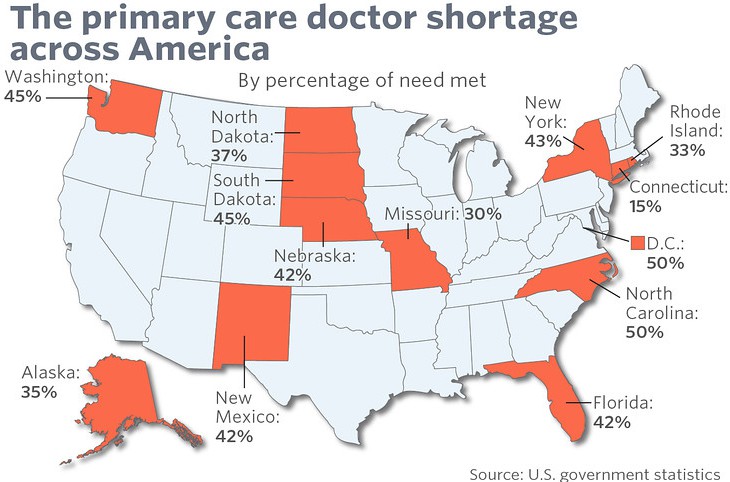
But there’s more than just more government spending, higher premiums, higher deductibles and higher tax penalties for those who opt out of the individual mandate. There’s also the regulation side of things. Doctors are now being regulated by the government to the point where they are dropping out of the field. And there are fewer people who want to become doctors, because of the regulations.

Primary care doctor shortage

So, how do we fix it? Well, one person who will not fix it is Donald Trump. Trump isn’t aware of any of the problems with Obamacare – he wants to expand government control of health care. Make it cover more people, for more mandated coverages (toupees, wigs, Viagra, hair replacement surgery?)

When government pays for all the health care provisioning, we call that a single-payer system. And Trump is for it – that clip is from September 27, 2015. In the Fox News debate in August, he said that single payer health care “works in Canada“.

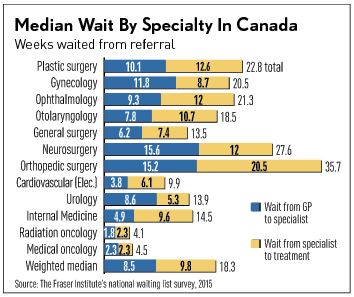
Do you think more government-control of health care will make things better? Look at how things are going in the single-payer system for our armed forces veterans in the VA single-payer system – they are dying while bureaucrats collect fat bonuses for concealing the waiting lists. Just as in Canada and the UK, the patients are dying on waiting lists while waiting for care. They pay into the Trump health care system their whole lives, then when they are old and of no use to the government, they are denied care and left to die.

Single-payer health care wait times in Canada

How much do Canadians pay in taxes, in order to wait on waiting lists for the government to decide to give them health care?

This Toronto Sun article explains:

Canadians retain just 21% of their income after paying the taxman and covering the cost of necessities, according to a Fraser Institute study.

Taxes gobble up a whopping 42% of the average Canadian family’s income. About 37% of income goes to cover housing, food and clothing.

“We’ve found … that over the last five decades or so, the tax bill for the average Canadian family has grown dramatically,” said study coauthor Charles Lammam.

Well, what about Ted Cruz? Has he got any sort of plan for Obamacare and consumer-centered health care reform?

Ted Cruz

Yes, he’s going to repeal Obamacare on day one, and then work to replace it with this:

Main points:

Ted Cruz's health care plan: choice and competition
Ted Cruz’s health care plan: choice and competition

Cruz explains it himself here:

At the eighth Republican presidential primary debate on February 6, 2016, Ted Cruz discussed repealing Obamacare: “Socialized medicine is a disaster. It does not work. If you look at the countries that have imposed socialized medicine, that have put the government in charge of providing medicine, what inevitably happens is rationing. … If I’m elected president, we will repeal every word of Obamacare. And once we do that, we will adopt common sense reforms, number one, we’ll allow people to purchase health insurance across state lines that will drive down prices and expand the availability of low cost catastrophic insurance. We’ll expand health savings accounts; and we will de-link health insurance from employment so that you don’t lose your health insurance when you lose your job, and that way health insurance can be personal, portable and affordable and we keep government from getting in between us and our doctors.”

Those of you who like to read consumer-centered health care policy scholars like me (Sally C. Pipes, Regina Herzlinger, Michael D. Tanner, Michael F. Cannon, John C. Goodman, Ilya Shapiro, Avik Roy, etc.) will recognize a lot of what he is proposing – he stole it all from the conservative and libertarian policy experts.

To me, that sounds better than Trump’s plan of expanding government-run health care into universal government-run health care. If I wanted that, I’d go to Canada or the UK, and just die on a waiting list after paying 42% of my salary into the system for my whole working life.

Desiring God asks: is socialism in conflict with Christianity?

Bible study that hits the spot

My friend Kevin sent me this amazing article about socialism, which appeared at Desiring God (!!!), of all places. It was authored by Phillip Holmes, who – I see from his picture -has dark skin like me, which is awesome!

In the past, I have given Desiring God and John Piper a lot of heat for not connecting Christianity to the real world. This was especially annoying to me during elections, or when legislation of interest to conservatives was being debated. But I’ve noted that Piper is now much better than he was before.

Anyway, here’s the intro to the article:

Socialism is trending in the minds of many Americans. Some love it, some hate it, and others are indifferent to it. Some Christians argue that it’s evil, while others argue that it’s morally good or neutral. Those that argue for its wickedness often fail to condemn the crony capitalism and corporate welfare that is widespread in the United States; therefore, their arguments often fall on deaf ears with socialist sympathizers. The arguments for its moral good or neutrality typically appeals to emotion, rather than evidence, which is considered insufficient for those that oppose it.

Then they quote John Piper for the definition of socialism – and it’s a great definition, it really captures what is interesting for us as Christians about socialism:

A social and economic system that through legal or governmental or military coercion — in other words, you go to jail if you don’t do this — establishes social ownership at the expense of private or personal ownership and/or you could say where coercion is used to establish social control — if not ownership, at least control of the means of production in society. And thus, through control, you effectively eliminate many of the implications and motivations of private ownership.

In other words, Socialism borrows the compassionate aims of Christianity in meeting people’s needs while rejecting the Christian expectation that this compassion not be coerced or forced. Socialism, therefore, gets its attractiveness at certain points in history where people are drawn to the entitlements that Socialism brings, and where people are ignorant or forgetful of the coercion and the force required to implement it — and whether or not that coercion might, in fact, backfire and result in greater poverty or drab uniformity or, worse, the abuse of the coercion as we saw in the murderous states like USSR and Cambodia.

F. A. Hayek says that the rule of law and private property are the foundations for all other rights, even religious liberty. So, Piper’s focus on property rights is right on the money. This is what we should care about when it comes to socialism, because it impacts our other liberties. The more free the free market is, the most Christians can follow their consciences. But the more the government takes hold of private industry, the harder it is for Christians to earn a living without toeing the secular government’s line. Take a look at what is happening to doctors and nurses in socialist countries like Canada. They are forced to perform abortions, they are forced to assist with assisted suicide. Why? Because government is running the health care system, and there is no other company you can run to that will respect your views. There is no escape when a secular government takes over large parts of the private sector.

This part is my favorite part, the author quotes my favorite economist, Thomas Sowell:

Despite the good they seem to do in some cases, I can’t in good conscience embrace them as a necessary means to escaping poverty. In my experience, I’ve witnessed it hinder more families than it has helped. We give social programs too much credit and the importance of family and faith too little. As a matter of fact, some economists assert that it was during the welfare state the condition of a particular group of its recipients began to decelerate. As the black economist Thomas Sowell pointed out:

The black family, which had survived centuries of slavery and discrimination, began rapidly disintegrating in the liberal welfare state that subsidized unwed pregnancy and changed welfare from an emergency rescue to a way of life.

Sowell continues to attack the myth that social programs improved the conditions of blacks in America:

The economic rise of blacks began decades earlier, before any of the legislation and policies that are credited with producing that rise. The continuation of the rise of blacks out of poverty did not — repeat, did not — accelerate during the 1960s.

The poverty rate among black families fell from 87 percent in 1940 to 47 percent in 1960, during an era of virtually no major civil rights legislation or anti-poverty programs.

Evidence seems to suggest that the families that have eliminated the poverty cycle while on social programs would have very likely done the same without the programs. While there have been numerous instances of grave injustices towards minority groups in our country that have hindered progress (slavery, Jim Crow), social programs don’t seem to be the cause of any significant improvements. Therefore, I want to humbly provide three practical reasons, based on my Christian worldview, why more social programs could actually substitute the family, empower the government, and hinder the church.

This is correct. Attempts to help the poor by redistributing wealth from those who produce to those who cannot or will not actually make things worse – by drawing more people “on the margin” into dependency.

One last snip:

Social programs are a slippery slope that could lead to unjust governments, more broken homes, and dead churches. Therefore, I simply can’t embrace them. A free society under a just government gives us plenty of options. We love our neighbors by starting non-profits, building hospitals, and opening schools that address the needs of the people without using the force of the government. What I’m proposing is not easy, but it is a biblical alternative that will require sacrifice, vision, newfound conviction, and a radical shift in how we view church, family, and government.

See, he sees private, voluntary charity as an option to government-run redistribution. An option that encourages economic growth, while safeguarding liberty and conscience for Christians.

I really love this article. The problem with me is that I don’t think enough about how to make my views palatable to well-meaning people on the other side. The author of this article does know how to defuse potential objections gently and graciously.