Tag Archives: Habitability

The connection between our moon, plate tectonics and habitability

Apologetics and the progress of science

I found an interview with Peter Ward (atheist) and Donald Brownlee (agnostic) discussing astrobiology in Forbes magazine. They were asked about how important plate tectonics are for a planet to be able to support complex life.

Excerpt:

Astrobiologists often cite the sheer numbers of stars and galaxies as evidence that complex life elsewhere must surely have evolved somewhere. But is probability enough?

Without a moon, we don’t have any idea of how commonly a planet could have the long-term stability needed for complex life. Until we “get” that, going to the sheer numbers argument is useless. Without that moon-forming collision, we wouldn’t have plate tectonics. Without plate tectonics, we might have microbes but we’d never get to animals.

What about the rarity of earth’s crustal dichotomy of oceans and continents?

If you can’t make granite, you’re not going to have continents. But granite formation is a consequence of our moon-forming collision. That scrambled the entire density of our crust. Mars doesn’t have granite; all it’s got is this volcanic basalt. To build granite you need a planetary subduction [or plate tectonic] process.

In triggering complex life, how important were plate tectonics’ role in the continual recycling of earth’s atmosphere?

It’s this recycling that allows for a very rich planetary atmosphere with an extended life. Photosynthesis gets you oxygen, but how do you get enough photosynthesis to get oxygen at 10 to 20 percent? You’ve got to have a shoreline next to a rich sea with rocks eroding into it in order to provide the nitrogen and phosphates for [plant] photosynthesis.

This article from Astrobiology explains more about the importance of plate tectonics.

Excerpt:

Plate tectonics is the process of continents on the Earth drifting and colliding, rock grinding and scraping, mountain ranges being formed, and earthquakes tearing land apart. It makes our world dynamic and ever-changing. But should it factor into our search for life elsewhere in the universe?

Tilman Spohn believes so. As director of the German Space Research Centre Institute of Planetary Research, and chairman of ESA’s scientific advisory committee, he studies worlds beyond our Earth. When looking into the relationship between habitability and plate tectonics, some fascinating possibilities emerged.

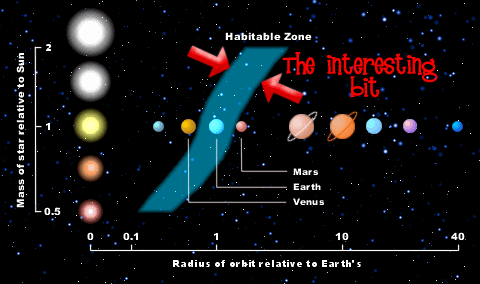
It is thought that the best places to search for life in the Universe are on planets situated in “habitable zones” around other stars. These are orbital paths where the temperature is suitable for liquid water; not so close to the star that it boils away, and not so far that it freezes. Spohn believes that this view may be outdated. He elaborates, “you could have habitats outside those, for instance in the oceans beneath ice covers on the Galilean satellites, like Europa. But not every icy satellite would be habitable. Take Ganymede, where the ocean is trapped between two layers of ice. You are missing a fresh supply of nutrition and energy.”

So planets and moons that lie beyond habitable zones could host life, so long as the habitat, such as an ocean, is not isolated. It needs access to the key ingredients of life, including hydrogen, oxygen, nitrogen, phosphorous and sulphur. These elements support the basic chemistry of life as we know it, and the material, Spohn argues, must be regularly replenished. Nature’s method of achieving this on the Earth appears to be plate tectonics.

Spohn found that the further he delved into the issue, the more important plate tectonics seemed to be for life. For example, it is believed that life developed by moving from the ocean to the kind of strong and stable rock formations that are the result of tectonic action. Plate tectonics is also involved in the generation of a magnetic field by convection of Earth’s partially molten core. This magnetic field protects life on Earth by deflecting the solar wind. Not only would an unimpeded solar wind erode our planet’s atmosphere, but it also carries highly energetic particles that could damage DNA.

Another factor is the recycling of carbon, which is needed to stabilize the temperature here on Earth. Spohn explains, “plate tectonics is known to recycle carbon that is washed out of the atmosphere and digested by bacteria in the soil into the interior of the planet from where it can be outcast through volcanic activity. Now, if you have a planet without plate tectonics, you may have parts of this cycle, but it is broken because you do not have the recycling link.”

It has also been speculated that the lack of tectonic action on Venus contributed to its runaway greenhouse effect, which resulted in the immense temperatures it has today.

Most planets don’t have a moon as massive as ours is, and the collision that formed the moon is very fine-tuned for life. This is just one of the many factors that needs to be present in order to have a planet that supports complex, carbon-based life.

If you want to learn more about this data, I recommend watching “The Privileged Planet” DVD, and someone posted it on YouTube:

If you haven’t seen it, and have 90 minutes, this is time well-spent.
Fine-tuning the habitable zone: tidal-locking and solar flares

Circumstellar Habitable Zone

Here’s an article from Evolution News that talks about liquid water and tidal locking, but it has even more factors that need to be fine-tuned for habitability.

Excerpt:

Stars with masses of 0.1-0.5 solar mass make up 75 percent of the stars in our Milky Way galaxy.6 These represent the red dwarfs, the M class. But these stars have low effective temperatures, and thus emit their peak radiation at longer wavelengths (red and near-infrared).7 They can have stable continuously habitable zones over long time scales, up to 10 billion years, barring other disruptions. It is also easier to detect terrestrial sized planets around them.8 But a serious problem with red dwarf stars in the K and M classes is their energetic flares and coronal mass ejection events. Potentially habitable planets need to orbit these stars closer, to be in these stars’ habitable zones. Yet the exposure to their stellar winds and more frequent and energetic flares becomes a serious issue for habitability. Because of these stars’ smaller mass, ejections get released with more violence.9 Any planet’s atmosphere would be subject to this ionizing radiation, and likely expose any surface life to much more damaging radiation.10 The loss of atmospheres in these conditions is likely, but the timescales are dependent on several factors including the planet’s mass, the extent of its atmosphere, the distance from the parent star, and the strength of the planet’s magnetic field.11 To protect its atmosphere for a long period, like billions of years, a planet with more mass and thus higher gravity could hold on to the gases better. But this larger planet would then hold on to lighter gases, like hydrogen and helium, and prevent an atmosphere similar to Earth’s from forming.12 Another consequence is that the increased surface pressure would prevent water from being in the liquid phase.13

So again, you need to have a huge, massive star in order to hold the planet in orbit over LONG distances. If it’s a short distance, you not only have the tidal-locking problem, but you also have this solar activity problem (flares, coronal ejections).

But wait! There’s more:

Another stellar parameter for advanced life has to do with UV (ultra-violet) radiation. The life-support star must provide just enough UV radiation, but not too much. UV radiation’s negative effects on DNA are well known, and any life support body must be able to sustain an atmosphere to shield them. Yet the energy from UV radiation is also needed for biochemical reactions. So life needs enough UV radiant to allow chemical reactions, but not so much as to destroy complex carbon molecules like DNA. Just this flux requirement alone requires the host star have a minimum stellar mass of 0.6 solar masses, and a maximum mass of 1.9 solar masses.14

So the ultra-violet radiation that is emitted has to be finely-tuned. (I’m guessing this assumes some sort of chemical origin-of-life scenario)

Still more:

Another requirement for habitable planets is a strong magnetic field to prevent their atmosphere from being lost to the solar winds. Planets orbiting a red dwarf star are also more affected by the star’s tidal effects, slowing the planet’s rotation rate. It is thought that strong magnetic fields are generated in part by the planet’s rotation.15 If the planet is tidally braked, then any potential for a significant magnetic field is likely to be seriously degraded. This will lead to loss of water and other gases from the planet’s atmosphere to the stellar winds.16 We see this in our solar system, where both Mercury and Venus, which orbit closer to the Sun than Earth, have very slow rotation rates, and very modest magnetic fields. Mercury has very little water, and surprisingly, neither does Venus. Even though Venus has a very dense atmosphere, it is very dry. This is due to UV radiation splitting the water molecules when they get high in the atmosphere, and then the hydrogen is lost to space, primarily, again, by solar wind.17

You have to hold on to your umbrella (atmosphere), or you get hit with dangerous rain (solar winds).

So a few more factors there, and remember, this is just the tip of the iceberg when it comes to circumstellar habitability constraints.

Is Kepler-452b an Earth-like planet? Does it support life?

Apologetics and the progress of science

Previously, I blogged about a few of the minimum requirements that a planet must satisfy in order to support complex life.

Here they are:

  • a solar system with a single massive Sun than can serve as a long-lived, stable source of energy
  • a terrestrial planet (non-gaseous)
  • the planet must be the right distance from the sun in order to preserve liquid water at the surface – if it’s too close, the water is burnt off in a runaway greenhouse effect, if it’s too far, the water is permanently frozen in a runaway glaciation
  • the planet has to be far enough from the star to avoid tidal locking and solar flares
  • the solar system must be placed at the right place in the galaxy – not too near dangerous radiation, but close enough to other stars to be able to absorb heavy elements after neighboring stars die
  • a moon of sufficient mass to stabilize the tilt of the planet’s rotation
  • plate tectonics
  • an oxygen-rich atmosphere
  • a sweeper planet to deflect comets, etc.
  • planetary neighbors must have non-eccentric orbits
  • planet mass must be enough to retain an atmosphere, but not so massive to cause a greenhouse effect

Now what happens if we disregard all of those characteristics, and just classify an Earth-like planet as one which is the same size and receives the same amount of radiation from its star? Well, then you end up labeling a whole bunch of planets as “Earth-like” that really don’t permit life.

Here’s an article from The Conversation which talks about a recent case of science fiction trumping science facts. (H/T JoeCoder)

Excerpt:

NASA’s announcement of the discovery of a new extrasolar planet has been met with a lot of excitement. But the truth is that it is impossible to judge whether it is similar to Earth with the few parameters we have – it might just as well resemble Venus, or something entirely different.

The planet, Kepler-452b, was detected by the Kepler telescope, which looks for small dips in a star’s brightness as planets pass across its surface. It is a method that measures the planet’s size, but not its mass. Conditions on Kepler-452b are therefore entirely estimated from just two data points: the planet’s size and the radiation it receives from its star.

Size and radiation from its star? That’s all?

More:

Kepler-452b was found to be 60% larger than the Earth. It orbits a sun-like star once every 384.84 days. As a result, the planet receives a similar amount of radiation as we do from the sun; just 10% higher. This puts the Kepler-452b in the so-called “habitable zone”; a term that sounds excitingly promising for life, but is actually misleading.

The habitable zone is the region around a star where liquid water could exist on a suitable planet’s surface. The key word is “suitable”. A gas-planet like Neptune in the habitable zone would clearly not host oceans since it has no surface. The habitable zone is best considered as a way of narrowing down candidates for investigation in future missions.

What about plate tectonics – does it have that?

Kepler-452b’s radius puts it on the brink of the divide between a rocky planet and a small Neptune. In the research paper that announced the discovery, the authors put the probability of the planet having a rocky surface about 50%-60%, so it is by no means sure.

Rocky planets like the Earth are made from iron, silicon, magnesium and carbon. While these ingredients are expected to be similar in other planetary systems, their relative quantities may be quite different. Variations would produce alternative planet interiors with a completely different geology.

For example, a planet made mostly out of carbon could have mantles made of diamond, meaning they would not move easily. This would bring plate tectonics to a screeching halt. Similarly, magnesium-rich planets may have thick crusts that are resilient to fractures. Both results would limit volcano activity that is thought to be essential for sustaining a long lasting atmosphere.

What about retaining the right kind of atmosphere, which depends on the mass of the planet. Does it have that?

If Kepler-452b nevertheless has a similar composition to Earth, we run into another problem: gravity. Based on an Earth-like density, Kepler-452b would be five times more massive than our planet.

This would correspond to a stronger gravitational pull, capable of drawing in a thick atmosphere to create a potential runaway greenhouse effect, which means that the planet’s temperature continues to climb. This could be especially problematic as the increasing energy from its ageing sun is likely to be heating up the surface. Any water present on the planet’s surface would then boil away, leaving a super-Venus, rather than a super-Earth.

You might remember that “retain atmosphere” requirement from the lecture by Walter Bradley that I posted with a summary a few days ago.

What about having a Jupiter-sized sweeper planet – does it have that?

Another problem is that Kepler-452b is alone. As far as we know, there are no other planets in the same system. This is an issue because it was most likely our giant gas planets that helped direct water to Earth.

At our position from the sun, the dust grains that came together to form the Earth were too warm to contain ice. Instead, they produced a dry planet that later had its water most likely delivered by icy meteorites. These frozen seas formed in the colder outer solar system and were kicked towards Earth by Jupiter’s huge gravitational tug. No Jupiter analogue for Kepler-452b might mean no water and therefore, no recognisable life.

What about having a magnetic field – does it have that?

All these possibilities mean that even a planet exactly the same size as Earth, orbiting a star identical to our sun on an orbit that takes exactly one year might still be an utterly alien world. Conditions on a planet’s surface are dictated by a myriad of factors – including atmosphere, magnetic fields and planet interactions, which we currently have no way of measuring.

You know, after the whole global warming hoax, you would think that NASA would have learned their lesson about sensationalizing wild-assed guesses in order to scare up more research money from gullible taxpayers who watch too much Star Trek and Star Wars.

The best answer to this is for parents to make sure that their kids are learning the facts about astrobiology from books like “The Privileged Planet” and “Rare Earth”, where the full list of requirements for a life-supporting planet will be found. Pity that we can’t rely on taxpayer-funded public schools to do that for us, because they are too busy pushing Planned Parenthood’s sex education curriculum and global warming fears, instead of real science and engineering.