
Tag Archives: Great Depression

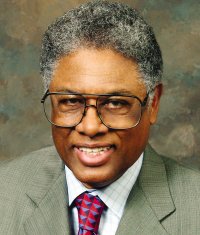
John Hawkins of Right Wing News interviews Tom Sowell

Thomas Sowell

Right Wing News has a great interview with my favorite economist, Tom Sowell.

Excerpt:

Paul Krugman is one of the best known and highest regarded economists on the Left. He says the problem we have right now is the government simply is not spending enough money and the fears we have about the debt causing all these major problems are extremely overblown. What do you say to that argument that is very prevalent on the Left?

Well, it’s a heads I win, tails you lose argument because if we spend twice as much for the next ten years and things don’t get any better – you can still say, “We didn’t spend enough.” We should have spent four times as much. And if we spend four times as much, you can say we should spend 10 times as much. It’s an impossible argument to refute.

It just so happens I’ve been reading a statement by Henry Morganfeld, the Secretary of Treasury under FDR, and he made the statement in 1939 — he said, “We have tried spending money. We are spending more than we have ever spent before and it does not work.” Now this is FDR’s closest confidant, the man who has been in charge of the spending — and after six years of it at this point, they have nothing to show for it and in point of fact, unemployment had gotten back up above 20 percent about a month before he made the statement.

Look at this – the man is branching out from fiscal conservatism into social conservatism. He’s not a Christian, so this is pretty awesome.

Excerpt:

Now, you talked a lot about cultural issues in the book. That’s something you’ve gotten more into in your columns lately. In the book you wrote about gay marriage and the comparison between gay marriage and interracial marriage. Why do you think that’s a bad comparison and what do you say to the argument that gay Americans have a right, perhaps even a constitutional right to get married?

Well, my Constitution must be out of date because I haven’t seen it there. It’s one of many things, such as the separation of church and state, that I’ve never seen there.

Marriage is not a right. Marriage is an imposition of a government’s interest in certain unions. Probably because those unions produce children, but for other reasons, too. Otherwise people could marry or not marry utterly independently of the government.

But what we’re talking about is not gay marriage. We’re talking about redefining marriage through the convenience of leaders who speak for the gays. And I don’t see any more reason for doing that than for allowing bigamists to redefine marriage to suit their convenience.

And you can read Tom Sowell’s latest column on FDR and the Great Depression here. He talks about how the policies of President Roosevely failed to lower unemployment and how they mirror the policies of Obama and the Democrats today.

Why Canada’s response to the recession saved more jobs

Here’s an amazing post from Ed Morrisey of Hot Air. (H/T Muddling)

Excerpt:

Barack Obama likes to tell people that we should thank him for his interventionist economic policies, and that without them, unemployment would be much worse in the US than it is now.  For instance, he told Racine that without his economic stimulus, we’d be at 12, 13, even 15% — even though Racine itself is at 14.2% unemployment.  D’oh! Otherwise, this looks like a classic Churchill conundrum.  Had the UK elected Winston Churchill as Prime Minister in 1936 and he fought Hitler early, forcing him from power, would Churchill have gotten credit for saving Western civilization?  Or would he have been seen as a war monger, without the context of tens of millions of dead people in World War II?

Actually, we can test the hypothesis in this case, at least to some extent.  The financial collapse also battered our northern neighbor, Canada, although not quite to the same extent it did us.  (Canada has more conservative banking and lending policies, which shielded them from the worst of the problems.)  Instead of using a blizzard of government spending to correct a downturn in unemployment, Canada tightened its belt and rode it out.

So how do the two compare?

Here’s Canada’s employment chart from their Statistics Canada web site – it shows how many thousands of people are employed.

Source: Statistics Canada

Where’s the recession? There is no recession in Canada.

And they say:

Employment rose by 93,000 in June, pushing the unemployment rate down 0.2 percentage points to 7.9%. This is the first time the rate has been below the 8% mark since January 2009.

Employment has been on an upward trend since July 2009, increasing by 403,000 (+2.4%). These gains offset nearly all the employment losses observed during the labour market downturn which began in the fall of 2008. The June unemployment rate, however, remained well above the October 2008 rate of 6.2%, due to a large increase in the number of people in the labour force over this period.

Yeah – they actually delivered the sub-8% unemployment rate that Obama promised and failed to deliver. And Ed hazards a guess as to why that may be.

He writes:

For those who have trouble recognizing it, that’s what a recovery looks like.  Canada’s job creation really has gone in the right direction, not simply plateaued at the nadir of the curve.  Maybe Canada’s private sector has been hiring because it doesn’t have to worry about the price signals of the massive government interventions created by the Obama administration that the US private sector has to deal with.

We talked before about how businesses fear “bold experimentation” in economic policy from an interventionist government. That’s the kind of thing that causes depressions, by the way.

Canada’s unemployment rate started off HIGHER than ours, and it is not LOWER than ours. How can that be? Their economy is dependent on us! Well, they didn’t act to “stimulate” the economy with massive government spending, and they’ve been signing free trade deals with everybody and their mother in order to diversify their trading so that we don’t take them down with us. And it’s working. Prime Minister Stephen Harper is an F.A. Hayek conservative, not a J.M. Keynes liberal. He doesn’t believe in deficit spending.

Ah, the benefits of electing an economist to run your country, instead of a demagogue community organizer who sues banks and wants to “spread the wealth”.

How economic uncertainty causes businesses to hire fewer workers

Story from center-leftist Fareed Zakaria in the radically leftist Washington Post. (H/T Marathon Pundit)

Excerpt:

But government spending can only be a bridge to private-sector investment. The key to a sustainable recovery and robust economic growth is to get companies investing in America. So why are they reluctant, despite having mounds of cash? I put this question to a series of business leaders, all of whom were expansive on the topic yet did not want to be quoted by name, for fear of offending people in Washington.

Economic uncertainty was the primary cause of their caution. “We’ve just been through a tsunami and that produces caution,” one told me. But in addition to economics, they kept talking about politics, about the uncertainty surrounding regulations and taxes. Some have even begun to speak out publicly. Jeffrey Immelt, chief executive of General Electric, complained Friday that government was not in sync with entrepreneurs. The Business Roundtable, which had supported the Obama administration, has begun to complain about the myriad laws and regulations being cooked up in Washington.

One CEO told me, “Almost every agency we deal with has announced some expansion of its authority, which naturally makes me concerned about what’s in store for us for the future.” Another pointed out that between the health-care bill, financial reform and possibly cap-and-trade, his company had lawyers working day and night to figure out the implications of all these new regulations. Lobbyists have been delighted by all this activity. “[Obama] exaggerates our power, but he increases demand for our services,” superlobbyist Tony Podesta told the New York Times.

Most of the business leaders I spoke to had voted for Barack Obama. They still admire him. Those who had met him thought he was unusually smart. But all think he is, at his core, anti-business. When I asked for specifics, they pointed to the fact that Obama has no business executives in his Cabinet, that he rarely consults with CEOs (except for photo ops), that he has almost no private-sector experience, that he’s made clear he thinks government and nonprofit work are superior to the private sector. It all added up to a profound sense of distrust.

I think this was one of the points that really stood out to me in Amity Shlaes’ book “The Forgotten Man”, a badly-written book on the Great Depression. She spoke at length about how the unpredictable interventionism of statists like Herbert Hoover and Franklin Delano Roosevelt caused businesses to get so flustered that they just stopped all entrepreneurial activity, including hiring, in order to wait the big-government socialists out. It ended up delaying the economic recovery.

And that’s what we see with Obama and his interventions into the free market today. Every dollar spend by the government costs jobs. Every regulation passed to control businesses costs jobs. Every line of anti-capitalist rhetoric costs jobs. Every Obama is doing to oppose businesses costs jobs. At some point, he’s going to realize that the election is over and he needs to stop scaring businesses in order to win the votes. Now is the time for tax cuts on businesses.