
Tag Archives: Freedom of Religion

Why are social conservatives unable to exert political pressure?

Hillary Clinton and her ally, the Human Rights Campaign

Right now, social liberals are having great success pushing through their agenda. Social conservatives seemed to be getting coerced and/or punished so effectively that many are wondering whether the tide can be turned at all.

Ben Shapiro, who writes at the Daily Wire, explains what’s been happening lately:

Leftists, the most tolerant people in America, are now demonstrating their tolerance by boycotting entire states that do not govern in accordance with leftist social policy. On Tuesday, New York Governor Andrew Cuomo announced that he would bar non-essential state-funded travel to Mississippi after the state passed a bill re-enshrining First Amendment protections for freedom of religion and association. Cuomo, who termed the law “sad, hateful,” isn’t the only big government leftist to utilize the power of taxpayer-funded nastiness: the mayor of San Francisco, Ed Lee, did the same.

Lee and Cuomo also announced travel bans to North Carolina, where the governor recently signed a bill that mandates that local governments may not allow people to use single-sex bathrooms based on subjective gender identity rather than biological sex; that bill also makes state anti-discrimination law supreme and exclusive over local anti-discrimination laws that would compel businesses to hire people regardless of sexual orientation or gender identity.

It’s not just government, either. Icons like the wildly overrated Bruce Springsteen are cancelling concerts in North Carolina; businesses like PayPal, which do business in countries like Saudi Arabia and Malaysia, which actually prosecute homosexuality. States like Virginia and Georgia have vetoed similar legislation out of fear of corporate and governmental blowback from companies ranging from Apple to Disney.

The left has ratcheted up their pressure on states to crack down on Americans who don’t want their daughters peeing next to grown men, to prosecute businessowners who don’t want to cater same-sex weddings. They’ve utilized their economic power to punish private actors who may or may not even agree with the left in an attempt to coax those actors into putting indirect pressure on their representatives.

Maggie Gallagher, a pro-marriage activists who has written some great books on marriage that I really liked, has some practical advice for social conservatives in National Review.

She has five points – here are four and five:

4) Social conservatives aren’t doing politics.

Before I explain what I mean, let me ask you to answer a simple question: What is the national organization that fights for religious-liberty protections by spending money in federal elections? Currently, there is none. There are many good nonprofits who issue voter guides or get pastors together. There are public-interest law firms galore. These are all good things to have — but there is a hole in the center of our movement.

How big is the hole? For my own amusement, I tried to figure out how much money social conservatives (excluding pro-life groups) spent in national elections in 2014 compared to what they spend on 501(c)3 and other nonprofit strategies. I looked for every organization I could find that has marriage or religious liberty in its mission statement and then compared it with election expenditures by either c(4)s or political-action committees (PACs). Then I asked around to major social-conservative donors I know to see if I had overlooked any major organization.

How big is the hole in the center of our movement?

In 2014 pro-family social conservatives invested $251,633,730 in tax-deductible 501(c)3 efforts (excluding pro-life efforts).

How much was spent on direct political engagement, counting both state and federal organizations? $2,484,359.

That 100-to-one ratio of doing politics by indirect versus direct means explains a lot about the relative powerlessness of social conservatism.

Social conservatives can’t get much out of politics because we aren’t in politics. We just talk like we are on television, when the Left allows us to get on television. Meanwhile, we don’t build political institutions that matter.

Social conservatives need to think like a minority and organize politically to protect our interests. Which leads me to Maggie’s fifth Big Truth of social-conservative politics:

5) The most important thing social conservatives could do in the 2016 cycle is to demonstrate to Democrats that extremism in pushing unisex showers on public schools or oppressing gay-marriage dissenters will cost them the White House.

In theory, this shouldn’t be hard to do: A July 2015 Associated Press–GFK poll showed that 59 percent of independents and 32 percent of Democrats agree that when gay rights and religious liberty conflict, religious liberty should have priority. Social conservatives should use the issue on offense — not just to gin up “the base,” but to persuade soft Democrats to abandon the party of anti-religious aggression. If intensive messaging to Democratic voters in a key swing state could move just 10 percent of them to switch their votes, the whole political dynamic of this issue would change.

But proving that would require raising a significant amount of money — say at least $2 million — and demonstrating in a key swing state, such as Ohio or Pennsylvania or Florida, that the Democrats’ anti-religion intolerance against gay-marriage dissenters could cost them something they care about: The White House. Power.

I see no signs yet that any such thing is happening among social conservatives.

But it could.

We should fill the hole in the center of the social-conservative movement by getting into politics for the first time in 50 years. It could happen.

I noticed that Maggie’s web site “The Pulse” is very pro-Cruz. They do not like John Kasich at all on social issues, and they were not fans of Marco Rubio’s tepid response to the gay marriage ruling.
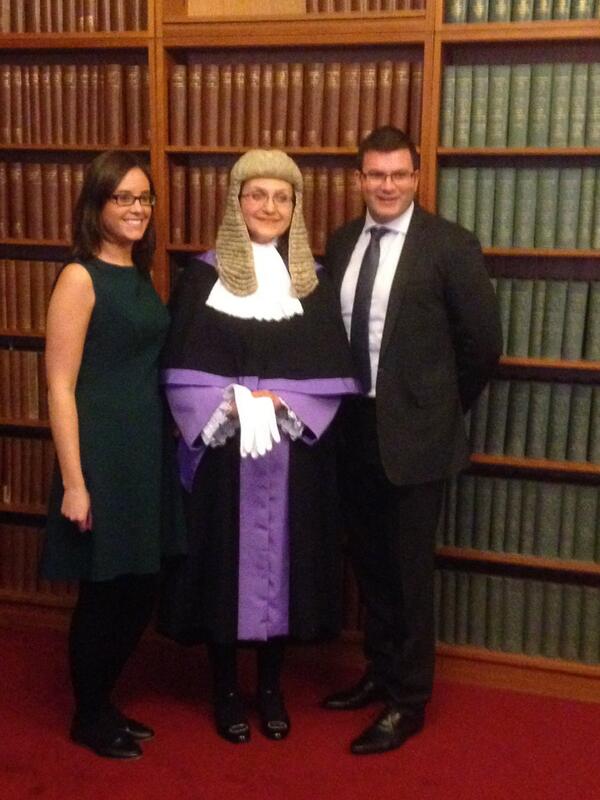
Christian NHS worker who gave a book to Muslim co-worker loses her appeal

Judge Jennifer Jane Eady, Queens Counsel

The UK Telegraph reports on the state of religious liberty in the United Kingdom.

Excerpt:

A Christian NHS worker suspended for giving a religious book to a Muslim colleague has lost her appeal against a ruling that the decision to discipline her was lawful.

Victoria Wasteney, 39, was found guilty by her NHS employer in 2014 of “harassing and bullying” a work friend for giving her a book about a Muslim woman’s encounter with Christianity, praying with her and asking her to church.

She was suspended for nine months and given a written warning, even though the woman had been happy to discuss faith with her and never gave evidence about her allegations to the NHS.

Ms Wasteney, a senior occupational therapist, challenged the decision by East London NHS Foundation Trust at an employment tribunal last year, but it ruled that her employer had not discriminated against her.

A judge gave her the chance to appeal against that decision, saying it should consider whether the original ruling had correctly applied the European Convention on Human Rights’ strong protection of freedom of religion and expression.

But at a hearing in central London on Thursday, Her Honour Judge Eady QC dismissed the appeal.

Following the decision, Miss Wasteney, from Epping, Essex, said: “What the court clearly failed to do was to say how, in today’s politically correct world, any Christian can even enter into a conversation with a fellow employee on the subject of religion and not, potentially, later end up in an employment tribunal.

“If someone sends you friendly text messages, how is one to know that they are offended? I had no idea that I was upsetting her.”

[…]The woman, who quit her job shortly after making the complaints, never gave any evidence about her allegations to the NHS or later to the employment tribunal.

It sounded to me like the Muslim woman encouraged the Christian woman and the Christian woman was later surprised by the complaints. I think most Christians can take no for an answer, but Christians are caring, and they see offering to pray and offering to bring someone to church as a caring thing to do. If they don’t hear a no, then they keep right on doing what comes naturally to Christians – talking about spiritual things and trying to lead others to the Lord.

It was much easier to do this in the past, before people got more concerned about not feeling offended than they were about discussing what is or is not true. So now, even in a country like England, you can be anything you want to be as long as you’re not behaving like a Christian in public. I think this is especially the case when the people who adjudicate these cases are more focused on feelings… the person who feels the most offended seems to win all the time.

Before I had an alias, I had experience dealing with co-workers who did not much like me talking about spiritual things at work. Some types of people are more risky than others, I’ve found. That’s when I started to make rules based on my experiences, about who was and who was not safe to talk to. And that’s when I decided that to really say what I wanted to say, I’d have to get an alias, and not tell too many co-workers about it.

So who is dangerous? Obviously, people who are committed to a sinful lifestyle already are dangerous to talk to. I don’t talk to people about anything interesting if they are committed to a sinful lifestyle, because they will feel obligated to discuss issues defensively, rather than in a truth-focused way. I also avoid people who are more focused on feelings, family and community above truth. They tend to be more focused on feeling good and getting along, and they are the worst people to disagree with. The safest people are people who like to argue about what is true, and who respond to evidence.

So how to detect who is safe? Well, If the person talks about themselves a lot, and about their feelings, and happy experiences, and their vacations, their families and popular culture fluff, then I would avoid them. Don’t say a word to them. The ones who are safer are the ones who accept disagreements and don’t just rush to agree with you while hiding their own opinions in order to be liked. You also want to avoid people who take everything personally, instead of debating the outside world with a focus on what is true.

I am terrified of people who try to agree with me on everything, or who cannot explain both sides of an issue respectfully. I watch what people watch on TV in the gym – if it’s sports, housewives of beverly hills, or other shallow life enhancement fluff, then I don’t talk to them. If it’s news or business, then it’s safer to talk to them – because then you can talk about facts. Beware of people who try to jump to agreement quickly, without showing any evidence or reasons for their view. It’s always better to talk about issues in the abstract, rather than offering to pray or asking someone to church. For example, you can discuss whether the universe had a beginning, or which books of the Bible were written early. Christians need to learn how to do that – how to talk about facts.

A good question to ask to test a person is to ask where they get their news. If there is no balance there, then it’s a good sign to avoid them. Two of my leftist co-workers this week asked me why I thought that the Washington Post and the New York Times were “radically leftist”. I asked them to name conservative columnists at either paper. They couldn’t name a single one. One tried to google it right in front of me! I named Arthur Brooks, Ross Douthat, Jennifer Rubin, etc. and explained why they weren’t conservative. Then I listed off a half-dozen liberal names at the Washington Post. If the person you are talking to is in a bubble, then they are too risky to talk to. Pretty much everyone on the secular left is that way, and you should check first by seeing what they read for news. If they’re not safe, then get yourself an alias and write something online, instead.

Marquette University threatens professor with termination for helping pro-marriage student

Gay activist vandalizes pro-marriage sign

I hope everyone remembers the case of Marquette University professor John McAdams. McAdams was punished severely by the “Catholic” university for blogging about a pro-gay-rights instructor (Cheryl Abatte) who told a pro-marriage student that if he disagreed with gay rights, then he must drop her class.

Here is the latest about the university’s final decision about what to do with professor McAdams from David French of National Review.

French writes:

There’s nothing like a good show trial to build confidence in the academy’s commitment to academic freedom. Marquette University is demanding that embattled professor John McAdams apologize for criticizing a colleague as a condition for keeping his job. And what outrage did McAdams commit? He tried to protect the academic freedom and free speech of conservative students:

On November 2014, McAdams, a tenured associate professor of political science, posted an entry on his Marquette Warrior blog describing a recorded conversation between an undergraduate student and the instructor for his “Theory of Ethics” philosophy course. The instructor, Cheryl Abbate, was recorded telling the student that the expression of certain opinions in class was inappropriate because those opinions may be considered offensive to other listeners. Abbate specifically cited the student’s stated opposition to same-sex marriage as a problem.

Abbate’s actions were criticized by readers of McAdams’ blog entry, and her alleged actions received widespread attention from national media. In response, Richard C. Holz, dean of Marquette’s Klingler College of Arts and Sciences, suspended McAdams.

You read that correctly. Rather than discipline the instructor who silenced a conservative student, the university suspended the whistleblower. Now it’s reportedly extending the suspension through the fall 2016 semester and demanding that he apologize as a condition of returning to work. My former colleagues at the Foundation for Individual Rights in Education (FIRE) are right to label the forced apology “an age-old inquisitorial tactic used to violate freedom of conscience through compelled speech.”

So, you might think that a “Catholic” University would punish the anti-marriage instructor, instead of the professor who defended the pro-marriage student, but you’d be wrong. I sure hope that none of you ever give money to Christian organizations that are not solid on issues like abortion and marriage. Because there are tons of “Christian” organizations who are aligned with the secular left on many cultural issues. It’s probably a good idea to cut off this institutions from taxpayer funding until they stop discriminating against Christians and conservatives.

David French also reports on McAdams’ response to the fascist college administators:

McAdams — to his immense credit — is not backing down.

Here’s his response:

The addition of a demand that we abase ourself and issue an apology and sign a loyalty oath to vaguely defined “guiding values” and to the University’s “mission” is obviously a ploy by Marquette to give the administration an excuse to fire us. They have calculated, correctly, that we will do no such thing.

I would say that it’s astonishing that a Catholic university punish a professor for defending the right of students to advocate the church’s teaching on marriage, but politically correct nonsense is par for the course even (especially) at many religious colleges. McAdams should be applauded — and supported — for his lonely, courageous stand.

David French also wrote an article in National Review on Friday about how universities weed out conservatives who apply to be teachers and administrators. It turns out that they are not interested in diversity at all.

French writes:

According to data compiled by the Higher Education Research Institute, only 12% of university faculty identify as politically right of center, and these are mainly professors in schools of engineering and other professional schools. Only 5% of professors in the humanities and social-science departments so identify.

A comprehensive study by James Lindgren of Northwestern University Law School shows that in a country fairly evenly divided between Democrats and Republicans, only 13% of law professors identify as Republican. And a recent study by Jonathan Haidt of New York University showed that 96% of social psychologists identify as left of center, 3.7% as centrist/moderate and only 0.03% as right of center.

He’s not kidding. Consider this article from the Cornell University campus newspaper.

It says:

Of the nearly $600,000 Cornell’s faculty donated to political candidates or parties in the past four years, over 96 percent has gone to fund Democratic campaigns, while only 15 of the 323 donors gave to conservative causes.

The Sun’s analysis of Federal Election Committee data reveals that from 2011 to 2014, Cornell’s faculty donated $573,659 to Democrats, $16,360 to Republicans and $2,950 to Independents. Each of Cornell’s 13 schools — both graduate and undergraduate — slanted heavily to the left. In the College of Arts and Sciences, 99 percent of the $183,644 donated went to liberal campaigns.

So how do we fix it? Well, I already mentioned that Christians should not give any money to universities, unless they are named Hillsdale College, Biola University, Grove City College, Patrick Henry College, etc. And I mentioned that Christians should not be voting for bigger government. We don’t want universities to get taxpayer money that has no strings attached. They should have to please customers instead of getting taxpayer money with no accountability.

In his second article, French lists some ideas for getting universities to not discriminate against Christians and conservatives. And maybe he we elect real conservatives, instead of Democrats pretending to be conservatives, then something will be done about it.