Tag Archives: Free Will

Angus Menuge’s ontological argument against naturalism

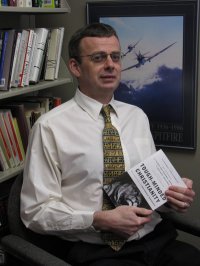
Dr. Angus Menuge
Dr. Angus Menuge

Here’s some information about Dr. Menuge:

Dr. Angus Menuge joined Concordia University Wisconsin in 1991. He earned his BA from the University of Warwick, England, and his MA and Ph.D. degrees from the University of Wisconsin-Madison, where he studied philosophy, computer science and psychology. Menuge’s dissertation was on the philosophy of action explanation, and his current research interests include philosophy of mind, philosophy of science and Christian apologetics.

In 2003, Menuge earned a Diploma in Christian Apologetics from the International Academy of Apologetics, Evangelism and Human Rights, which meets each July in Strasbourg, France. His thesis, a critique of scientific materialism, went on to become the book Agents Under Fire: Materialism and the Rationality of Science (Lanham, MD: Rowman and Littlefield, 2004).

Menuge has also edited volumes on C. S. Lewis, Christ and culture and the vocation of scientist, and has written several Bible studies. He is currently working with Joel Heck (Concordia Texas) on a collection of essays defining Lutheran education for the 21st century, entitled Learning at the Foot of the Cross (Concordia University Press, forthcoming).

A frequent speaker, Menuge has given presentations on Christianity and culture, science and vocation, philosophy of mind, C. S. Lewis, Intelligent Design and the case against scientific materialism. He is a member of the Evangelical Philosophical Society.

Dr. Menuge presented a paper at the real Evangelical Philosophical Society conference for students and professors of philosophy, and you can download the paper here in Word format. (here’s a PDF version I made)

Here is the introduction to the paper that Dr. Menuge read at the EPS conference:

The argument from reason is really a family of arguments to show that reasoning is incompatible with naturalism. Here, naturalism is understood as the idea that foundationally, there are only physical objects, properties and relations, and anything else reduces to, supervenes on, or emerges from that. For our purposes, one of the most important claims of naturalism is that all causation is passive, automatic, event causation (an earthquake automatically causes a tidal wave; the tidal wave responds passively): there are no agent causes, where something does not happen automatically but only because the agent exerts his active power by choosing to do it. The most famous version of the argument from reason is epistemological: if naturalism were true, we could not be justified in believing it. Today, I want to focus on the ontological argument from reason, which asserts that there cannot be reasoning in a naturalistic world, because reasoning requires libertarian free will, and this in turn requires a unified, enduring self with active power.

The two most promising ways out of this argument are: (1) Compatibilism—even in a deterministic, naturalistic world, humans are capable of free acts of reason if their minds are responsive to rational causes; (2) Libertarian Naturalism—a self with libertarian free will emerges from the brain. I argue that neither of these moves works, and so, unless someone has a better idea, the ontological argument from reason stands.

The paper is 11 pages long, and it is awesome for those of you looking for some good discussion of one of the issues in the area of philosophy of mind. The thing you need to know about Dr. Menuge is that he is quite strong and forceful in his writing and presentation, and to me, that is an excellent thing for a scholar to be. He reminds me of Doug Geivett, Paul Copan and William Lane Craig. Very direct, and very confrontational. You can even read an account of his debate with that radical atheist nutcase P.Z. Myers in 2008 here.

By the way, the epistemological argument from reason (P(R) on N & E is low) is the argument made by the famous Christian philosopher Alvin Plantinga. I blogged about that argument before here. You need to know BOTH of these arguments. Plantinga also spoke at the EPS apologetics conference, explaining exactly this argument.

Powerpoint slideshow

But there is more than just the paper! At the EPS apologetics conference, which is meant for lay people as well as scholars, he presented this Powerpoint slideshow, (here’s a PDF version I made) . The slides are easier to understand than the paper, but the paper is not too bad.

And here is another article by Dr. Menuge on intelligent design.

Triablogue: a funeral for atheism

The Poached Egg linked to this striking post on Triablogue. (H/T Please Convince Me)

Excerpt:

If there is no objective morality, then why are they arguing for anything? It’s not as if you’re supposed to be an atheist. Absent objective moral norms, there’s nothing you’re supposed believe or disbelieve.

Likewise, atheists not only admit, but insist on the fact that evolution is blind. It has no prevision or purpose. Brains weren’t made to think. Yet they still act as if their brains were made to think.

Likewise, they admit that what we value has no intrinsic value. Evolution has programmed us to project value on certain things. But that’s an illusion.

We value love. We value our parents, kids, spouse, and friends. Yet there’s nothing objectively right or good about loving friends and family. That’s just brain chemistry. The indifferent effect of a thoughtless process conditioning us to feel that way.

Pull its string and the doll cries. It doesn’t cry because there’s something worth crying about.

Atheists cry when a loved one dies. Yet they can retrace the process. They can see the pull-string. They can see evolution tugging their string. They don’t cry because the death of their loved one actually means anything. They cry because blind evolution pulled their string. A doll’s prerecorded cry at the demise of another doll.

They can see evolution take the doll apart. They can see evolution operating on themselves. They dissect themselves. Peel back the layers. Cloth. Metal. Plastic. A pile of parts. The more you look the less you find.

Atheists act as though these are throwaway concessions that don’t cost them anything in the long run. That having admitted that atheism has these consequences, it’s time to resume the argument. Get back to the issue at hand. Having another beer.

But there’s nothing more to say. At that point the atheist is sitting on a pile of spent rounds.

It’s like a doctor telling a man he has stage 4 pancreatic cancer. He has 2 weeks to live. Having got that out of the way, let’s get back to what he plans to do with the rest of his life.

But there is no “rest of his life” to plan for. At most, he can make funeral arrangements. Pick a coffin. Pick a tombstone. Prepay the florist. Buy a cemetery plot. Choose an epitaph.

Atheism ran out of road miles ago. There’s nowhere left to go. That’s the end of the line.

The argument that Hays makes seems to be that if there is no objective morality, then discovering the truth and persuading others of the truth and living according to the truth are no longer morally right.  Therefore, we have no moral obligation to do any of these things, on atheism.

The author, Steve Hays, engages with atheists who object to this argument in the comments to the post.

Sean McDowell reviews Sam Harris’ new book “Free Will”

Jay Watts of LTI tweeted this book review by Sean McDowell.

Excerpt:

After rightly emphasizing the importance of the question of free will, Harris concludes, “Free will is an illusion” (p. 5). According to Harris, we are not the conscious source of our actions and we could not have behaved differently in the past than we did. He says, “I, as the conscious witness of my experience, no more initiate events in my prefrontal cortex than I cause my heart to beat” (9). “In physical terms,” says Harris, “we know that every human action can be reduced to a series of impersonal events” (27).

Harris rightly points out that there are three main approaches to the problem of free will and determinism: determinism, libertarianism, and compatibilism. He then says, “Today, the only philosophically respectable way to endorse free will is to be a compatibilist” (16). But if determinism were true, as Harris asserts, why would any position be philosophically unrespectable? After all, people are determined to hold their beliefs—whether compatibilist, libertarian, or determinist—by forces outside of their control. Why would he bother to critique other positions if the people who hold them couldn’t have believed differently? In fact, his critique is just the result of chemicals moving in his brain, so why do they matter? What makes his chemicals more respectable than others?

Later in the book Harris says that giving up free will (and becoming more aware of the background causes of our feelings) allows people to have greater creative control over their lives. “Getting behind our conscious thoughts and feelings,” says Harris, “can allow us to steer a more intelligent course through our lives” (p. 47). Do you see the contradiction? The idea of “steering” a more intelligent course through life, of course, has no meaning in a deterministic world. On Harris’ view we can’t steer anything! The belief that we can steer our lives is an illusion. All of our beliefs and behavior are entirely the result of forces outside our control. In one breath Harris says all our beliefs are determined, but then in another breath he speaks about steering the course of our lives. Which is it?

[…]He says that dispensing with the idea of free will allows us to focus on things that matter most—assessing risk, protecting the innocent, and deterring crime (p. 53). He seems to be implying that we ought to accept his deterministic views for the betterment of mankind. Yet again, if determinism is true then we can’t change any of our beliefs—we can’t freely follow his logic since our beliefs are already set. The very fact that he argues for his position undermines his stated belief in determinism.

Sean McDowell did a debate a while back in which he argued that morality was not rationally grounded on atheism because atheism denies free will, and free will is necessary for making moral choices. And here is the atheist Lawrence Krauss denying that free will exists. It’s very hard to see how there could be any freedom of the will if humans are just matter in motion, which is the view of humans that fits most naturally with atheism.

Another atheist William Provine also says atheists have no free will, no moral accountability and no moral significance:

Let me summarize my views on what modern evolutionary biology tells us loud and clear — and these are basically Darwin’s views. There are no gods, no purposes, and no goal-directed forces of any kind. There is no life after death. When I die, I am absolutely certain that I am going to be dead. That’s the end of me. There is no ultimate foundation for ethics, no ultimate meaning in life, and no free will for humans, either.

Like Provine, Krauss also denied that objective morality existed at all in his debate with William Lane Craig. His view is that morality evolves in different times and places arbitrarily, and that whatever evolves in any group is right for them in their time and place. It’s important to understand what the implications of atheism are for things like rationality and morality.

I always thought that the “freethought” name that atheists sometimes apply to themselves was ironic for that reason. Not only are they not free, but they have no non-physical minds to think with, either.