Here is a splendid post about the economics of health care from Ben Shapiro, writing for National Review.
He responds to a view held by those on the radical left: people need health care, therefore health care is a right.
Excerpt:
The idea here seems to be that unless you declare medical care a right rather than a commodity, you are soulless — that as Marx might put it, necessity, rather than autonomy, creates rights.
This is foolhardy, both morally and practically.
Morally, you have no right to demand medical care of me. I may recognize your necessity and offer charity; my friends and I may choose to band together and fund your medical care. But your necessity does not change the basic math: Medical care is a service and a good provided by a third party. No matter how much I need bread, I do not have a right to steal your wallet or hold up the local bakery to obtain it. Theft may end up being my least immoral choice under the circumstances, but that does not make it a moral choice, or suggest that I have not violated your rights in pursuing my own needs.
But the left believes that declaring necessities rights somehow overcomes the individual rights of others. If you are sick, you now have the right to demand that my wife, who is a doctor, care for you. Is there any limit to this right? Do you have the right to demand that the medical system provide life-saving care forever, to the tune of millions of dollars of other people’s taxpayer dollars or services? How, exactly, can there be such a right without the government’s rationing care, using compulsion to force individuals to provide it, and confiscating mass sums of wealth to pay for it?
The answer: There can’t be. Rights that derive from individual need inevitably violate individual autonomy.
But there are ways to make a commodity less expensive, and of higher quality. It happens all the times in free markets, where innovators are rewarded with profits – just think of the people who sell smartphones.
More:
To make a commodity cheaper and better, two elements are necessary: profit incentive and freedom of labor. The government destroys both of these elements in the health-care industry. It decides medical reimbursement rates for millions of Americans, particularly poor Americans; this, in turn, creates an incentive for doctors not to take government-sponsored health insurance. It regulates how doctors deal with patients, the sorts of training doctors must undergo, and the sorts of insurance they must maintain; all of this convinces fewer Americans to become doctors. Undersupply of doctors generally and of doctors who will accept insurance specifically, along with overdemand stimulated by government-driven health-insurance coverage, leads to mass shortages. The result is an overreliance on emergency care, costs for which are distributed among government, hospitals, and insurance payers.
So, what’s the solution for poor people? Not to declare medical care a “right,” and certainly not to dismiss reliance on the market as perverse cruelty. Markets are the solution in medical care, just as they are in virtually every other area.
Treating medical care as a commodity means temporary shortages, and it means that some people will not get everything we would wish them to have. But that’s also true of government-sponsored medical care, as the most honest advocates will admit. And whereas government-sponsored medical care requires a top-down approach that violates individual liberties, generates overdemand, and quashes supply, markets prize individual liberties, reduce demand (you generally demand less of what you must pay for), and heighten supply through profit incentive.
It’s always a good idea to look at how health care is working in countries that do have single payer health care systems. Canada has a single-payer system. How is that working out?
Waiting for treatment has become a defining characteristic of Canadian health care. In order to document the lengthy queues for visits to specialists and for diagnostic and surgical procedures in the country, the Fraser Institute has—for over two decades—surveyed specialist physicians across 12 specialties and 10 provinces.
This edition of Waiting Your Turn indicates that, overall, waiting times for medically necessary treatment have in-creased since last year. Specialist physicians surveyed report a median waiting time of 20.0 weeks between referral from a general practitioner and receipt of treatment—longer than the wait of 18.3 weeks reported in 2015. This year’s wait time—the longest ever recorded in this survey’s history—is 115% longer than in 1993, when it was just 9.3 weeks.
[…]It is estimated that, across the 10 provinces, the total number of procedures for which people are waiting in 2016 is 973,505. This means that, assuming that each person waits for only one procedure, 2.7% of Canadians are waiting for treatment in 2016.
[…]Patients also experience significant waiting times for various diagnostic technologies across the provinces. This year, Canadians could expect to wait 3.7 weeks for a computed tomography (CT) scan, 11.1 weeks for a magnetic resonance imaging (MRI) scan, and 4.0 weeks for an ultrasound.
Research has repeatedly indicated that wait times for medically necessary treatment are not benign inconveniences. Wait times can, and do, have serious consequences such as increased pain, suffering, and mental anguish. In certain instances, they can also result in poorer medical outcomes—transforming potentially reversible illnesses or injuries into chronic, irreversible conditions, or even permanent disabilities. In many instances, patients may also have to forgo their wages while they wait for treatment, resulting in an economic cost to the individuals themselves and the economy in general.
The typical cost of the single-payer health care system to a Canadian family is nearly $12,000.
Socialist Canada has been doing a lot of taxing and spending to try to fix this problem, but the problem is getting worse. And no wonder: when the government controls health care, it becomes a tool for buying votes. Abortions and sex changes are “health care” in Canada. Breast enlargements and IVF are “health care” in the UK. Of course, good luck getting treatment when you are in your old age and will not be voting much in the future : both Canada and the UK have euthanasia programs to get rid of elderly people who are no longer as useful to politicians as young people who still have lots of voting ahead of them.
Economist Thomas Sowell changed the minds of a generation of young people, including me
I had written enough posts to carry me through the Christmas and New Year’s vacation. But then something happened that caused me to come off vacation and postpone today’s scheduled post in order to write about the retirement of a man who influenced my worldview as much as anyone has. And I am not exaggerating when I say that this man contributed the most of anyone to the economic views of libertarians and conservatives. (Although his views on social and foreign policy issues were largely conservative, as well). I never disagreed with his views, or maybe it’s just that he always convinced me to change to agree with him. He’s that kind of man – if you liked having a friend who knew how to think through just about anything, then this was the guy for you.
But now he has announced his retirement. Here is his farewell column. (H/T Mary)
Excerpt:
After enjoying a quarter of a century of writing this column for Creators Syndicate, I have decided to stop. Age 86 is well past the usual retirement age, so the question is not why I am quitting, but why I kept at it so long.
[…]Looking back over the years, as old-timers are apt to do, I see huge changes, both for the better and for the worse.
In material things, there has been almost unbelievable progress. Most Americans did not have refrigerators back in 1930, when I was born. Television was little more than an experiment, and such things as air-conditioning or air travel were only for the very rich.
My own family did not have electricity or hot running water, in my early childhood, which was not unusual for blacks in the South in those days.
It is hard to convey to today’s generation the fear that the paralyzing disease of polio inspired, until vaccines put an abrupt end to its long reign of terror in the 1950s.
[…]Most people living in officially defined poverty in the 21st century have things like cable television, microwave ovens and air-conditioning. Most Americans did not have such things, as late as the 1980s. People whom the intelligentsia continue to call the “have-nots” today have things that the “haves” did not have, just a generation ago.
[…]With all the advances of blacks over the years, nothing so brought home to me the social degeneration in black ghettoes like a visit to a Harlem high school some years ago.
When I looked out the window at the park across the street, I mentioned that, as a child, I used to walk my dog in that park. Looks of horror came over the students’ faces, at the thought of a kid going into the hell hole which that park had become in their time.
When I have mentioned sleeping out on a fire escape in Harlem during hot summer nights, before most people could afford air-conditioning, young people have looked at me like I was a man from Mars. But blacks and whites alike had been sleeping out on fire escapes in New York since the 19th century. They did not have to contend with gunshots flying around during the night.
We cannot return to the past, even if we wanted to, but let us hope that we can learn something from the past to make for a better present and future.
It’s a tragedy that Thomas Sowell is not more recognized in our culture. Thomas Sowell makes public appearances, but mostly to conservatives. Although I am not a Rush Limbaugh listener, I once heard Thomas Sowell sitting in for Rush, and he had another conservative black economist Walter Williams on with him. Rank-and-file conservatives bought Sowell’s books by the bushel and we went through them one after another. The first girl I ever dated went though 6 Thomas Sowell books in 2 months, then enrolled in university to study economics. That’s the kind of effect that Thomas Sowell had on people – you couldn’t read just one of his books. You read as many as you get from the public library, then you read all could afford to buy. Then you asked for them on birthdays and Christmases from your dumbfounded liberal relatives. It was fresh air – you read Thomas Sowell to get the lies and dishonesty of the progressive culture out of your mind.
But most people on the left have never heard of Thomas Sowell. Despite Sowell’s splendid scholarly credentials and academic publications, the leftist gatekeepers don’t want their liberal followers to know that the real intellect behind economic conservative is a black economist. Instead of fighting against Sowell’s ideas, their response has been to ignore him.
Let’s take a quick look at some of the institutions who are recognizing the great man’s retirement.
In my opinion, there is no economist alive today who has done more to eloquently, articulately, and persuasively advance the principles of economic freedom, limited government, individual liberty, and a free society than Thomas Sowell. In terms of both his quantity of work (at least 40 books and several thousand newspaper columns) and the consistently excellent and crystal-clear quality of his writing, I don’t think any living free-market economist even comes close to matching Sowell’s prolific record of writing about economics. And I don’t think there is any writer today, economist or non-economist, who can match Thomas Sowell’s “idea density” and his ability to consistently pack so much profound economic wisdom into a single sentence and a single paragraph.
Even at 86 years old, Thomas Sowell has remained intellectually active with his syndicated newspaper columns and the publication last year of his 40th book — Wealth, Poverty and Politics: An International Perspective — which was, amazingly, his 13th book in the last decade! To honor Thomas Sowell’s well-deserved retirement from writing his invaluable weekly column for the last quarter century, I present below some of my favorite quotations from Dr. Thomas Sowell (most were featured on a CD post in June on Sowell’s birthday) and a bonus video of the great economist:
I had to choose just a few of these, so here goes:
6. Politicians as Santa Claus. The big question that seldom— if ever— gets asked in the mainstream media is whether these are a net increase in jobs. Since the only resources that the government has are the resources it takes from the private sector, using those resources to create jobs means reducing the resources available to create jobs in the private sector.
So long as most people do not look beyond superficial appearances, politicians can get away with playing Santa Claus on all sorts of issues, while leaving havoc in their wake— such as growing unemployment, despite all the jobs being “created.”
If you show or read the quote below to anyone who is a serious conservative, they will immediately tell you that the author is Thomas Sowell, or someone summarizing Sowell’s work:
10. The Anointed Ones. In their haste to be wiser and nobler than others, the anointed have misconceived two basic issues. They seem to assume: 1) that they have more knowledge than the average member of the benighted, and 2) that this is the relevant comparison. The real comparison, however, is not between the knowledge possessed by the average member of the educated elite versus the average member of the general public, but rather the total direct knowledge brought to bear through social processes (the competition of the marketplace, social sorting, etc.), involving millions of people, versus the secondhand knowledge of generalities possessed by a smaller elite group.
The vision of the anointed is one in which ills as poverty, irresponsible sex, and crime derive primarily from ‘society,’ rather than from individual choices and behavior. To believe in personal responsibility would be to destroy the whole special role of the anointed, whose vision casts them in the role of rescuers of people treated unfairly by ‘society.’
Celebrating entrepreneurs:
12. Helping the Poor. It was Thomas Edison who brought us electricity, not the Sierra Club. It was the Wright brothers who got us off the ground, not the Federal Aviation Administration. It was Henry Ford who ended the isolation of millions of Americans by making the automobile affordable, not Ralph Nader.
Those who have helped the poor the most have not been those who have gone around loudly expressing “compassion” for the poor, but those who found ways to make industry more productive and distribution more efficient, so that the poor of today can afford things that the affluent of yesterday could only dream about.
Distinctions like this is what gave so many ordinary people the desire to read more and more of Thomas Sowell to clean popular culture socialist pablum out of their minds:
13. Income Mobility. Only by focusing on the income brackets, instead of the actual people moving between those brackets, have the intelligentsia been able to verbally create a “problem” for which a “solution” is necessary. They have created a powerful vision of “classes” with “disparities” and “inequities” in income, caused by “barriers” created by “society.” But the routine rise of millions of people out of the lowest quintile over time makes a mockery of the “barriers” assumed by many, if not most, of the intelligentsia.
Everything becomes clear – as spiderwebs – with a little Thomas Sowell. And for evidence, he used the best studies from all over the world, from across all different times and places, so that you always had the evidence at your fingertips. His books are filled with footnotes for further study.
The Weekly Standard
The Weekly Standard has an article entitled “Thomas Sowell, America’s Greatest Public Intellectual, Says ‘Farewell'” by Fred Barnes.
Excerpt:
Thomas Sowell is giving up his column. I can think of lots of columnists whose writing we wouldn’t miss. Sowell isn’t one of them. Every column he wrote in a quarter-century career as a columnist was eminently worth reading. I say this having read nearly every one of them.
What made his columns so good? He wrote with sparkling clarity. He relied on facts. He didn’t showcase his scholarship, but his range of subjects was impressive. He understood his readers and didn’t write down to them. He was prolific. He wrote two columns a week and, when he had more to say, sometimes three or four. Best of all, he analyzed things from conservative—and somewhat libertarian—perspective better than anyone else and in fewer words.
If you wanted more words, you could always look to his books, and that’s what my friends and I did.
National Review
National Review has an article entitled “Thank You, Professor Sowell” by Michelle Malkin. They also re-posted an article from 2011, entitled “A Lion in High Summer”.
One quote from Michelle Malkin:
I first read Thomas Sowell in college — no thanks to my college.
At the majority of America’s institutions of “higher learning,” reading Thomas Sowell was a subversive act in the early 1990s when I was a student. It remains so today. Why? Because the prolific libertarian economist’s vast body of work is a clarion rejection of all that the liberal intelligentsia hold dear.
[…]The former leftist playwright David Mamet, in his 2008 manifesto “Why I Am No Longer a Brain-Dead Liberal,” cited his exposure to Sowell, whom he dubbed “our greatest contemporary philosopher,” as a critical factor in his conversion. Whether tackling the “bait and switch media,” the “organized noisemakers,” or the lawless enablers of “social disintegration,” Thomas Sowell’s dozens of academic books and thousands of newspaper columns have sparked generations of his readers across the political spectrum to think independently and challenge imposed visions.
Asked once how he would like to be remembered, Sowell responded: “Oh, heavens, I’m not sure I want to be particularly remembered. I would like the ideas that I’ve put out there to be remembered.” Mission accomplished. Though it has been decades since he taught in a formal classroom, his students are legion.
This is where today’s conservatives came from – we read the Thomas Sowell. Many conservatives (e.g. – Michelle and myself) came from non-white families and cultures, just like Sowell. We were convinced to give up on the socialism popular in our families and cultures by his writing. He convinced himself, then he convinced us. In contrast, there isn’t much convincing on the secular left – most people just accept secular leftism in order to be liked – it’s not cognitive, it’s just virtue signaling. Conservatives are convinced by Thomas Sowell’s writing, whereas liberals blindly follow Hollywood celebrities. It’s just tribalism.
Ben Shapiro
Jewish conservative Ben Shapiro wrote an article in The Daily Wire entitled “Farewell to Thomas Sowell, Dean of Conservative Columnists”.
One excerpt:
In what we can only hope is the final heartbreak of 2016, Senior Fellow at the Hoover Institution Thomas Sowell announced his retirement from his syndicated column. Sowell isn’t just one of the great thinkers of our time. He’s a genuine voice of decency and truth in a time when screaming and hysterics gain headlines. His voice will be missed every week.
[…]For years, I’ve named Sowell as the man I’d most love to see as president. That doesn’t end just because his column has.
At the end, he lists his favorite Thomas Sowell books.
That’s to show you how real conservatives like Ben Shapiro who are having a real influence (his podcast is the #1 conservative podcast, it has exploded in popularity) were influenced by Thomas Sowell. Shapiro always says that people new to conservatism should always start with a study of basic economics, e.g. – books by Thomas Sowell. No one in my own family started out conservative. I read Thomas Sowell, then they read Thomas Sowell. That’s how we became conservatives.
Wintery Knight
I’m busy cleaning stuff out of my parents basement this holiday season. This trip, I am taking some of my books back with me. I made the choices about what to take before I saw Sowell’s retirement. Without any sentiment at all, I chose:
Basic Economics, 4th edition
Applied Economics, 2nd edition
Economics Facts and Fallacies, 2nd edition
Intellectuals and Society, 2nd edition
The Housing Boom and Bust, 2nd edition
Inside American Education
A Personal Odyssey
A Conflict of Visions
The Vision of the Anointed (best book for beginners)
Barbarians Inside the Gates
Black Rednecks and White Liberals
I am leaving my second edition of Basic Economics for my Dad. I understand that a new 5th edition is now out, and I might get that. I have many, many more on audio books – I buy all the audio books editions that I can get, and listen to them over and over. This is where my worldview on economic issues (not to mention marriage, gun rights, education, war, etc.) came from.
Migration from California to other states – top 3 states are conservative states
A lot of young people seem to be really excited about socialism, and they want the United States to give it a try. They don’t know where socialism has been tried, and they don’t know what happens with it is tried. It just sounds nice to them.
Well, if you were going to pick one of the most socialist states in the United States, no one would fault you for picking California, where Democrats are running everything, and have been for a long time.
The number of Californians leaving the state and moving to Texas is at its highest level in nearly a decade, according to data from the Internal Revenue Service.
According to IRS migration data, which uses individual income tax returns to record year-to-year address changes, over 250,000 California residents moved out of the state between 2013 and 2014, the latest period for which data was available. The tax returns reported more than $21 billion in adjusted gross income to the IRS.
Of the returns, 33,626 reported address changes from California to Texas, which has been the top destination for individuals leaving California since 2007. Californians who moved to Texas between 2013 and 2014 reported $2.19 billion in adjusted gross income.
[…]“California’s taxes and regulations are crushing businesses, and there are more opportunities in Texas for people to start new companies, get good jobs, and create better lives for their families,” said Nathan Nascimento, the director of state initiatives at Freedom Partners. “When tax and regulatory climates are bad, people will move to better economic environments—this phenomenon isn’t a mystery, it’s how marketplaces work. Not only should other state governments take note of this, but so should the federal government.”
According to Tom Gray of the Manhattan Institute, people may be leaving California for the employment opportunities, tax breaks, or less crowded living arrangements that other states offer.
“States with low unemployment rates, such as Texas, are drawing people from California, whose rate is above the national average,” Gray wrote. “Taxation also appears to be a factor, especially as it contributes to the business climate and, in turn, jobs.”
“Most of the destination states favored by Californians have lower taxes,” Gray wrote. “States that have gained the most at California’s expense are rated as having better business climates. The data suggest that may cost drivers—taxes, regulations, the high price of housing and commercial real estate, costly electricity, union power, and high labor costs—are prompting businesses to locate outside California, thus helping to drive the exodus.”
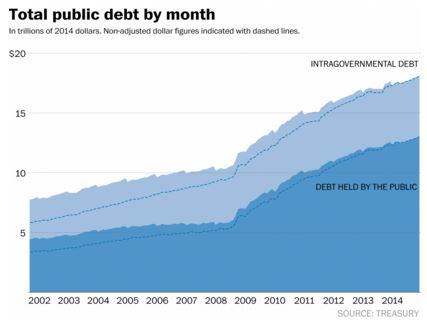
Just recently, I heard some of my Democrat co-workers laughing to each other about “trickle-down economics”, which is the “ridiculous” idea that if you allow businesses and workers to keep what they earn, then you’ll get more economic growth than if the government takes the money to study the drug use patterns of sex workers in the far East. Actually, we’ve been trying socialism-lite in this country for the past 7 years. How has it worked? Well, Obama has averaged 1.2% GDP growth through his presidency, far below average. And in order to get even that little growth, Obama will double the debt from 10 to 20 trillion in just 8 years.
Debt increase under Barack Obama
But what about tax cuts? Do tax cuts create economic growth?
The conservative Heritage Foundation think tank describes the effects of the Bush tax cuts.
Excerpt:
President Bush signed the first wave of tax cuts in 2001, cutting rates and providing tax relief for families by, for example, doubling of the child tax credit to $1,000.
At Congress’ insistence, the tax relief was initially phased in over many years, so the economy continued to lose jobs. In 2003, realizing its error, Congress made the earlier tax relief effective immediately. Congress also lowered tax rates on capital gains and dividends to encourage business investment, which had been lagging.
It was the then that the economy turned around. Within months of enactment, job growth shot up, eventually creating 8.1 million jobs through 2007. Tax revenues also increased after the Bush tax cuts, due to economic growth.
[…]The CBO incorrectly calculated that the post-March 2003 tax cuts would lower 2006 revenues by $75 billion. Revenues for 2006 came in $47 billion above the pre-tax cut baseline.
Here’s what else happened after the 2003 tax cuts lowered the rates on income, capital gains and dividend taxes:
GDP grew at an annual rate of just 1.7% in the six quarters before the 2003 tax cuts. In the six quarters following the tax cuts, the growth rate was 4.1%.
The S&P 500 dropped 18% in the six quarters before the 2003 tax cuts but increased by 32% over the next six quarters.
The economy lost 267,000 jobs in the six quarters before the 2003 tax cuts. In the next six quarters, it added 307,000 jobs, followed by 5 million jobs in the next seven quarters.
The timing of the lower tax rates coincides almost exactly with the stark acceleration in the economy. Nor was this experience unique. The famous Clinton economic boom began when Congress passed legislation cutting spending and cutting the capital gains tax rate.
Regarding the “Clinton economic boom”, that was caused by supply-sider Newt Gingrich passing tax cuts through the House and Senate. Bill Clinton merely signed the bills into law.
Very important to compare times and places where socialism has been tried to times and places where free enterprise and limited government have been tried. We know what works. It may not be what makes us feel smug, but we know what works.




 WINTERY KNIGHT