
Tag Archives: Fraud

What produces more fraud? The free market or government-run programs?

From National Review, an article examining how government programs like Medicare and Medicaid are ripe for fraud and waste.

Excerpt:

The three most salient characteristics of Medicare and Medicaid fraud are: It’s brazen, it’s ubiquitous, and it’s other people’s money, so nobody cares.

Consider some of the fraud schemes discovered in recent years. In Brooklyn, a dentist billed taxpayers for nearly 1,000 procedures in a single day. A Houston doctor with a criminal record took her Medicare billings from zero to $11.6 million in one year; federal agents shut down her clinic but did not charge her with a crime. A high-school dropout, armed with only a laptop computer, submitted more than 140,000 bogus Medicare claims, collecting $105 million. A health plan settled a Medicaid-fraud case in Florida for $138 million. The giant hospital chain Columbia/HCA paid $1.7 billion in fines and pled guilty to more than a dozen felonies related to bribing doctors to help it tap Medicare funds and exaggerating the amount of care delivered to Medicare patients. In New York, Medicaid spending on the human-growth hormone Serostim leapt from $7 million to $50 million in 2001; but it turned out that drug traffickers were getting the drug prescribed as a treatment for AIDS wasting syndrome, then selling it to bodybuilders. And a study of ten states uncovered $27 million in Medicare payments to dead patients.

These anecdotes barely scratch the surface. Judging by official estimates, Medicare and Medicaid lose at least $87 billion per year to fraudulent and otherwise improper payments, and about 10.5 percent of Medicare spending and 8.4 percent of Medicaid spending was improper in 2009. Fraud experts say the official numbers are too low. “Loss rates due to fraud and abuse could be 10 percent, or 20 percent, or even 30 percent in some segments,” explained Malcolm Sparrow, a mathematician, Harvard professor, and former police inspector, in congressional testimony. “The overpayment-rate studies the government has relied on . . . have been sadly lacking in rigor, and have therefore produced comfortingly low and quite misleading estimates.” In 2005, the New York Timesreported that “James Mehmet, who retired in 2001 as chief state investigator of Medicaid fraud and abuse in New York City, said he and his colleagues believed that at least 10 percent of state Medicaid dollars were spent on fraudulent claims, while 20 or 30 percent more were siphoned off by what they termed abuse, meaning unnecessary spending that might not be criminal.” And even these experts ignore other, perfectly legal ways of exploiting Medicare and Medicaid, such as when a senior hides and otherwise adjusts his finances so as to appear eligible for Medicaid, or when a state abuses the fact that the federal government matches state Medicaid outlays.

Government watchdogs are well aware of the problem. Every year since 1990, the U.S. Government Accountability Office has released a list of federal programs it considers at a high risk for fraud. Medicare appeared on the very first list and has remained there for 22 straight years. Medicaid assumed its perch eight years ago.

They waste money because it’s not their money – it’s your money. Private companies minimize waste because it is in their interest to minimize waste – they have to be competitive and be responsive to customers, or they don’t get paid. The profit motive reduces waste and fraud.
Former alarmist scientist admits global warming is a “fiction”

David Evans consulted full-time for the Australian Greenhouse Office (now the Department of Climate Change) from 1999 to 2005, and part-time 2008 to 2010, modelling Australia’s carbon in plants, debris, mulch, soils, and forestry and agricultural products. And then he stopped working for them. Now that he is no longer obligated to toe the party line, he explains what global warming really is about. (H/T Neil Simpson)

Excerpt:

The debate about global warming has reached ridiculous proportions and is full of micro-thin half-truths and misunderstandings. I am a scientist who was on the carbon gravy train, understands the evidence, was once an alarmist, but am now a skeptic. Watching this issue unfold has been amusing but, lately, worrying. This issue is tearing society apart, making fools out of our politicians.

Let’s set a few things straight.

The whole idea that carbon dioxide is the main cause of the recent global warming is based on a guess that was proved false by empirical evidence during the 1990s. But the gravy train was too big, with too many jobs, industries, trading profits, political careers, and the possibility of world government and total control riding on the outcome. So rather than admit they were wrong, the governments, and their tame climate scientists, now outrageously maintain the fiction that carbon dioxide is a dangerous pollutant.

The evidence that was ignored by the global warming alarmists:

Most scientists, on both sides, also agree on how much a given increase in the level of carbon dioxide raises the planet’s temperature, if just the extra carbon dioxide is considered. These calculations come from laboratory experiments; the basic physics have been well known for a century.

The disagreement comes about what happens next.

The planet reacts to that extra carbon dioxide, which changes everything. Most critically, the extra warmth causes more water to evaporate from the oceans. But does the water hang around and increase the height of moist air in the atmosphere, or does it simply create more clouds and rain? Back in 1980, when the carbon dioxide theory started, no one knew. The alarmists guessed that it would increase the height of moist air around the planet, which would warm the planet even further, because the moist air is also a greenhouse gas.

This is the core idea of every official climate model: For each bit of warming due to carbon dioxide, they claim it ends up causing three bits of warming due to the extra moist air. The climate models amplify the carbon dioxide warming by a factor of three — so two-thirds of their projected warming is due to extra moist air (and other factors); only one-third is due to extra carbon dioxide.

That’s the core of the issue. All the disagreements and misunderstandings spring from this. The alarmist case is based on this guess about moisture in the atmosphere, and there is simply no evidence for the amplification that is at the core of their alarmism.

Weather balloons had been measuring the atmosphere since the 1960s, many thousands of them every year. The climate models all predict that as the planet warms, a hot spot of moist air will develop over the tropics about 10 kilometres up, as the layer of moist air expands upwards into the cool dry air above. During the warming of the late 1970s, ’80s and ’90s, the weather balloons found no hot spot. None at all. Not even a small one. This evidence proves that the climate models are fundamentally flawed, that they greatly overestimate the temperature increases due to carbon dioxide.

This evidence first became clear around the mid-1990s.

At this point, official “climate science” stopped being a science. In science, empirical evidence always trumps theory, no matter how much you are in love with the theory. If theory and evidence disagree, real scientists scrap the theory. But official climate science ignored the crucial weather balloon evidence, and other subsequent evidence that backs it up, and instead clung to their carbon dioxide theory — that just happens to keep them in well-paying jobs with lavish research grants, and gives great political power to their government masters.

Read the whole thing.

The Blog Prof also linked this useful video in which a Physics professor from the University of California at Berkeley explains the Climategate scandal.

These revelations should mark the end of global warming alarmism, but they won’t, because global warming is such a useful fiction for so many people. As the article noted, it’s a source of endless research grants and prestigious travel budgets for researchers in academia who must apply for government money before they can prove what the governments wants them t0 prove – namely, that government needs to control individuals and corporations. It provides those who reject traditional morality with a way of feeling better about themselves by being “moral” about recycling, turning of their lights and not having any children. It gives people a feeling of pride, because they are better than those greedy oil companies that pay a 40% tax rate, much higher than the 0% paid by companies that are favored by the Democrat Party, like GE. It also provides a useful fiction for the socialists to mislead the public into voting for them to “solve” the “crisis” with bigger government, higher taxes and less individual liberty.

Related posts

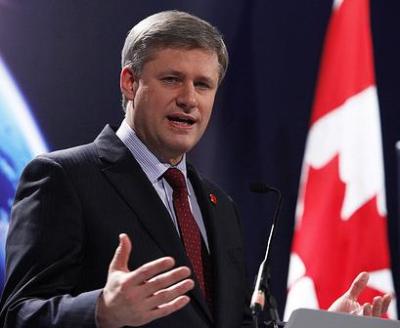
Stephen Harper’s Conservative Party cuts federal spending by 6.2%

Prime Minister Stephen Harper

More news from up north. (H/T Ben)

Excerpt:

Federal government expenditures are set to fall next fiscal year by $16.5-billion, or 6.2%, with big cuts to regional development and environment programs, according to documents tabled Tuesday.

That would leave total expenditures for the 2011-12 year at $250-billion, with the bulk taken up by transfer payments to individuals and governments, and operating costs. Just over $30-billion of that expense is attributed to refinancing Canada’s debt.

The figures, contained in spending estimates provided by the Treasury Board, sees budget increases for departments entrusted with security and law enforcement – such as a 21% boost to jails — but cuts of roughly 20% to Environment Canada, Natural Resources Canada and Agriculture and Agri-Food Canada.

Government is supposed to be concerned with security and law enforcement, not with environmentalist wastefulness.

Here’s Paul Ryan. He would like to cut our budget by 6.2% – and maybe even more.

If Canada is cutting their government waste, then why can’t we?

There are a lot of programs that we could be cutting.

Excerpt:

The federal government could save billions in taxpayer dollars annually by consolidating duplicative government programs, according to a new report.

The newly-released report from the Government Accountability Office “makes us all look like jackasses,” Sen. Tom Coburn (R-Okla.) told reporters Monday night.

The conservative senator said the report — which identifies redundancies in more than 546 individual programs — reveals why the United States is $14 trillion in debt.

“Anybody who says we don’t look like fools up here hasn’t read the report,” he said.

[…]The GAO reviewed 34 areas (among them agriculture, defense and social services) where agencies, offices or initiatives have similar or overlapping objectives. The report also looked at 47 additional cost-saving opportunities related to more general government efficiency. For instance, the report said, “Improved corrosion prevention and control practices could help [the Defense Department] avoid billions in unnecessary costs over time.”

Addressing duplicative efforts on even a single issue could save billions, the report found. For instance, the GAO says the government could save up to $5.7 billion annually by addressing potentially duplicative policies designed to boost domestic ethanol production. Additionally, the Defense Department could save $460 million annually by making broader changes to the governance of its military health care system.

The report finds that there are 15 agencies involved in food safety, 80 programs involved in economic development and more than 100 involved in surface transportation. There are 10 agencies and 82 programs involved in teacher quality, and more than 20 agencies and about 56 programs involved in financial literacy efforts. There are about 2,300 investments across the Defense Department to modernize its business operations.

House Majority Leader Eric Cantor (R-Va.) said today that in order to foster long term economic growth, “we’re going to deal with the pressing issues of regulatory waste in our agencies, as well as long term issues facing our country with entitlement programs.”

This is why we have to stop giving private sector money to government. They don’t earn any money by making things or helping people – they don’t sell anything useful. They just steal money from the productive workers and businesses and then they waste it and run up trillion dollar deficits. This kind of corruption, fraud and waste would not survive in small businesses, and probably not even in big businesses. Business have to be efficient or they go bankrupt. They have to perform or their competitors will have them for lunch. The consumer is king in the private sector.

Related posts