
Tag Archives: Fracking

Technological advances make the Keystone XL pipeline safer than alternatives

My Dad loves to read Fox News, and he sent me this article about the technology behind the Keystone XL pipeline. We got into a good discussion on this article, too. My Dad used to be a big believer in big government, but now he only cares about what problems the private sector can solve.

The article says:

The Obama administration continues to block the controversial Keystone XL pipeline that would transport nearly 35 million gallons of oil a day from Canada to the U.S., citing environmental concerns as the reason. But according to pipeline advocates, it would use the latest technology and best safety features to prevent spills.

Advanced steel is part of it. The current part of the Keystone pipeline that already exists uses 2,638 miles of hardened steel built to “withstand  impact from a 65-ton excavator with 3.5-inch teeth,” according to TransCanada, the company behind the Keystone pipeline.

The steel is also coated with alloys to prevent it from wearing out.

“They use all kinds of methodologies to reduce friction. Corrosion inhibition is pretty sexy stuff in this business,” Eric Smith, associate director of Tulane University’s Energy Institute, told FoxNews.com

Pumping stations are another critical part. All along the pipeline, pumps move the oil using centrifugal force: a motor spins and forces oil to the edges of the pump, which causes more oil to rush forward to take the place of the oil pulled to the edges.

Each pump has 6,500 horsepower – meaning that the pump exerts an amount of power roughly equivalent to that of 6,500 horses. Total pumping power on the existing pipeline is nearly half a million horsepower, according to TransCanada.

Another critical technology is leak detection systems. The existing Keystone pipeline, for instance, has sensors that collect data from 20,000 different points along the pipeline.

If a leak occurs anywhere along the pipeline, the pressure in the pipeline changes, and TransCanada notes that such changes travel through the pipeline at the speed of sound and so can be detected nearly instantly.

The company adds that the pipeline has “fail-safe” mechanisms that automatically reduce oil pressure in the pipeline to safe levels.

TransCanada also has airplanes monitor the pipeline from the sky, using both the eyes of human pilots and a “Laser Spectroscopy Unit” that shoots a laser near the pipeline and then analyzes the reaction of whatever material is hit by the laser beam. TransCanada says this is “capable of identifying tiny methane leaks at patrol altitudes.”

The human pilots also catch things. TransCanada reports that one of its pilots once noticed that a circus in Kansas had tethered an elephant to a pipeline stake, which posed a potential threat.

All the layers of security help, say experts.

“It’s a belt-and-suspenders kind of approach. You just don’t want even minute leaks,” Smith said, adding that pipelines are the safest way of moving oil across land.

Pipelines are actually much safer than transporting the oil by train, which is the method favored by environmentalist opponents to Keystone XL:

According to a 2006 study by Environmental Research Consulting using Department of Transportation data, pipelines have spilled far less than trucks or railroads per ton of oil transported.

Critics of President Obama’s delay of the Keystone XL construction say the holdup actually makes everyone less safe, as oil producers instead rely on comparatively dangerous railroads for transportation. From 2008 to 2013, the amount of oil transported by rail skyrocketed from 9,500 carloads in 2008 to 41 times that – 407,642 – in 2013.

My big point to my Dad about this is how the private sector responds to the desires of customers on their own, developing solutions for the people who they expect to buy their products. The government spends 2 billion on the Obamacare web site, and forces people to use it. They can never develop anything people actually want to buy. Government just taxes, regulates and restricts the businesses who seek to solve problems for customers.

It’s the private sector businesses who are the real heroes to customers – making the things that we want and need and competing with other businesses to sell the most quality at the lowest price. They even find solutions to our concerns about the environment, if we let them, because that is part of pleasing the customer, too. If we had to wait on public school teachers, politicians, Hollywood clowns and academics to innovate, we would be waiting a long time indeed. I stand with private sector business, and the free-market system in general.

UPDATE: Holy snouts. For the first time in 6 years I am actually proud of Obama for doing something:

The Obama administration has opened a new front in the global battle for oil market share, effectively clearing the way for the shipment of as much as a million barrels per day of ultra-light U.S. crude to the rest of the world.

The Department of Commerce on Tuesday ended a year-long silence on a contentious, four-decade ban on oil exports, saying it had begun approving a backlog of requests to sell processed light oil abroad. It also issued a long-awaited document outlining exactly what kinds of oil other would-be exporters can ship.

The administration’s first serious effort to clarify an issue that has caused confusion and consternation in energy markets for more than a year will likely please domestic oil drillers, foreign trade partners and some Republicans who have urged Obama to loosen the export ban, which they see as an outdated holdover from the 1970s Arab oil embargo.

The latest measures were wrapped in regulatory jargon and couched by some as a basic clarification of existing rules, but analysts said the message was unambiguous: a green light for any company willing and able to process their light condensate crude through a distillation tower, a simple piece of oilfield kit.

“In practice this long-awaited move can open up the floodgates to substantial increases in exports by end 2015,” Ed Morse, global head of commodities research at Citigroup in New York said in a research note.

[…]By opening the door to U.S. crude exports, the administration is offering a bit of relief to some domestic drillers that have said that they are forced to sell their shale oil at a discount of as much as $15 a barrel versus global markets as fast-rising domestic supplies overwhelm local demand.

Let’s hope Obama signs the Keystone XL pipeline in the new year, too. That will help people so much and hurt our enemies, Russia, Venezuela and Iran. There are ways to fight wars without firing a shot, and this is how you do it – he looks like Ronald Reagan, now. Well done, Barack Obama! Finally!
Good news: Venezuelan President complains that fracking is “flooding” oil markets

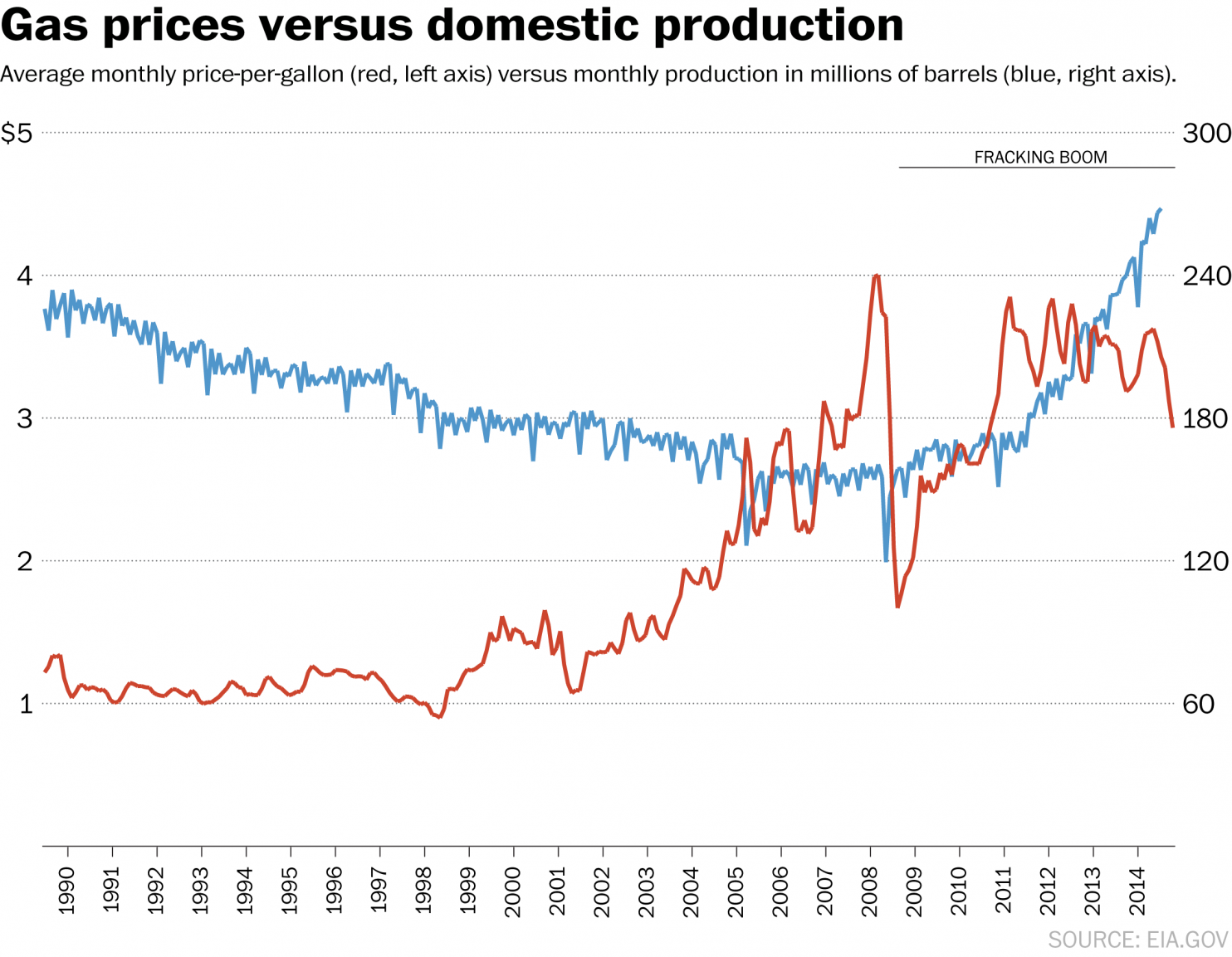
Gas prices vs domestic oil production

(Click for larger image. Source)

Why are gas prices so low all of a sudden?

Well, let’s ask the communist President of Venezuela:

The broadcast networks may not want to give credit to hydraulic fracturing for increasing U.S. oil production and lowering global oil prices, but at least one angry world leader did just that.

Venezuelan President Nicolas Maduro complained that fracking in the U.S. has “flooded” the world market and contributed to lower oil prices, a connection that broadcast networks’ evening news reports barely made recently.

“The oil they’re taking from (shale deposits) and the gas. They’ve flooded the international market to batter the Russian economy …, Iran and to hurt us, Venezuela,” Maduro said in a broadcast on VTV, a state-run TV channel in Venezuela, according to Fox News Latino.

Fracking has been one cause of increased oil production in the U.S. That increased production helped lower oil prices by more than 30 percent since September 29. The decline in oil prices since June has severely impacted Venezuela, since oil exports were a major source of government income. “Some estimates put the break-even price for Venezuela to balance its budget at around $121 a barrel,” CNBC reported on December 7. That’s more than double current oil prices. Oil closed at $59.15-per-barrel on December 11.

As of January 2014, Venezuela’s state-run oil company brought in 96 percent of foreign earnings, according to The Economist. Maduro announced on December 2 that the government would cut spending by 20 percent.

[…]Venezuela was experiencing particular difficulties. That economy was on the verge of collapsing, CNBC said on Dec. 1. If low oil prices continued, Venezuela may face a “game over” situation and “barbarity and people looting.”

Do you know who else is hurt by this? Russia. I sure hope they don’t do anything aggressive to their neighbors while their economy feels the pinch of lower gas prices.

It’s a good thing when villains shake their fists at us, but it’s a better thing when consumers pay less for gas:

Thanks in part to the widespread use of technologies like hydraulic fracturing and horizontal drilling, global oil prices plummeted in 2014. Energy experts even predicted the U.S. could be the top oil producer in the next several years.

[…]Fracking and other advanced technologies helped the U.S. nearly double its average daily output of oil, from 5 million barrels in 2008 to an expected 9.42 million barrels in 2015. The huge supply increase was one factor sending crude oil prices down. Crude fell by more than 32 percent, from $93 to $63 just since Sept. 29. This already drove gas prices down to a national average of $2.66 for regular on Dec. 9, according to AAA.

This is great news for consumers and businesses which could save as much as $1.3 trillion worldwide because of lower oil prices, according to Julian Jessop, chief global economist at Capital Economics in London. Here in the U.S., Americans could save $230 billion if prices remain low for the next year, The Washington Post said on Dec. 1.

The only bad side to this story is that fracking is an expensive way of drilling, so as the price of oil drops, energy companies will be scaling back fracking until it becomes profitable again.

I think this story is important, because it helps to explain what the people who oppose the Keystone XL pipeline are concerned about. They know that there are two results to allowing that pipeline to be built. First, a hell of a lot of jobs will be created, reducing dependency on government. Second, the price of gas at the pump will go down further. That’s what the environmentalists (and their Democrat allies in Washington) are seeking to avoid. They want more government dependency, and higher gas prices.

Would Hollywood environmentalists take Middle East oil profits to oppose fracking?

Well, before you answer, you can watch this new video from Project Veritas.

And read this article from the liberal Hollywood Reporter about the sting.

Excerpt:

James O’Keefe says he duped Ed Begley Jr. and Mariel Hemingway into agreeing to get involved with an anti-fracking movie while hiding that its funding comes from Middle Eastern oil interests.

Journalist James O’Keefe, known for his controversial undercover sting operations aimed usually at liberals — is set to unveil at the Cannes Film Festival on Wednesday the first of a group of videos that he says will reveal hypocrisy among Hollywood environmentalists.
In the video, obtained exclusively by The Hollywood Reporter and embedded below, actors Ed Begley Jr. and Mariel Hemingway are duped by a man named “Muhammad,” who is looking to make an anti-fracking movie while hiding that its funding is coming from Middle Eastern oil interests.

Muhammad, accompanied by a man pretending to be an ad executive, seemingly has the two actors agreeing to participate in the scheme, even after he acknowledges that his goal is to keep America from becoming energy independent. The meeting, which appears to have been secretly recorded, took place a few months ago at the Beverly Hills Hotel.

But the real target of the sting operation appears to be Josh and Rebecca Tickell, a husband and wife team known for their environmental movies, such as 2008’s Fuel, which won an award at Sundance and was later screened at the White House for members of President Obama’s administration.

Begley tells THR that if it looks like he’s agreeing with faux Muhammad about anything, it’s because the Tickells asked him to be polite so that they’d get their funding for a movie they’re making calledFracked, a film that will argue a technique for extracting natural gas called fracking is bad for the environment. Also, Begley says that he is hard of hearing and couldn’t understand everything Muhammad was saying.

The video also includes some audio from phone conversations between the fake Muhammad’s representatives and the Tickells. “We’re confident that we can keep this zip-locked. You know, tight. Tight. Air-tight forever,” Josh Tickell is heard saying. “If we don’t protect who is kind of funding this thing … if we have to disclose that or that becomes a necessary part of it, the whole enterprise will not work.”

Rebecca Tickell adds: “Because if people think the film is funded by Middle Eastern oil it will, it will not have that credibility,” and Josh Tickell says, “It’s money, so in that sense we have no moral issue.”

I always marvel at how liberals in Hollywood were able to get so much money from Americans at a time when we were a much more conservative, Christian nation. When you give money to Hollywood, you have to understand that you are transferring wealth to immoral, anti-American people. Is your entertainment worth that? How will you explain that to God when he asks you about your stewardship of what he entrusted you with? Your money is your voice in a culture war. Don’t let someone else speak for you.

I watch maybe one movie a year in the theaters, and I don’t have a TV, cable, or Netflix. If I buy anything, it will be some DVD like the BBC’s “North and South” or the complete “Danger Man” with Patrick McGoohan. Why would I give some of the most immoral people in the world my money? How does that help?