Tag Archives: Foreign Policy

Could Obama have done better? He could learn from Canada’s success

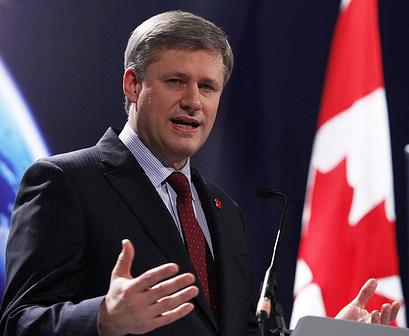
Prime Minister Stephen Harper

Here’s an editorial from Investors Business Daily.

Excerpt:

Away from the low growth and high regulation of an America under Washington’s thumb, our northern neighbor is economically strong. As 2011 ends, Canada has announced yet another tax cut — and will soar even more.

The Obama administration and its economic czars have flailed about for years, baffled about how to get the U.S. economy growing.

In reality, the president need look no further than our neighbor, Canada, whose solid growth is the product of tax cuts, fiscal discipline, free trade, and energy development. That’s made Canada a roaring puma nation, while its supposedly more powerful southern neighbor stands on the outside looking in.

On Thursday, Canadian Prime Minister Stephen Harper announced that he will slash corporate taxes again on Jan. 1 in the final stage of his Economic Action Plan, dropping the federal business tax burden to just 15%.

Along with fresh tax cuts in provinces such as Alberta, total taxes for businesses in Canada will drop to 25%, one of the lowest in the G7, and below the Organization of Economic Cooperation and Development average.

“Creating jobs and growth is our top priority,” said Minister Jim Flaherty. “Through our government low-tax plan … we are continuing to send the message that Canada is open for business and the best place to invest.”

It’s not just that Canada’s conservative government favors makers over takers. Harper’s also wildly popular for shrinking government. “The Harper government has pursued a strategic objective to disembed the federal state from the lives of citizens,” wrote University of Calgary Professor Barry Cooper, in the Calgary Herald.

Harper also has made signing free trade treaties his priority. Canada now has 11 free trade pacts in force, and 14 under active negotiation — including pacts with the European Union and India, among others.

“We believe in free trade in Canada, we’re a free-trading nation. That’s the source of our strength, our quality of life, our economic strength,” Flaherty said last month.

Lastly, Canada has pursued its competitive advantage — oil. And it did so not through top-down “industrial policy,” but by getting government out of the way.

Harper has enacted market-friendly regulations to accomplish big things like the Keystone Pipeline — and urged President Obama to move forward on it or else Canada would sell its oil to China.

These policies have been well-known since the Reagan era. But in a country that’s been institutionally socialist since the 1950s, Harper’s moves represent a dramatic affirmation for free market economics.

For Canada, they’ve had big benefits.

Canada’s incomes are rising, its unemployment is two percentage points below the U.S. rate, its currency is strengthening and it boasts Triple-A or equivalent sovereign ratings across the board from the five top international ratings agencies, lowering its cost of credit.

Is it too much to ask Washington to start paying attention to the Canadian success story?

These sound principles work every time they are tried, and they have led to a transformation in Canada.

Although this article doesn’t mention it, Stephen Harper is also the most solid statesman on foreign policy issues as well.

And here’s a view from up north from Canadian journalist Brian Lilley.

Excerpt:

Prime Minister Stephen Harper has put out his own list of accomplishments for the year that just ended but here are a few of the key conservative minded actions that spring to mind for me.

  • Ending political welfare. The per-vote subsidy that made political parties lazy and unresponsive to the voters of this country and insulated them from angering their core supporters will be gone by 2015-2016. Legislation ending the subsidy has already passed but the parties are slowly being weaned off the money and will get smaller amounts each year until the subsidy is gone.
  • They saw the light of common sense and released the names of those on their wanted list of suspected foreign war criminals. These were people that officials admitted should not be in the country, had been ordered out but that were still in Canada. At first officials would only admit there was a list of suspected war criminals but not say who they were. After much pressure, common sense won the day.
  • Ending the insane rules that would see farmers from certain provinces jailed for daring to sell their wheat to the customer of their choice. The Canadian Wheat Board still exists for those that want to use its centralized system. For those that want freedom, they now have that choice.
  • While much attention has been paid to Bill C-10, the omnibus crime bill, the government has passed C-2 (the mega-trials bill), this bill will make it easier to conduct the mega-trials now associated with organized crime without infringing on the right to a fair trial.
  • While the bill to end the gun registry has not been passed yet, it has been introduced and will pass early this year.
  • Immigration. On this file the Conservatives continue to push for ever higher numbers of newcomers while keeping those skeptical of high immigration onside by cracking down on fraud, cleaning up the system and putting Canada first.

Another thought for those, often myself included, that like to say this government is not conservative enough.

Lilley also notes that electing Harper presented a national day care program (which punishes families with stay-at-home), increasing unemployment benefits (which encourages people not to work), etc.


John Bolton: Ron Paul’s foreign policy is worse than Barack Obama

Partial transcript:

That’s why I think the debate on the Republican side is so important. And why when I see, I have to be candid, a candidate like Ron Paul whose foreign policy is if anything is worse than the Obama administration apparently leading in Iowa according to some polls, it just gives me great concern. …

But I guess I’d say to people who look at Ron Paul and have some measure of support for his domestic policies on the libertarian side, I’d have to say look, I consider myself pretty libertarian but you cannot live in fantasy land. The rest of the world is not going to leave us alone and we need a Commander-in-Chief who understands that. A Ron Paul president would simply not address the challenges we face.

So if you’re thinking about Ron Paul because of his domestic issues, think again and look at virtually any of the other candidates and consider how they would be as Commander-in-Chief. That’s the president’s first duty, defending the country.

John Bolton is probably the person I trust most on foreign policy.

In other news, Ron Paul endorses the Occupy Movement. Some capitalist.

Former Ron Paul campaign official explains Ron Paul’s views on foreign policy

From Right Wing News, an exclusive interview with a Ron Paul insider who was working for Ron Paul from 1987-2003.

Excerpt:

Ron Paul was opposed to the War in Afghanistan, and to any military reaction to the attacks of 9/11.

He did not want to vote for the resolution. He immediately stated to us staffers, me in particular, that Bush/Cheney were going to use the attacks as a precursor for “invading” Iraq. He engaged in conspiracy theories including perhaps the attacks were coordinated with the CIA, and that the Bush administration might have known about the attacks ahead of time. He expressed no sympathies whatsoever for those who died on 9/11, and pretty much forbade us staffers from engaging in any sort of memorial expressions, or openly asserting pro-military statements in support of the Bush administration.

On the eve of the vote, Ron Paul was still telling us staffers that he was planning to vote “No,” on the resolution, and to be prepared for a seriously negative reaction in the District. Jackie Gloor and I, along with quiet nods of agreement from the other staffers in the District, declared our intentions to Tom Lizardo, our Chief of Staff, and to each other, that if Ron voted No, we would immediately resign.

Ron was “under the spell” of left-anarchist and Lew Rockwell associate Joe Becker at the time, who was our legislative director. Norm Singleton, another Lew Rockwell fanatic agreed with Joe. All other staffers were against Ron, Joe and Norm on this, including Lizardo. At the very last minute Ron switched his stance and voted “Yay,” much to the great relief of Jackie and I. He never explained why, but I strongly suspected that he realized it would have been political suicide; that staunchly conservative Victoria would revolt, and the Republicans there would ensure that he would not receive the nomination for the seat in 2002. Also, as much as I like to think that it was my yelling and screaming at Ron, that I would publicly resign if he voted “No,” I suspect it had a lot more to do with Jackie’s threat, for she WAS Victoria. And if Jackie bolted, all of the Victoria conservatives would immediately turn on Ron, and it wouldn’t be pretty.

If you take anything from this lengthy statement, I would hope that it is this final story about the Afghanistan vote, that the liberal media chooses to completely ignore, because it doesn’t fit their template, is what you will report.

If Ron Paul should be slammed for anything, it’s not some silly remarks he’s made in the past in his Newsletters. It’s over his simply outrageously horrendous views on foreign policy, Israel, and national security for the United States. His near No vote on Afghanistan. That is the big scandal. And that is what should be given 100 times more attention from the liberal media, than this Newsletter deal.

I think Paul’s comments on World War 2, which I didn’t excerpt here, are pretty disturbing as well. I guess I just don’t believe that he knows enough about national security and counter-terrorism to be President. If I asked him questions like “who is FARC?” or “who is the Quds force?” or “How is Iran working with the Mexican drug cartels?” or “How is Iran working with Hugo Chavez?” then all I’ll get in response is Libertarian rhetoric.

Ron Paul doesn’t know a thing about national security or Islamic terrorism, he can’t quote any specifics at all about who terrorists are, what they’ve done, what they want to do, etc.. It’s like asking a witch doctor to explain modern medicine. You’ll only get conspiracy theories and unverifiable assertions – never any details. Everything Ron Paul asserts about how unilateral disarming would do this, or unilateral withdrawal would do that is really nothing more than his uninformed personal ideology. If you asked him to prove out any of his views on foreign policy, you would just get more excitable old crank rhetoric – devoid of data and history.

The best way to engage a libertarian who thinks that Ron Paul conspiracy theory diplomacy would work is to bring up a specific example when actual counter-terrorism produced results. For example, when KSM was waterboarded and gave up intelligence on the 9/11-style attack on Los Angeles, or when enhanced interrogation techniques led to the location of Osama Bin Laden. You can also point out how Clinton’s policies of appeasement emboldened terrorists to commit actual terrorist attacks against American assets. And how Bush’s invasions of Iraq and Afghanistan did actually dissuade terrorist attacks from occurring. And how large-scale attacks resumed under Obama, e.g. – the NYC subway bomb, the NYC Times Square bomb, the attempted assassination of the Saudi ambassador in New York, etc., to name a few. This is kryptonite to a fever-swamp libertarian who forms his foreign policy reading dead economists from the 1800s – prior to the invention of nuclear weapons.

Like this:

How to defeat Ron Paul in 2012

We can’t put someone like Ron Paul in charge of national security. It would be like putting a witch doctor in as the Surgeon General. Conspiracy theories are not good foreign policy. The antidote is to talk about the way things work in the real world.

Libertarian: a person who thinks waterboarding a terrorist to prevent a 9/11 attack is “cruel”, but who thinks aborting 50 million unborn babies since 1973 is “just”. Just understand what libertarianism is, and the scope in which it is useful, and don’t apply it to areas where it doesn’t apply.