
Tag Archives: Feminism

Feminist explains how she chose to drink alcohol before recreational sex

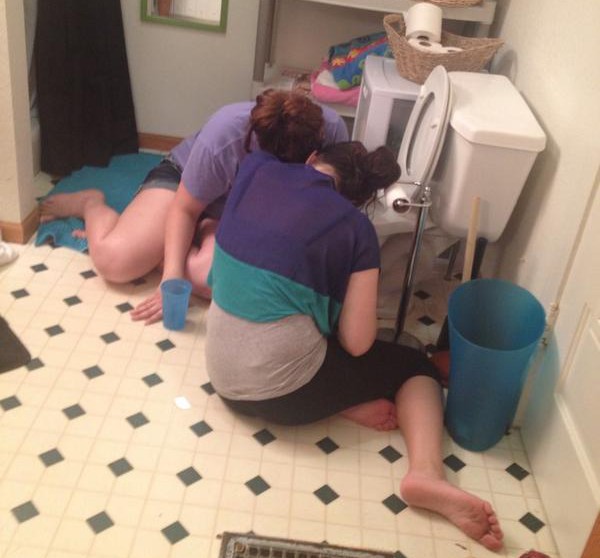
College students puking in toilet

Guess where I’m linking today? To a radical feminist web site named Jezebel, to an article written by a radical feminist who writes for the radically leftist Slate.

No, I’m not crazy. Just read it:

Much of the conversation around alcohol and sex has focused on assault—the line at which intoxication becomes incapacitation, for instance—but what we fail to mention is how haunted people can be by the sex they actually, technically consented to.

[…]I wonder what my sex life would even look like if alcohol hadn’t been there. Alcohol gave me comfort in my own body, and it allowed me to turn my erotic curiosity and hunger for experience into an action plan. I was tired of being the stuttering girl sucking in her stomach after the lights went out. I wanted to be the woman who roamed wild and free.

Alcohol also helped me cut the girlish strings on my heart, an action my college years demanded. Three months into my freshman year, I split a six pack with a dashing sophomore, and we wound up partially clothed on his bed, my bare legs wrapped around his waist, my hands around his neck. I pulled back slightly and asked him the question, the naive question of a girl who does not yet understand her fate: “What does this mean?”

He looked past me, into his studio apartment, and then back into my eyes. “It means that I’m a 19-year-old boy, and we’re having fun.”

What is interesting is that she didn’t see this man’s using her for fun after getting her drunk as any disqualification for a serious relationship. On the contrary, she believes that a serious relationship built on self-sacrificial love and commitment that lasts through difficulties can be found in a man who uses her for fun sex:

I’m not saying I didn’t enjoy that night with the dashing sophomore. I’m saying the fun part for me might have been turning our physical intimacy into a sustained attachment.

Amazing. She wasn’t looking for men with good educations, good jobs, lots of savings, who were sober and chaste – they would have made her unhappy with their bossy leading, and strict plans about courting and marriage. She thought that she could get to live-long married love by choosing what was free, easy and fun in the moment.

She is 35 now, and still single. I’m sure if you ask her, she would like to be married “some day”, but who would say that her past decisions were good preparation for the challenges of marriage? Marriage is about self-sacrificial love, and endurance. To prepare for marriage, you practice self-denial and self-control. You learn how to accept expectations, obligations and responsibilities. You grow up.

Anyway, back to the article. She choose the alcohol herself, and she did it for a very specific reason:

I wanted to have fun, too. And alcohol evened the score. I cared less about everything when I was drinking: What you thought of me, what I looked like in this dress, whether that taco was warm or cold when I stuffed it in my mouth. I don’t want to make it sound like I drank in order to have sex. I drank for a million reasons.

[…]Booze downshifted my intense body consciousness, and it revved up my bravado. Sex was scary—but alcohol made me feel safe.

She drank in order to have sex. Got it? She chose to get drunk in order to feel safe about having sex. Many young women think that recreational sex with hot guys is a pathway to marriage. They drink in order to make progress towards the marriage they want – the marriage to the man who is fun. Not the man who is serious. They don’t want the serious man who makes plans for marriage, and expects the woman to sober up, behave responsibly and honor obligations.

Why are millenials acting like children into adulthood?

This reminds me of the Institute for American Values study. Despite their name, it is not a conservative organization

Look at this citation from p. 15:

A number of students noted that being drunk could later serve as your excuse for the hook up.

A Yale University student said, “Some people like hook up because they’re drunk or use being drunk as an excuse to hook up.”

A New York University student observed, “[Alcohol is] just part of an excuse, so that you can say, oh, well, I was drinking.”

A Rutgers University student commented, “If you’re drinking a lot it’s easier to hook up with someone… [and] drugs, it’s kind of like a bonding thing… and then if you hook up with them and you don’t want to speak to them again, you can always blame it on the drinking or the drugs.”

[…]A University of Chicago junior observed, “One of my best friends… sometimes that’s her goal when we go out. Like she wants to get drunk so I guess she doesn’t have to feel guilty about [hooking up].”

I hope that many of the men out there who refuse to hold women accountable for their own desires start to understand that not everything a woman wants is good, and not every plan a woman makes will work. Sometimes, you need to calmly and constructively challenge them about their priorities, plans and actions. It’s for their own good.


Why don’t men today talk to women about commitment and marriage?

Painting:
Painting: “Courtship”, by Edmund Blair Leighton (1888)

I saw this essay from a young woman named Jordana Narin who is explaining how she feels about not being able to talk seriously to a man she chose to have premarital sex with on multiple occasions. She is a radical feminist and has a non-STEM degree in creative writing. The essay was published in the radically leftist New York Times.

First kiss:

I met [a guy] at summer camp in the Poconos at 14, playing pickup basketball by day and talking in the mess hall late into the night. Back home we lived only 30 minutes apart, but I didn’t see him again until 11th grade, when we ran into each other at a Halloween party in a Lower Manhattan warehouse.

[…]Under the muted flashes of a strobe light, we shared our first kiss.

No communication:

We stayed in touch for the rest of high school, mostly by text message.

[…]Every time his name popped up on my phone, my heart raced.

Still, we were never more than semiaffiliated, two people who spoke and loved to speak and kissed and loved to kiss and connected and were scared of connecting.

Where is this relationship going? This boy has no job and no savings and no proven record of steady work – and therefore he cannot afford to marry anyone. Why is she even talking to a man who cannot afford to marry her? He is not able to marry her, and handle getting her pregnant.

More:

Two years after our first kiss, we were exchanging “I’ve missed you” messages again. It was a brisk Friday evening in our first semesters of college when I stepped off a train and into his comfortable arms.

He had texted weeks earlier on Halloween (technically our anniversary) to ask if I would visit. We had not talked since summer, and I was trying to forget him. We had graduated from high school into the same inexpressive void we first entered in costume, where an “I’ve missed you” was as emotive as one got.

Long gaps in between text messages – they have nothing to talk about, and there is no purpose to the relationship.  This is the man she chose. Nevertheless, they are away from their parents, and so she had sex with him, choosing to lose her virginity to a man she was not married to.

And then:

Naïvely, I had expected to gain clarity, to finally admit my feelings and ask if he felt the same. But I couldn’t confess, couldn’t probe. Periodically I opened my mouth to ask: “What are we doing? Who am I to you?” He stopped me with a smile, a wink or a handhold, gestures that persuaded me to shut my mouth or risk jeopardizing what we already had.

On the Saturday-night train back to Manhattan, I cried. Back in my dorm room, buried under the covers so my roommates wouldn’t hear, I fell asleep with a wet pillow and puffy eyes.

The next morning I awoke to a string of texts from him: “You get back OK?” “Let’s do it again soon :)”

So my question for you is this: should a woman who has recreational sex with a jobless man she barely knows expect to have real relationships, including a marriage relationship?

There’s an interview that goes with it on the radically leftist NPR web site, but I saved a copy of the MP3 file here in case it disappears.

In the interview, she says:

“Everyone in college uses Tinder,” she said, referring to the wildly popular dating and hook-up app. “You can literally swipe right and find someone just to hang out for the night. 

And:

In a different time, my grandparents, my great grandparents, they might have thought they were missing out on casual sex. But since my generation has been saddled down with that, we kind of look to the past and say well, wasn’t that nice. I think both are optimal. I’m a huge feminist, and I think women should be able to do whatever they want to do. If a woman wants to have tons of casual sex, she totally should. But I think that there should be the option. And they shouldn’t be gendered, women and men. But there should be the option of being in a relationship.”

Right. Young women like her accept radical feminism, which basically means that they think that the traditional path to marriage must be avoided, because it’s “sexist” and “controlling”. Chastity is sexist. Stay at home wife is sexist. Stay at home motherhood is sexist. She believes that women should prioritize recreational sex and career, marry later, and continue her career by placing the children in daycare and public schools. Any attempt by a marriage-minded man to get her to stop drinking, being promiscuous, having a career, and giving the kids to strangers is “sexist” and “controlling”. Is radical feminism a path to relationships and marriage?

How should marriage-minded men perceive a woman’s past choices to have premarital sex?

Consider this story from the Ottawa Sun about a woman who didn’t want to say no to sex right now, but wanted to get married “some day”:

A New York woman is facing charges after police say she lied about being raped by two football players at a party to get sympathy from a prospective love interest.

Nikki Yovino, 18, has been charged with falsely reporting an incident and tampering with or fabricating physical evidence.

Last October Yovino reported that she had been sexually assaulted in a bathroom by two Sacred Heart University football players at an off-campus party.

The men, however, said it had been consensual.

Capt. Brian Fitzgerald tells WABC-TV another student informed authorities of explicit text messages between the three. He says one man also recorded some of the incident on his cellphone.

“She admitted that she made up the allegation of sexual assault against (the football players) because it was the first thing that came to mind and she didn’t want to lose (another male student) as a friend and potential boyfriend. She stated that she believed when (the other male student) heard the allegation it would make him angry and sympathetic to her,” said an affidavit, according to the New York Post.

Two. Football. Players. At the same time.

She wanted a “relationship” with this other guy. She didn’t see why the “opportunity” to have premarital sex with two no-commitment bad boys at the same time should be rejected. After all, the man who would eventually have a relationship with her and marry her would presumably be OK with her choice. Because her choice was a good sign that she was ready for wife and mother roles.

I think that every single choice by a woman to have premarital sex with a no-commitment man is committing infidelity and adultery against her future husband. It’s a sign that she doesn’t have the self-control to value commitment over fun. She won’t be able to respect her husband as a leader, and be faithful (and sexually available) to him. She doesn’t see sex as a gift for the man who promises to take care of her. She sees sex as something to give to bad men to get validation and entertainment. And if she does marry later, I doubt that she will be as generous sexually with her husband. There is an epidemic of sex-withholding these days being committed by women who don’t see the man they took wedding vows with as worth of the energetic sex they freely gave to the no-commitment bad boys in their youth. Women who give bad boys premarital sex don’t see husband and father ability as desirable and worth rewarding.

No man can marry a “huge feminist”

Most men are not interested in committing to, or discussing commitment with, women who put pleasure above self-control. Most non-Christian men will have sex with a hedonistic women, but they won’t commit to them. Why would a man commit to a narcissist? If a man’s role is just to be ruled by the “huge feminist”, then there is no reason to discuss commitment or to commit. Radical feminists believe that relationships are about their plans and their needs. They are not interested in responsibilities, expectations or obligations to men or to children. Most men, even secular men, understand that such women are not suitable for commitment.

Will anyone explain marriage to these women?

Whenever I tell my Christian women mentors about what I am seeing today, they always say that women need to have marriage explained to them. But today, no one has the courage to tell young women that radical feminism is not the path to marriage. Instead, they are taught by parents and pastors to blame and shame men for not marrying them, as if their past decision-making had prepared their character for the roles of wife and mother.

Why are so many women with good careers being forced to freeze their eggs?

Is this woman choosing a path that leads to marriage?

The New York Times says that more and more women are having to freeze their eggs because they can’t find good men to marry. The NYT doesn’t think that women are doing anything wrong. They blame the men for refusing to commit. According to feminism, women who value careers, abortion rights, no-fault divorce, big government, high taxes, etc. are doing everything right. But does it work?

I thought it might be a good idea to help Western women to make better decisions with men and marriage. Although setting out boundaries seems harsh and restrictive, it’s actually protective and loving. If we want women to get to a stable marriage and children, (what they really need long term, after they lose their looks and youth), then we should be bold about leading them.

The first thing to point out is that the women celebrated by the New  York Times are intentionally delaying marriage for their education and careers.

Another New York Times article explains:

It could be that the new generation of millennial women is delaying having children even longer than the women who came before them, as prime childbearing years are also critical years for advancing in a career. A recent study shows that the marital pay gap that springs up after a first child is born typically does not close if the birth happens between age 25 and 35.

Shannon Hettinger, a 32-year-old from Washington, D.C., said she definitely wanted children. She grew up in a large family in a small town in Pennsylvania and almost all her high school friends are married with children. But she moved to Washington, and spent her 20s deciding on a career. Now that she has one she loves — she works in residential real estate sales — she is not going to stop until she gets established. That means not having children for a while.

“I just want to build my book of business and see where I can go from here,” she said. “My whole focus is career growth. That’s my No. 1 priority.”

“Once I achieve a certain level of success,” she added, “then I’ll start thinking about a family.”

Ivy Gray-Klein, 26, who lives in Philadelphia and works at the University of Pennsylvania School of Design, said she was open to having children but cannot imagine doing so until she is 30 or 35. She wants to feel settled in her own life first. Now she has three roommates, is paying down her student loans and is working to build a little bit of savings.

“I’m just really trying to get myself to a place that is solid,” she said by phone. “Having a child right now would be so destabilizing. Children just seem like such an enormous financial undertaking.”

As far as I’m concerned, once a woman reaches 30 , she’s actually chosen not to marry, and not to have children. Marriage is something that men are willing to do with women in their early 20s. They want a woman to commit and invest herself in his life early. They don’t commit to a woman who has spent her 20s running up debts, traveling, being promiscuous, etc. The pattern of selfish behavior that  women get into damages their ability to be good wives and mothers later. And men know that.

But in this post, I’m discuss something that I think is responsible for women not finding good men: and that’s the fact that many women are not looking for good men. In fact, some women are very attracted to very bad men.

Here’s the first editorial about women and domestic terrorist Dzhokar Tsarnaev, one of the Boston marathon bombers.

Excerpt:

Mostly, though, they think Dzhokhar is cute. The Bambi eyes (looking right out of his Instagram-doctored photos at you!), the hipster facial stubble, the masses of wine-dark tousled hair — adorable! Impassioned believers have written “Dzhokhar is innocent” on their hands and plastered “Innocent until proven guilty!!!!” posters around their towns. An 18-year-old waitress interviewed by the New York Post vowed to have Dzhokhar’s last tweet before the bombing tattooed onto her arm: “If you have the knowledge and the inspiration all that’s left is to take action.”

[…]But the real cause of the Jahar craze more likely lies in something more primal and less pretty in the female psyche. I’m betting that women, young and old, are drawn to Dzhokhar not because he is a good-looking late adolescent but because he is a good-looking accused killer. He’s a classic “bad boy” of the sort to whom women are chronically attracted because they want to reform them, or minister to their wounds, or be the healing presence they’ve never had — but mostly because they find them sexy.

That article also noted:

It’s not surprising, then, that every homicide perp on death row who is reasonably attractive has groupies. Consider the handsome (and widely philandering) Scott Peterson, sentenced in 2005 for killing his wife and unborn son and throwing their remains into San Francisco Bay. The day he checked into San Quentin, he received three dozen phone calls from smitten women, including an 18-year-old who wanted to become the second Mrs. Peterson.

Some of the tweets and other fangirl comments about Tsarnaev were collected in this New York Post article.

Lots of Western women from the UK, France, Russia, etc. all picked up and moved to the Middle East to become ISIS jihadi brides.

Excerpt:

Western women joining Islamic State are increasingly from comfortable backgrounds and often well educated with romantic notions of adventure often quickly dispelled by the harshness of life as a “Jihadi bride”, according to a British research report.

Some 550 women from Western countries have left their homelands to join Islamic State, which has captured swathes of Syria and Iraq, said the report by the Institute for Strategic Dialogue and the International Centre for the Study of Radicalisation at King’s College, London.

[…]It said female recruits were increasingly younger, some from comfortable backgrounds and often well-educated, and were playing “crucial” propaganda and recruitment roles.

That article is three years old, the numbers have more than doubled since then. The most common reasons cited for leaving are romance and adventure.

Psychology Today has some comments about why some women do this:

In her post, “Women Who Love Serial Killers,” PT blogger, Katherine Ramsland, offers some suggestions about why some women can be so attracted to, or hopelessly beguiled by, the most terrifying of human predators. At first, she provides explanations from the women themselves, women who actually married these dangerously unhinged criminals. Their reasons (somewhat elaborated here) include the assumptions that:

  • their love can transform the convict: from cunning and cruel, to caring, concerned, and compassionate.

  • there’s a wounded child nested somewhere inside the killer that can be healed through a devoted nurturance that only they can provide.

  • they might share the killer’s media spotlight, and so triumphantly emerge from their anonymity, and maybe in the process even land a book or movie deal (an aspiration about as cynical as it is narcissisticand self-serving).

And this is even more interesting:

To simplify this work’s findings for my present purpose, however, let me begin by emphasizing that Ogas and Gaddam find substantial evidence from Web searches, posts, and many 1,000s of romance novels that women demonstrate a strong erotic preference for dominant men. Or toward what’s now commonly referred to as alpha males—in the authors’ words, men who are “strong, confident, [and] swaggering [as in “cocky,” and the pun is intended].” Unfortunately, what these descriptors often imply is behavior sufficiently bearish, self-centered, and insensitive as to often cross the line into a physical, mental, and emotional abuse that can be downright brutal.

[…]Moreover, in responding to the question as to whether some men, such as “serial killers, violent offenders, and rapists,” might be too dominant for women to accept, Ogas and Gaddam note: “It turns out that killing people is an effective way to elicit the attention of many women: virtually every serial killer, including Ted Bundy, Charles Manson, and David Berkowitz, have received love letters from large numbers of female fans” (p. 98).

Women choose good-looking bad boys, because they think that they can change them:

The fantasy that seems to be operating in such devotees, and that constitutes the plot of virtually all erotic/romantic novels written with women in mind, is that the “misogyny and jerkdom” they might have to battle with in such super-dominant males is only temporary. That it doesn’t really represent the man’s innermost reality. That his violence and lack of tender feelings is only the beginning of the story, and that their unsparing love, affection, and dedication can ultimately transform his character by helping him get in touch with his, well, “inner goo.”

I blogged before about feminists going after pro-choice bad boys like William Clinton, Peter Strzok, Eliot Spitzer, Anthony Weiner, John Edwards, Harvey Weinstein, etc. These men support selfish policies like abortion and no-fault divorce. Women seem to not understand that men who support selfishness as policy might actually BE selfish in their own lives. Men who are able to commit and raise children are not pro-abortion and pro-divorce. Those are the men who women should be pursuing, and during their early-to-mid 20s.