Tag Archives: Feminism

New study: Contraceptives double risk of depression in teenage girls

The Sydney Morning Herald reports:

A Danish study of a million women has found a link between the use of hormonal contraception such as the the pill and increased risk of depression.

Compared with non-users, women and teenage girls aged 15 to 34 who used hormonal contraception had a 1.23 times higher risk of being diagnosed with depression, especially adolescents, according to a paper published in the journal JAMA Psychiatry.

Researchers at the University of Copenhagen in Denmark analysed health registry data of one million Danish women from 2000 and followed them up after an average of six years.

Of the 55 per cent of those who used hormonal contraception, there were just over 23,000 first diagnoses of depression at the time of follow up.

More than 133,000 had received their first prescription of antidepressants.

The highest risk of depression was among the adolescent girls, who had a 1.8-times higher risk of first use of an antidepressant.

The risk varied slightly among the different types of hormonal contraception, but the risk was three times higher among those who used non-oral products, such as progestogen implants.

Few studies have quantified the effect of low-dose hormonal contraception on the risk for depression, but study author Ojvind Lidegaard says their research warrants the need for further studies into the potential adverse effects of the pill.

“Use of hormonal contraceptives was associated with subsequent antidepressant use and first diagnosis of depression at a psychiatric hospital among women living in Denmark.

“Adolescents seemed to be more vulnerable to this risk than women 20 to 34 years old,” Lidegaard said.

Of course, one wonders where these studies were BEFORE the pill was championed by the radical feminists. We didn’t have studies before we adopted abortion, no-fault divorce, single mother welfare and gay marriage, either. Do you think that those might have unintended consequences? Shouldn’t we care about the consequences before we adopt policies that go against traditional moral values?

Anyway, let’s review some studies on birth control pills, since no one ever tells young people these things before it’s too late.

This is from the ultra-leftist Time magazine, of all places.

Excerpt:

Dr. David Gaist, a neurologist at Odense University Hospital and the University of Southern Denmark, and his colleagues found that women taking hormonal contraceptives — those containing estrogen, progestin or a combination of both — showed higher rates of a rare brain tumor known as glioma. Their results, published Thursday in the British Journal of Clinical Pharmacology, raise questions about the connection between oral contraceptives and brain cancer, but shouldn’t yet be interpreted as a reason to stop taking birth control, says Gaist.

Using data from Denmark’s national registries of health records, cancer cases and prescriptions, Gaist zeroed in on the women aged 15 years to 49 years diagnosed with glioma, and then analyzed whether they were prescribed contraceptives and for how long. Overall, women who had used hormonal contraceptives at any point in their lives showed a 50% higher risk of developing the brain tumors compared to those who had not used them. And women who used the birth control for more than five years nearly doubled their risk of the cancer.

Let’s take a look at some previous studies on the effects of contraceptives.

From the Times of India.

Excerpt:

 Women who take oral contraceptives regularly are at a higher risk of developing breast cancer compared to others, shows a study by AIIMS doctors. Breast cancer risk was found to be 9.5 times more in women with a history of consuming such pills. Early menstruation cycle, late marriage and lower duration of breastfeeding were the other major factors responsible for the disease among Indians, according to the study published in the latest issue of the Indian Journal of Cancer.

The study was conducted on 640 women, of which 320 were breast cancer patients. “We found long-term use of oral contraceptive pills (OCP) higher among those suffering from breast cancer-11.9%-compared to healthy individuals-1.2%,” said Dr Umesh Kapil, a professor at the public health nutrition unit, AIIMS. He said breast cancer is caused by repeated exposure of breast cells to circulating ovarian hormones, and long-term use of OCPs, which contain estrogen and progesterone, may be increasing this risk by causing hormonal imbalance.

The study mostly had women who used OCPs for birth control. Emergency contraceptives, popularly called morning-after pills, were not included.

This is not the first study, nor even the second study, to confirm this link.

Birth control pills

Many studies showed that taking birth control pills caused an increased risk of breast cancer.

Study 1: (March 2003)

RESULTS: Among the youngest age group (<35 years, n = 545), significant predictors of risk included African-American race (RR = 2.66: 95% CI 1.4-4.9) and recent use of oral contraceptives (RR = 2.26; 95% CI 1.4-3.6). Although these relationships were strongest for estrogen receptor-negative (ER-) tumors (RRs of 3.30 for race and 3.56 for recent oral contraceptive use), these associations were also apparent for young women with ER+ tumors. Delayed childbearing was a risk factor for ER+ tumors among the older premenopausal women (Ptrend < 0.01), but not for women <35 years in whom early childbearing was associated with an increased risk, reflecting a short-term increase in risk immediately following a birth.

Study 2: (October 2008)

Oral contraceptive use ≥1 year was associated with a 2.5-fold increased risk for triple-negative breast cancer (95% confidence interval, 1.4-4.3) and no significantly increased risk for non-triple-negative breast cancer (Pheterogeneity = 0.008). Furthermore, the risk among oral contraceptive users conferred by longer oral contraceptive duration and by more recent use was significantly greater for triple-negative breast cancer than non-triple-negative breast cancer (Pheterogeneity = 0.02 and 0.01, respectively).

When people talk about a war on women, maybe they should be thinking about this practice of promoting behaviors to women that make them sick. And eventually, we all have to pay for the increased costs of health care when we encourage people to do things that make them sick. We should not be promoting birth control to young women in order to enable them to have recreational sex. It’s not worth the harm it causes them. When you add in the psychological damage and the risk of abortion if the contraception fails, it really is not the right thing to tell a young woman.

Lori Alexander is right: serious Christian men prefer debt-free virgins without tattoos

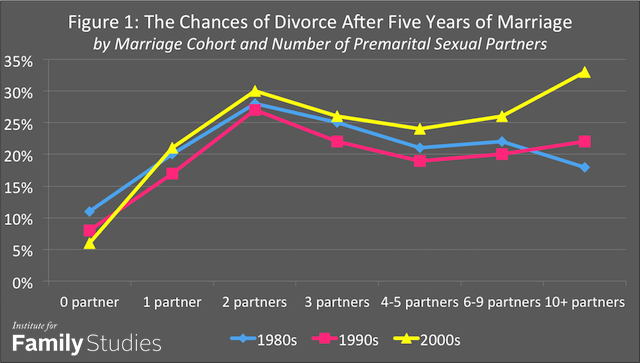
Marriage stability vs sexual partners,(Teachman et al. JAMF, August 2010)

Christian writer Lori Alexander recently wrote a blog post (H/T Lindsay) urging Christian women to do 3 things:

  1. be a virgin before marriage
  2. be debt-free before marriage
  3. don’t get any tattoos

She also urged women to be cautious about college, because it often gets them into debt. I disagree with her a little here. I always urge young women to earn a STEM degree in college, then work a few years to pay off their loans (if any) before marrying. This is because women, like men, need to have the experience of doing something hard that they don’t “feel” like doing, in order to grow. STEM degrees teach young people that the world doesn’t revolve around them, and that their feelings don’t matter when trying to solve a problem in the real world. It’s a very useful way for women and men to break themselves out of the desire for free and easy happiness that is so common in our time.

Lori’s article drew enormous opposition from both secular and Christian sources. So far, the only people defending her are men’s rights sites, like Dalrock (Christian) and Spawny (non-Christian). Every other “Christian” blog or news site that I read disagreed her article, and argued that premarital sex was no big deal, that having debt was no big deal, and that having tattoos was no big deal.

Let’s take a look at her three points, then I’ll explain why her article is largely correct, and why she is correct about what she asserts about the criteria that godly men have for women.

Even one non-husband premarital sex partner raises risk of divorce

Virginity

Regarding her first point, virginity is commanded by the Bible, it’s in line with peer-reviewed studies on marriage quality and stability. The reason that people find this difficult is that they want the freedom to give in to sexual desires without feeling shame. They want to believe that there is no permanent effect. It doesn’t help that parents and pastors are terrified of telling young people, and young women in particular, that promiscuity harms marital stability. Right now, the culture is drowning in feminism. Feminism tells women that the traditional male roles of provider, protector, and spiritual leader are “sexist”. The “best” men are good-looking pro-abortion bad boys. If a Christian woman is not able to think through the meaning of sex with respect to marriage enough to control herself, it seriously harms the stability of her future marriage.

Starting and Mid-Career salaries by profession (click for larger image)

Debt-free

Regarding her second point, almost everything a serious Christian man might plan to do for Christ with his marriage is impacted by finances. From education, to marriage timing, to number of children, to home ownership, early investment, to the success of children. to age of retirement. Less money means fewer choices, and less ability to counter challenges. Think of how important money for legal defense is to Christian-owned businesses who are being persecuted, for example. The reason that many people find the Bible’s teaching on stewardship difficult is that they don’t want to exercise self-control with money if they don’t feel like it. They want to waste money seeking fun and thrills, and then act like their poverty could not be avoided. Being debt-free is an indicator of practical wisdom and self-control in a woman.

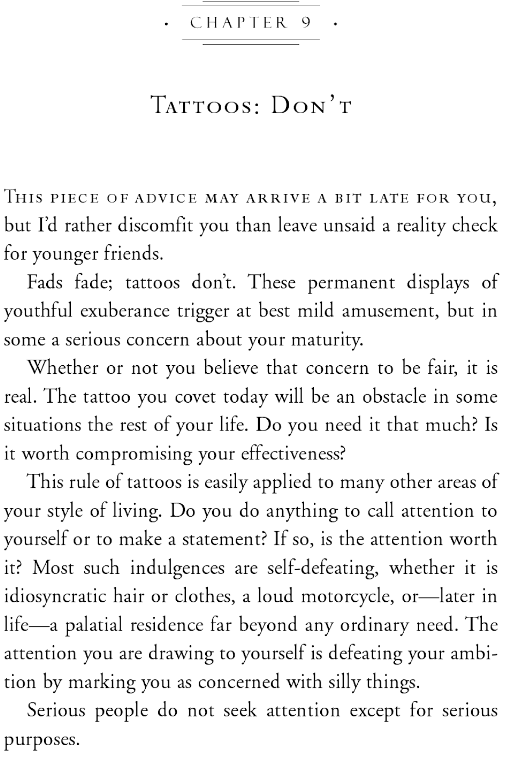
Hugh Hewitt's "In, But Not Of", Chapter 9: Tattoos, Don't
Chapter 9 of Hugh Hewitt’s “In, But Not Of: A Guide to Christian Ambition”

Tattoos

Tattoos are a problem for serious Christian men for several reasons. First, they cost money and for no gain, and can even cause you losses in your career. Second, most people get them because of low self-esteem or vanity or to look rebellious or to look dangerous. None of these motivations should be acted upon by someone with a robust Christian worldview. The money could be better used on charity, or investments, etc. Women show what their priorities really are by how they spend their money and time. Show me a woman’s bookshelf, and I’ll tell you how seriously she has thought about what it means to be a Christian in all areas of life. Instead of showing me your tattoos to demonstrate your “spirituality”, show me your apologetics books, to demonstrate your intellectual engagement. And tell me how you used that information to engage in conversations with educated non-Christians to answer their challenges to your faith. That way I’ll know that you use your money to train do hard things in order to have an influence for Christ in serious, practical, effective ways. A woman who can defend her faith and discuss Christianity with non-Christians is demonstrating her ability to raise Christian children in a secular society.

A family praying and reading the Bible

The goal of marriage is to serve God

Today, young people have been taught to follow their hearts, and to deny that there is any authority or practical wisdom that should govern their decisions. They always imagine themselves to be exempt from moral rules, statistics, cause and effect, etc. They think they know better than everyone else – even though they do almost no research on their own. Every adviser who tells them to study computer science instead of creative writing is wrong. Their same-age friends know more about what causes divorces than peer-reviewed research papers. And money should be spent on skydiving and zip-lining, regardless of what financial experts like Dave Ramsey might say.

A woman who has made many mistakes cannot fix those mistakes with words. Rationalizations, evasions, and blame-shifting do not work to show that there has been real repentance. The man can only assess whether grace has caused any real re-prioritization of goals by evaluating her outward actions over a long period of time. Furthermore, if a woman who has made mistakes attacks those who correct her from Bible’s teachings on chastity, stewardship, etc., then it’s a sign that there is no real repentance.

Choosing a wife wisely doesn’t mean that Christian men treat OTHER Christian women poorly. Christian men love all the Christian women. We care for them and support them. But when a man chooses a wife, he is choosing someone who will have more influence on his ability to serve God than anyone else. In my case, the goals for my marriage involve making a difference with apologetics in the church, having many children who will receive the educations and careers they need to have an influence, influencing government to promote Christian-friendly policies, charitable giving, mentoring young Christians, modeling a good marriage to others, and having a home that can serve to host discussions about issues that matter. These things are not free – they take careful planning and execution to achieve.

Lori’s advice is  intended for men who are serious about making their marriage produce a return for God. Men who are chaste themselves. Men who accept the Bible as an authority. Men who earned STEM degrees, instead of easy nonsense degrees that don’t lead to good careers. Men who earn 6-figure salaries, who buy houses for cash, and who are on track have a 7-figure net worth by age 50. Men who made good decisions cannot risk marrying someone who hasn’t prepared for marriage. The wrong woman in the home could ruin the man’s effort to produce a marriage that gives glory to God.

Not every man intends to achieve something for God with his marriage, but those who do need to choose a woman who has demonstrated ability at doing the job. For example, if the job requires marital fidelity, then chastity is a good indicator that the woman has the necessary self-control. If the job requires frugality, and practicality, then being debt-free, having a STEM degree, and having some private sector work experience are good indicators that she’s qualified for the role. Nothing valuable in life is ever been achieved by being lazy, wild and irresponsible. Serious Christian men look for wives who have applied themselves to difficult tasks that they didn’t feel like doing, who achieved success by remaining committed to the plan, in spite of their unhappy feelings and unmet desires.

We have a problem in the church such that we aren’t serious about teaching young people to develop marriage-ready character and to make serious plans for marriage. We are teaching them to follow their hearts, and that their feelings and desires are clues about God’s will for their happiness. We are teaching them to be uncomfortable with responsibilities, expectations and obligations to others. We are teaching them not to do their own research. We are teaching them not to make practical, wise plans. We are teaching them to ATTACK those who try to get them to be serious about doing what is likely to work. This approach is not working.

My own criteria for a wife are more demanding than Lori’s. My advice there is only for serious Christian men who want their marriage to serve God.

Unmarried 35-year-old woman reflects on her adventurous life of fun, travel and serial cohabitation

I found an interesting article featuring a 35-year-old woman who is alarmed that her approach to life has left her in debt and single, with a gap-filled resume of short-term jobs. I thought it might be useful for young women to read this, and consider whether making “rash” decisions and being “adventurous” works out.

She writes:

I feel like a ghost. I’m a 35-year-old woman, and I have nothing to show for it. My 20s and early 30s have been a twisting crisscross of moves all over the West Coast, a couple of brief stints abroad, multiple jobs in a mediocre role with no real upward track. I was also the poster child for serial monogamy. My most hopeful and longest lasting relationship (three and a half years, whoopee) ended two years ago. We moved to a new town (my fourth new city), created a home together, and then nose-dived into a traumatic breakup that launched me to my fifth and current city and who-knows-what-number job.

Rash decisions, adventure, exploring…. and lots of debt:

For all these years of quick changes and rash decisions, which I once rationalized as adventurous, exploratory, and living an “original life,” I have nothing to show for it. I have no wealth, and I’m now saddled with enough debt from all of my moves, poor decisions, and lack of career drive that I may never be able to retire. I have no career milestones and don’t care for my line of work all that much anyway, but now it’s my lifeline, as I only have enough savings to buy a hotel room for two nights.

No STEM degree, which means she doesn’t like to study hard things that can be tested against the real world for correctness:

I used to consider myself creative — a good writer, poetic, passionate, curious. Now, after many years of demanding yet uninspiring jobs, multiple heartbreaks, move after move, financial woes, I’m quite frankly exhausted.

Surprised by aging and poor health:

Also, within the past year I’ve had a breast-cancer scare and required surgery on my uterus due to a fertility issue. On top of that, I’m 35 and every gyno and women’s-health website this side of the Mississippi is telling me my fertility is dropping faster than a piano falling out of the sky. Now I’m looking into freezing my eggs, adding to my never-ending financial burden, in hopes of possibly making something of this haunted house and having a family someday with a no-named man.

She’s still trying to be the sexpot 25-year-old she used to be:

I’m dating. I’m working out and working hard. Listening to music I enjoy and loving my cat. Calling my mom…. I’m drinking too much… And with men I date, I feel pressure to make something of the relationship too soon (move in, get married, “I have to have kids in a couple of years”; fun times!). All the while still trying to be the sexpot 25-year-old I thought I was until what seemed like a moment ago.

But her plan hasn’t worked out:

I used to think I was the one who had it all figured out. Adventurous life in the city! Traveling the world! Making memories! Now I feel incredibly hollow. And foolish. How can I make a future for myself that I can get excited about out of these wasted years?  What reserves or identity can I draw from when I feel like I’ve accrued nothing up to this point with my life choices?

Well, I’ve known women like this, and I think we’re going to see more and more women like this as the society becomes more secular and feminist. I want to say something about whether she is sincere about wanting to get married and have children, and what women should do to avoid ending up like her.

Do women today understand male nature and marriage?

This woman’s demonstrated life plan is that she chose whatever made her feel good from age 18-35+, and now wants to enter into a marriage some time after age 35. And what does marriage mean to her? Has she prioritized entering the traditional roles of wife and mother? Don’t listen to her words. Look at her actions. Her actions show that marriage and children were of NO importance to her. And her current approach to getting married and having kids is the same as ever – work out in order to look hot, and try to coerce a man who signs up for recreational sex with no commitment into becoming a man who makes a life-long commitment to provide for her and her children (which is the opposite of what he signed up for). She wants marriage now for the same reason that she’s wanted anything: for fun, thrills, adventure and to keep up with her girlfriends who are already married.

What kind of man should she have been pursuing from age 18 to 35, if she really wanted marriage and children? Well, the first thing to realize is that not all men want marriage. And the next thing to realize is that women who are serious about marriage need to focus ONLY on men who want to marry. All the men that the women quoted above wanted in her youth didn’t want to marry. They wanted premarital recreational sex with her, and that was fine with her – she chose them, and disregarded the men who were interested in marriage.

A man who was interested in marrying her would have:

  • ….told her no to sex before marriage (because the more sexual partners a woman has, the less happy she will be in marriage, and the more unstable her marriage will be).
  • …led her to become better at being a wife and mother, by discouraging her thrill-seeking, traveling and wasteful spending, and instead encouraging her focus on a STEM education, career and getting debt-free.
  • …led her to develop a Christian worldview in which she would understand the importance of marriage and children, and learn to sacrifice her own interests to love and care for others.

Was she interested in getting ready for marriage? No. She never chose those marriage-minded men. She didn’t want to be a wife. The men she chose were chosen for fun, for thrills, and to show off their outward appearance to her girlfriends.

So, who are the men in this group of marriage-minded men? How do you recognize them? Marriage-minded men are interested in marriage because they want to lead a home. They will have invested a lot of time learning how to protect others, how to provide, and how to debate and lead on moral and spiritual issues. Marriage-minded men see the marriage enterprise as a way of advancing the causes that they care about most. Women who really want to get married will recognize those men, and pursue those men. And they’ll do it early, so that they can invest in their husbands early and be young enough to have children.