Tag Archives: Evolution

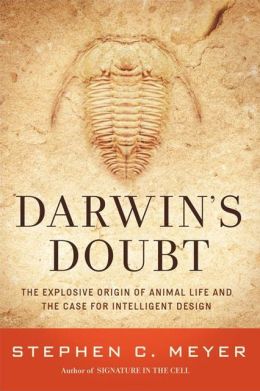
Stephen C. Meyer discusses his new book “Darwin’s Doubt” on the Michael Medved show

The Michael Medved show is a national radio show broadcast out of Seattle, Washington. According to Talkers magazine, he has the fifth largest radio audience. He has a regular weekly segment on science and culture featuring  scholars from the Discovery Institute.

Here is the segment from this past week, courtesy of the Intelligent Design: The Future podcast.

The MP3 file is available for download. (38 minutes)

The description is:

On this episode of ID the Future, the Michael Medved Show welcomes Dr. Stephen Meyer to talk about his new bestselling book, Darwin’s Doubt: The Explosive Origin of Animal Life and the Case for Intelligent Design. Listen in as Meyer and Medved discuss the mysteries of the Cambrian explosion and why this phenomenon continues to stump Darwinian evolutionists.

Each week, leading fellows from Discovery Institute will join Michael Medved to talk about the intersection of science and culture. Listen in live online or on your local Medved station, or stay tuned at ID the Future for the weekly podcast.

Topics:

  • Darwinism offers a materialistic account of where humans and animals came from, but is that all human beings are?
  • Darwin was the first to have doubt about his theory of evolution because of the sudden origin if many different animal forms in the Cambrian era
  • The book is about the sudden origin of these animal forms and more generally about how much information is needed to make an animal genome
  • An animal is not just the form or the organs it is also the information to make new proteins and the instructions to make proteins are in the DNA
  • At least 20 new phyla appear suddenly in the Cambrian fossils and the question is what is capable of creating all of that new information
  • Mathematicians and computer scientists are especially likely to doubt evolution as a way of making new features because they know that random changes to the code base of an application are more likely to break things and degrade performance
  • Naturalists have tried to explain the Cambrian explosion as being a case of the transitional fossils being not yet discovered
  • The consensus of science at this time is that there is no known naturalistic explanation for the sudden origin of these animal types
  • Caller: how abrupt are we talking about for the introduction of these new animal forms?
  • Meyer: We can calculate the amount of time that is needed to generate change, and the period of time that is needed to generate new forms of life exceeds the time available
  • Caller: is it possible that meteors, asteroids and comets could transport biological components to the Earth to shorten the development time?
  • Meyer: that’s related to my first book on the origin of the first living cell “Signature in the Cell”, and that life-from-space hypothesis would only get you building blocks, but not the bio-molecules that have the building blocks sequences – it’s the difference between a pile of Scrabble letters and a Shakespearean play – it’s the arranging of the components that is the problem
  • Medved: The book has a lot of endorsements from scientists who are working at good universities and institutions
  • Meyer: the strange thing about exploring the limits of evolution is that you can cite mainstream papers to criticize the Darwinian mechanisms, and then the proponents of Darwinism just assert that no criticism of Darwinian evolution is allowed
  • Caller Greg: are you saying that all the phyla came in during the Cambrian explosion?
  • Meyer: No, of the 26 phyla that we see in the fossil record, 20 come in during the Cambrian explosion
  • Caller Greg: But there are some sponges that existed before the Cambrian explosion, so maybe all the Cambrian phyla came from sponges?
  • Meyer: There are 3 phyla present in the pre-Cambrian but they are not ancestral to the 20 Cambrian phyla, the sponges are very simple – 6-10 cell types, arthropods have 60-90 cell types – you can’t go from sponges to compound eyes in just 5-10 million years
  • Meyer: even the sponges in the pre-Cambrian appear abrutly at the end of the pre-Cambrian
  • Caller Greg: but there are complex worms in the Pre-Cambrian as well, and maybe those are ancestral to the 20 new phyla that appear suddenly in the Cambrian explosion
  • Caller Greg: what you’re saying is that we scientists don’t understand what happened so an intelligence did it
  • Meyer: No, what I am saying is that the Cambrian explosion involves massive amounts of new biological information, and none of the naturalistic Darwinian mechanisms can create that much new information in that short of the time
  • Caller Greg: it’s magic!
  • Meyer: there are two points in the development of life forms where intelligence is needed: the origin of life and the Cambrian explosion, and this is because of the new information that is being added
  • Caller Greg: new information is added by Hox Gene duplication
  • Caller: don’t we have to look a bit more at epistemology when discussing these issues?
  • Meyer: Yes, we have to highlight that many people reject intelligent design because of a pre-supposition of naturalism that prevents them from seeing that intelligence explains anything regardless of the evidence
  • Caller: well if you define evolution as change over time, then evolution happened, and who cares about the details like the origin of life and Cambrian explosion?
  • Meyer: well there are many definitions of evolution: 1) change over time, 2) universal common ancestry, 3) undirected random process can explain the origin of life and the explosion of new animal forms in the fossil record
  • Meyer: I accept 1) and I am skeptical of 2) and 3)

You can read more about caller Greg and Hox gene duplication at Evolution News.

I subscribe to the ID the Future podcast, and I really recommend that you do as well!

Previous entries

Thinking Christian reviews “Darwin’s Doubt”, a new book by Stephen C. Meyer

Darwin's Doubt: The Explosive Origin of Animal Life and the Case for Intelligent Design
Darwin’s Doubt: The Explosive Origin of Animal Life and the Case for Intelligent Design

NOTE: you can tune in to the Dennis Prager radio show  at 2 PM Eastern today in order to hear Dr. Meyer discuss the new book.

I found a book review of the new book on intelligent design by Dr. Stephen C. Meyer. This book is concerned with the fossil record, and it is the sequel to the highly acclaimed “Signature in the Cell“, which dealt with the origin of biological information in the first living cell.

Excerpt:

The title of the book refers to the difficulty [Charles Darwin] had in explaining the “Cambrian Explosion,” the vast proliferation of new animal body plans (new “phyla” or major animal groupings) that appears in fossils in the Cambrian strata, deposited some 530 million years ago. These animals appear suddenly in the fossil record, without any plausible predecessor such as Darwin’s theory predicted. Darwin wrote,

The difficulty of understand the absence of vast piles of fossiliferous strata, which on my theory were no doubt somewhere accumulated before the Silurian [i.e., Cambrian] epoch, is very great. I allude to the manner in which numbers of species of the same group suddenly appear in the lowest known fossiliferous rocks.

Darwin saw this accurately as a challenge to his theory. It remains one still. The animals appear too quickly in the record to be explained through his gradualistic theory.

And it remains a challenge from the perspective of mainstream science. Various theories have been proposed in explanation of the suddenness with which these new phyla came on the scene. Perhaps selective fossilization caused their predecessors to disappear from paleontologists’ view. Mainstream science casts serious doubt on that view. Statistical paleontology renders it deeply improbable. The soft-body hypothesis appears unlikely to succeed, since the evidence shows soft-bodied organisms have been frequently fossilized.

Or maybe the Cambrian animals’ precursors really are there in the record, in the form of exotic Ediacaran fossils. But these organisms are not clearly animals of any sort, and what they are is so in confusion that they could hardly be considered evidence for anything. Further,

As Nature recently noted, if the Ediacaran fauna “were animals, they bore little or no resemblance to any other creatures, either fossil or extant.” … This absence of clear affinities has led an increasing number of paleontologists to reject an ancestor/dependent relationship between the Ediacaran and Cambrian fauna.

Scientists have proposed genetic histories for these phyla, but as Meyer pointedly puts it, these scenarios all “assume a gene.” And a lot more besides. That is to say, they beg the question of evolution’s explanatory adequacy by assuming that it must be true. From there they suggest pathways according to which genes “must have” evolved. But there’s no evidence of it in the record.

Now the exciting thing is that at the time of writing (Monday night), the book is number one on Barnes and Noble:

Darwin's Doubt #1 at Barnes and Noble
Darwin’s Doubt #1 at Barnes and Noble

And number ten on Amazon:

Darwin's Doubt #10 at Amazon.com
Darwin’s Doubt #10 at Amazon.com

Now is this a book for the layman? Well, I’ve met the guy who wrote the book review above face-to-face, and his background is not in biology. I think if he can struggle through it, then I could do it too. And so could you. I think that both of Dr. Meyer’s books are must-read books for anyone interested in knowing how well the presumption of naturalism succeeds when confronted with the latest scientific evidence. These are the books you need to buy and read if you are serious about integrating science and religion. The thing to realize is that naturalists and atheists and materialists have no answer to these books. None. Do you like winning? Then spend the money and time on the books that are unstoppable in a debate.

Man of Steel movie opens today, and here’s a review by Focus on the Family

A review of the new “Man of Steel” movie, that opens today. (H/T ECM) This might be an excellent movie to take Dad to on Father’s Day – see below for the reasons.

Excerpt:

Clark is an extraordinary man of character who comes by his heroism tendencies honestly. His Kryptonian parents, Jor-El and Lara Lor-Van, put their lives at risk to save their infant son and stand up to the evil schemes of General Zod. And by way of hologram, Jor-El encourages his adult son to stand strong for the people of Earth, saying, “You can embody the best of both worlds.”

His earthly mom and dad also give him some direct examples: During an unexpected tornado, Jonathan Kent puts his own life at risk to save others, clearly showing his son the meaning of self-sacrifice. He talks repeatedly to his boy about the importance of good choices and solid character. And when a preadolescent Clark is having something of a breakdown thanks to the onset of his supersenses, Martha Kent talks him through it. “The world is too big, Mom,” Clark cries from inside a locked closet at school. “Then make it small,” Martha coaches him lovingly. “Focus on my voice.”

So when Clark finds out about his otherworldly origins, he cries out to his father, “Can’t I just keep pretending that I’m your son?” To which Jonathan immediately embraces the boy and retorts with a breaking voice, “You are my son.”

Those kinds of parental moments of love and instruction are obviously reflected in Clark’s subsequent choices, large and small. Even when he’s in the heat of thunderous battle, he takes the time and puts in the extra effort to deflect harm from an innocent or break a wounded soldier’s fall. And it’s these kinds of others-focused actions that eventually motivate human soldiers and civilians alike to unquestioningly accept Clark (aka Superman) as one of their own—belying the Kents’ fears of his probable rejection.

And not just character, but spiritual issues:

[T]his Man of Steel movie is one of the most spiritually symbolic and Messianic-image-packed treatments ever made about this character. Here, Clark Kent even comes to understand—at the age of 33, no less—his responsibility to step up, face off with and destroy an ultimate evil that threatens all mankind.

But that’s at the end. At the climax. All through this film dialogue and images hint at connections between Superman and Jesus. Several people, from Jor-El to Jonathan to Zod’s female second, Faora-Ul, talk to Clark about his ability (or lack of ability) to save the people on his adopted planet. Superman levitates with his arms spread in a cross-like form on several occasions. When he goes to his church to ask a priest for advice, the camera’s eye frames a stained-glass representation of Christ over the young Clark’s shoulder. The priest tells him, “Sometimes you have to take a leap of faith first. The trust part comes later.”

After Clark rescues a bus full of children, a kid’s mother states, “This was an act of God!” Clark asks his dad, “Did God do this to me?” When Lara worries about her infant son’s safety on Earth, Jor-El assures her, “He’ll be a god to them.” Bad guy Kryptonians tell Superman that they will win because “evolution always wins.”

And their conclusion:

“It’s the most realistic movie I’ve made,” director Zack Snyder (who helmed Watchmen, 300 and Dawn of the Dead) told the L.A. Times. “There’s no tongue in anyone’s cheek. I’m not apologizing for Superman in any way. I’m saying, ‘Superman is a thing that must be taken seriously and embraced and understood.'”

Indeed, his version of the now 75-year-old superhero story is straightforward and earnest. It’s an honest-to-goodness sci-fi opera that reflects both the classic roots and the modern comic book sensibilities of its well-known superhero legend.

[…][W]e come to what Snyder calls Superman’s “inherent goodness.” The director says, “If you really think about it, you still want him to be right and to make the right choices and to do the right thing. I think that we all hope for that in ourselves, and I think that’s what always has made him a very interesting character. He’s a Christ-like figure. There’s no two ways about it.”

And Snyder leaves that inherent goodness and Christ-likeness in his film for all to see. (Through the cascades of sci-fi dust and debris, of course.)

Evolution News even commented on the evolution issue:

No, I haven’t seen Man of Steel yet since it just opened today but I do want to. Among other points of interest: the bad guys, pursuing Kal-El a/k/a Clark Kent to Earth, are animated in the film’s telling by an eerily Darwinian philosophy.

In one clip, chief bad guy General Zod confronts Superman’s birth father Jor-El and calls on him to join in a campaign against the “degenerative bloodlines that led us to this state.” Later, in a duel with planet Krypton’s assassin sent to wipe him out, Superman gets knocked around, which prompts the villainess to observe that he is weak: “The fact that you possess a sense of morality, and we do not, gives us an evolutionary advantage. And if history has proven anything, it is that evolution always wins.” (See the MTV clip above.)

The only problem with her analysis is that evolution, in the presumed Darwinian sense here, “always wins” by discarding things that don’t give an “evolutionary advantage.” That would seem to include the exquisitely tuned conscience with which human beings are gifted — what advantage does that confer? —  the existence of which, as we know well, poses one of many enigmas that a Darwinian view is helpless in explaining.

I think that it would be a good idea to go into the theaters and see this movie at least once to signal Hollywood about what people really want to see. Obviously, it would be great if we could go into theaters and see William Lane Craig debates and Thomas Sowell lectures, but when something good and wholesome comes out of Hollywood, we should go and see it so that we at least send a message to the movie makers who are influencing the culture. When an organization like Focus on the Family clears a movie, then surely it’s safe to go see it.

If you don’t feel like going out to see a movie this weekend, here’s a list of older “character” movies that I also recommend:

  • Rules of Engagement (Samuel L. Jackson)
  • Bella
  • The Lives of Others
  • United 93
  • Taken (Liam Neeson)
  • Cinderella Man
  • The Blind Side
  • Cyrano de Bergerac (Gerard Depardieu)
  • Amazing Grace (Ioan Gruffudd)
  • We Were Soldiers
  • Stand and Deliver
  • Blackhawk Down
  • The Pursuit of Happyness
  • High Noon (Gary Cooper)
  • The Way Back
  • The Incredibles

If I like Superman enough, I might even add it to my list of favorites.