
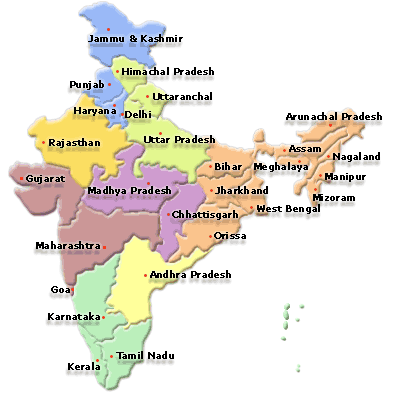
Consider this article from the Philadelphia Bulletin.
Excerpt:
In 2007, the School Choice Campaign, a New Delhi-based education think tank, designed, funded, and implemented a pilot school choice program in the city. The program randomly selected students to be offered a school tuition voucher, which was taken up by 63 percent of students selected. The money could be used at any qualifying private school.
India’s teacher unions have fought the privately funded program tooth-and-nail. “They fight vouchers [because] they will enable students to leave the malfunctioning government schools and make the teachers redundant,” says Jan S. Rao, director of the School Choice Campaign in Delhi. “It is already happening in urban areas. In Delhi there are schools with more teachers than students, since the students have left.”
Oxford economist Francis Teal examined the effect of teacher unions on academic performance in India for a 2008 study. “We thus have in this data clear evidence that unions raise cost and reduce student achievement,” he bluntly states.
[…]For leaders of India’s education choice movement, the success of this trial is only the beginning. They will not be satisfied, says Dr. Parth J. Shah, president of India’s Centre for Civil Society, until “the Delhi government immediately adopts funding all new government schools on a per-pupil basis through vouchers.” That is already the national strategy in Sweden and Chile.
If I ever go totally crazy and just do whatever I want to do, then I’m moving to Chile. Just to see what it would be like. I’d like to move to India, but I’m told that there are a lot of mosquitoes, and the roads aren’t good. But that could change.
What about Louisiana?

Well, Louisiana has an Indian-American Republican Governor – his name is Bobby Jindal, and he is very enthusiastic about education reform. What has he done to make education reform work better?
Consider this study done by the Thomas B. Fordham Institute. (H/T Independent Women’s Forum)
Excerpt:
The charter environment thrives in New Orleans. Louisiana state law places no cap on the number of schools that can operate, and it provides for adequate funding of both charters and authorizers. The Louisiana Charter School Start-Up fund also provides zero-interest loans for charter schools to use for facilities-an element of charter funding that many states ignore. New Orleans leads the country in its percentage of students in charters at 57 percent.
That’s right – Louisiana is number one in education reform!
And there’s more:
Every city that receives a D or an F in this analysis is in a collective-bargaining state. Meanwhile, two-thirds of the top nine scorers (cities receiving a B) are located in right-to-work states. All of the cities located in right-to-work states included in this study received a B or C, and none received a D or F.
Right-to-work means that a teacher can work without having to join a union! And that means that they can be fired if they can’t perform – but if they can perform, then they make more money! So they have an incentive to work harder and to make their students learn more – there is no safe job for them if they underperform.
Is South Carolina next? South Carolina has an Indian-American Republican Nikki Haley running for governor, so they’re probably next for major education reforms. I’m being silly, but you have to wonder… is there something about the Indian culture that makes them take education more seriously?
 WINTERY KNIGHT