Moral relativism is the view that moral values and moral duties do not exist in reality, but only exist as opinions in people’s minds. When you ask a moral relativist where the belief that stealing is wrong comes from, he may tell you that it is his opinion, or that it is the opinion of most people in his society. But he cannot tell you that stealing is wrong independent of what people think, because morality (on moral relativism) is just personal preference.
So what’s wrong with it?
I found this list of the seven flaws of moral relativism at the Salvo magazine web site.
Here’s the summary:
Moral relativists can’t accuse others of wrongdoing.
Relativists can’t complain about the problem of evil.
Relativists can’t place blame or accept praise.
Relativists can’t make charges of unfairness or injustice.
Relativists can’t improve their morality.
Relativists can’t hold meaningful moral discussions.
Relativists can’t promote the obligation of tolerance.
Here’s my favorite flaw of relativism (#6):
Relativists can’t hold meaningful moral discussions. What’s there to talk about? If morals are entirely relative and all views are equal, then no way of thinking is better than another. No moral position can be judged as adequate or deficient, unreasonable, acceptable, or even barbaric. If ethical disputes make sense only when morals are objective, then relativism can only be consistently lived out in silence. For this reason, it is rare to meet a rational and consistent relativist, as most are quick to impose their own moral rules like “It’s wrong to push your own morality on others”. This puts relativists in an untenable position – if they speak up about moral issues, they surrender their relativism; if they do not speak up, they surrender their humanity. If the notion of moral discourse makes sense intuitively, then moral relativism is false.
I sometimes get a lot of flack from atheists who complain that I don’t let them make any moral statements without asking them first to ground morality on their worldview. And that’s because on atheism morality IS NOT rationally grounded, so they can’t answer. In an accidental universe, you can only describe people’s personal preferences or social customs, that vary by time and place. It’s all arbitrary – like having discussions about what food is best or what clothing is best. The answer is always going to be “it depends”. It depends on the person who is speaking because it’s a subjective claim, not an objective claim. There is no objective way we ought to behave.
So, practically speaking, everyone has to decide whether right and wrong are real – objectively real. If they are objectively real, that means that there is a right way for human beings to behave, and a wrong way for human beings to behave. It means that things like rape are wrong for all times and all places, regardless of what individuals and societies might think of it. In order to rationally ground that kind of morality, you have to bring a cosmic Designer who decides for all times and places what the conduct of his creatures ought to be. And then our moral duties are duties that are owed to this Designer. It is like playing football or playing a boardgame – the person who invents the game decides the rules. But if there is no designer of the game, then there are no rules. Without a designer, how we ought to act is decided by people – specifically, by the people who have power.
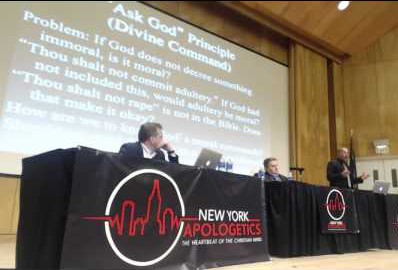
Turek’s cross-examination period starts at 74m22s and ends at 89m20s.
Shermer’s cross-examination period starts at 89m50s and ends at 105m0s.
Topics of Turek’s cross-examination:
evolution produces Shermer’s moral sense and Hitler’s moral sense
why does Shermer think his is better than Hitler’s, since both were produced by the same evolution?
what makes right or wrong if evolution is the source of morality?
why is Stalin’s opinion of right and wrong less valuable than the herd’s opinion of right and wrong?
do the Founding Fathers ground inalienable rights in a Creator, or in evolution?
can atheism ground the existence of inalienable rights?
can you ground objective moral values and objective moral duties by asking people how they feel?
can you ground objective human rights on atheism by shouting like a madman and interrupting?
how can you trust your thinking if they are the result of an unguided, random process of evolution?
how can you have rational thoughts if materialism is true, and you are a machine made out of meat?
can you ground objective moral values and objective moral duties on personal preferences?
how do the personal preferences of some individuals create an objective moral duty for other individuals?
does naturalistic evolution orient human beings toward survival or truth?
on materialism, what is the chemical composition of justice?
Topics of Shermer’s cross-examination:
Radical muslims are exactly the same as evangelical Christians, and have the same God (Allah is the same as the Triune Christian God)
Radical muslims would assert that their God is the same as the Triune Christian God, with Jesus and the Holy Spirit also being God
Therefore, we can lay the blame for what radical muslims do on the backs of evangelical Christians
Radical muslims and evangelical Christians are the same, because “you’re enthusiastic, they’re enthusiastic”
The Bible’s notion of indentured servitude to pay off debt is the identical to the idea of slavery based on race
The Bible’s notion that masters and slaves are equal in the sight of God forms a basis for thinking they are unequal
The Bible teaches things that I disagree with, like the idea that marriage should provide children with a mother and a father
Gay marriage is solidly grounded in evolution, even though the morality that evolution produces varies by time and place
Atheists can ground objective moral values and objective moral duties by asking people how they feel
Can atheists who want to legalize gay marriage because “they’re in love” prohibit polygamy or incest as marriage?
Is shouting “you’re on the wrong side of history” a way to rationally ground morality in an accidental atheistic universe?
Is it loving for atheists to celebrate a lifestyle that exposes gay men to sickness and premature death?
Is it “bigotry” for the Center for Disease Control to warn men who have sex with men about higher health risks?
How do Christians decide what is right and wrong when they are confronted with a moral dilemma?
How do humans sense the objective moral standard that is required for them to make moral judgments
Can enlightenment philosophers who merely imagine human rights actually create those human rights?
If revelations change over time for Mormons, does that undermine the need for God to ground objective morality?
I apologize for the poor quality of the video and audio. The moderator was extremely ineffective, letting Shermer go on and on making speeches instead of asking questions during his questioning time. Also, Shermer apparently thought that shouting at Turek and waving his finger at Turek was a good strategy to defend against Turek’s use of logic and evidence.
My thoughts on Michael Shermer
I do want to make some general comments about what Shermer said. Shermer’s view of morality is “what is best for the greatest number of people”. There are no inalienable rights that act as a break on the will of the majority. Shermer has no objection to anything that the majority has decided in any time or in any place. If he were there, he would agree that whatever they decided was morally right.
Two hundred years ago, Shermer would have endorsed slavery. And if he were in Germany 50 years ago, he would have endorsed the Holocaust. If he lived in a Pakistan today, he would endorse stoning women for wearing the wrong clothes. Atheists always think that whatever the majority is doing in a particular time and place is right for them. There are no inalienable human rights that exist apart from human opinions, on atheism.
Another problem is that Shermer is constantly making moral judgments when his own view is that morality is constantly changing in different times and places. He condemns the moral values of other times and places without having any standard in his worldview that can decide between different moral values and duties. It is like saying that lunch is better than breakfast because lunch is here and now, and breakfast was then and there. That is literally what atheists do when they make moral judgments. They have no standard that applies to different times and places, just the ever evolving opinions of the majority of people in different times and places.
Is Michael Shermer concerned about morality?
Finally, I want people to understand what kind of person Michael Shermer is. You can read a post by PZ Myers on his blog Pharyngula to get the picture. I think it’s useful to know about Shermer’s own morality since he seems to like to make moral judgments so much during debates. In my own experience in dealing with atheists, although they will talk about slavery and the Crusades, there is nothing in an atheist’s moral system that makes things wrong for all times and all places. They bring it up to stop you from judging them about the things that they care about. When an atheist says “the Crusades! Slavery!” what they really mean is “I need to shame you for having a basis for moral judgments against me, so that you won’t say anything about me getting married women drunk then raping them”. That’s what atheistic use of moral language is really about.
What atheists really think about morality
Atheist Richard Dawkins says atheists have no objective moral standards:
In a universe of blind physical forces and genetic replication, some people are going to get hurt, other people are going to get lucky, and you won’t find any rhyme or reason in it, or any justice. The universe that we observe has precisely the properties we should expect if there is, at bottom, no design, no purpose, no evil and no good, nothing but blind, pitiless indifference… DNA neither knows nor cares. DNA just is. And we dance to its music. (Richard Dawkins, River Out of Eden: A Darwinian View of Life (1995))
So, when Shermer tries to shame Christians for behaviors in other times and places which our society here and now disagrees with, what he really means is “morality, objectively speaking, is nonsense, but I will use your moral sense that comes from your non-atheistic worldview to shame you, so that you won’t have the confidence to judge me for my immoral behavior”. And we need to get used to understanding this about atheists. Morality is nonsense to them, and their real goal is to get you off their back for their hedonism. For atheists, morality is just complying with arbitrary social customs which vary by time and place. There is nothing more to it than aping their neighbors (at least when their neighbors are watching). And they would have aped slave-owners, widow-burners and Nazi prison guards too, if they lived in that time and place. And shouted at Christians for disagreeing with them, just like Shermer did about gay marriage.
If you like the way that Frank Turek debates, then be sure and check out his new book “Stealing From God“. I highly recommend it.
I read Dr. Craig’s report of his debate with Louise Antony on the topic of God and morality. My impression from his review was that she hadn’t prepared for the debate and didn’t understand the moral argument at all.
Recently, I listened [again] to the debate between William Lane Craig and Louise Anthony. Some have lauded this debate as a stirring victory for secular ethics. (See, for example, the comments here–one comment even goes so far as to say “I swoon when someone evokes the Euthyphro Dilemma and frown at the impotent, goal-post-moving, ‘Divine nature’ appeal.”) In reality, I think Louise Anthony did indeed present the case for secular metaethics. The problem is that this case is utterly vacuous.
I’ll break down why this is the case by focusing upon three areas of development in secular and theistic ethics: objective moral truths, suffering, and moral facts.
Here’s the snarkiest part:
Louise Anthony seems to be just confused about the nature of objective morality. She says in response to a question from the audience, “The universe has no purpose, but I do… I have lots of purposes…. It makes a lot of difference to a lot of people and to me what I do. That gives my life significance… The only thing that would make it [sacrificing her own life] insignificant would be if my children’s lives were insignificant. And, boy you better not say that!”
Craig responded, “But Louise, on atheism, their lives are insignificant.” Anthony interjected, “Not to me!”
But then she goes on to make this confused statement, “It’s an objective fact that they [her children] are significant to me.”
Note how Anthony has confused the terms here. Yes, it is an objective fact that according to Louise Anthony, her children matter to her. We can’t question Anthony’s own beliefs–we must trust what she tells us unless we have reason to think otherwise. But that’s not enough. What Craig and other theists are trying to press is that that simple fact has nothing to do with whether her children are actually valuable. Sure, people may go around complaining that “Well, it matters to me, so it does matter!” But that doesn’t make it true. All kinds of things can matter to people, that doesn’t mean that they are ontologically objective facts.
It matters to me whether the Cubs [an American baseball team] win the World Series. That hasn’t happened in 104 years, so it looks like it doesn’t matter in the overall scheme of the universe after all. But suppose I were to, like Anthony, retort, “But the Cubs matter to me! It’s an objective fact that them winning the World Series is significant to me!” Fine! But all the Cardinals [a rival team] fans would just laugh at me and say “SO WHAT!?“
Similarly, one can look at Anthony with incredulity and retort, “Who cares!?” Sure, if you can get enough people around Anthony who care about her children’s moral significance, you can develop a socially derived morality. But that’s not enough to ground objective morality. Why should we think that her values matter to the universe at large? On atheism, what reason is there for saying that her desires and purposes for her children are any better than my desires and purposes for the Cubs?
She doesn’t even understand the difference between objective and subjective morality! Sigh. For her, it’s enough that people have feelings about what they like and don’t like, and that they have the feeling that they ought to act in line with their feelings. And if you challenge her about obviously evil people, e.g. – radical Islamists blowing up innocent children for their ideology, well she has no reason to say that their feelings-based morality is any more rationally grounded than her own. The problem with atheists is that they approach morality with the goal of explaining it away. They want to avoid having to comply with objective, prescriptive morality, but they also want to justify themselves to theists by saying “look at me, I have standards too, I’m not a sociopath!” So, they invent a subjective morality based on their need to feel good and get the praise of their peers and congratulate themselves about acting according to a subjective standard. Problem solved! The fact is that there is no way to get to an objective moral standard that applies in all times and places on atheism. Accidental universe = anything goes. Period. End of issue.



 WINTERY KNIGHT