
Tag Archives: Energy

Supreme Court rules against EPA’s job-killing tax on electricity

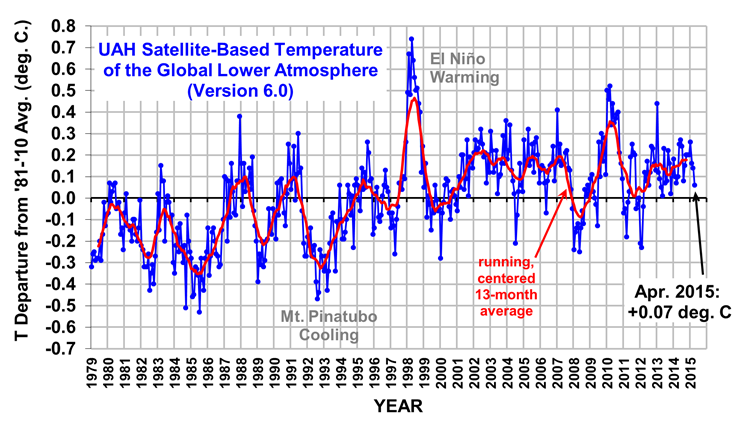
Atmospheric temperature measurements though April 2015

If you have to pay your own electricity bill out of your own earnings, then I have some good news for you.

The Daily Signal has the story.

Excerpt:

Today, the Supreme Court in Michigan v. EPA held that the Environmental Protection Agency improperly ignored costs when it decided to regulate hazardous air pollutants from power plants. The court, in this 5-4 opinion, struck down this extremely costly rule, known as Utility MACT or Mercury and Air Toxics Standards (MATS).

Under Section 112 of the Clean Air Act, which applies to power plants, the EPA administrator shall regulate if the regulation is found to be “appropriate and necessary.” According to the EPA, they didn’t have to consider cost when deciding to regulate, even though the statute specifically says that the regulation has to be “appropriate.”

Justice Antonin Scalia, writing for the majority, explained, “[a]gainst the backdrop of this established administrative practice [consideration of cost], it is unreasonable to read an instruction to an administrative agency to determine whether ‘regulation is appropriate and necessary’ as an invitation to ignore costs.”

The EPA was going to ignore an astonishing amount of costs. The EPA estimated the costs to be $9.6 billion annually. This compared to benefits of $4 million to $6 million annually. As pointed out by Scalia, “[t]he costs to power plants were thus between 1,600 and 2,400 times as great as the quantifiable benefits from reduced emissions of hazardous air pollutants.” As the court succinctly explained, “[n]o regulation is ‘appropriate’ if it does significantly more harm than good.”

Unfortunately, energy prices are still going to go up, and jobs are still going to be lost as a result of previous EPA regulations.

The Stream says:

While this is a major legal win for the coal industry, it may have come too late. Power plant operators have already slated to retire 13 gigawatts of coal-fired power by the end of this year. Coal plant owners also must ready themselves to comply with upcoming ozone and greenhouse gas regulations.

Well, it’s been a rough week, but we have to take our victories where we can. A win’s a win. Hopefully, the next President will abolish the EPA and the Department of Energy entirely, so that those clowns have to get real jobs doing something useful for a change.
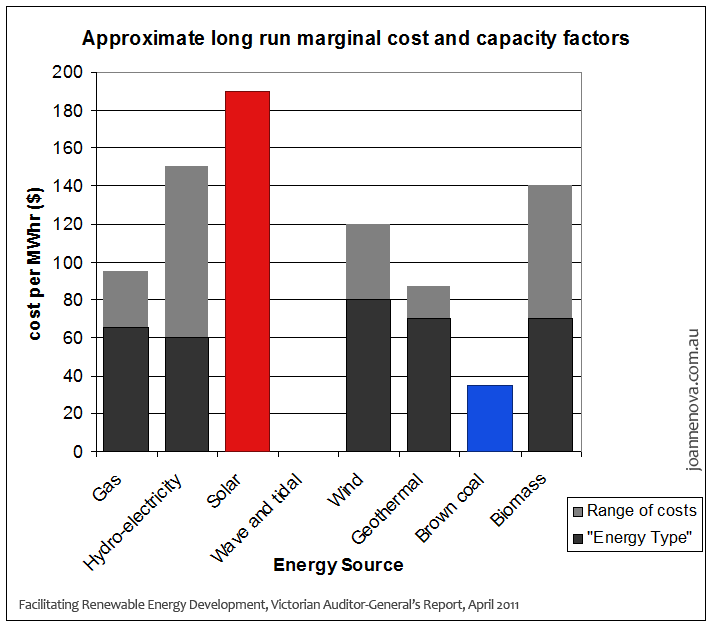
Germany is further along the green energy road, how is it working for them?

Cost of renewable wind and solar energy

This is from National Review, and I think it’s important for the young people to know, because they are the ones who think that green energy is a moral imperative that has no downside.

Look:

According to EU data, Germany’s average residential electricity rate is 29.8 cents per kilowatt hour. This is approximately double the 14.2 cents and 15.9 cents per kWh paid by residents of Germany’s neighbors Poland and France, respectively, and almost two and a half times the U.S. average of 12 cents per kWh. Germany’s industrial electricity rate of 16 cents per kWh is also much higher than France’s 9.6 cents or Poland’s 8.3 cents. The average German per capita electricity consumption is 0.8 kilowatts. At a composite rate of 24 cents per kWh, this works out to a yearly bill of $1,700 per person, experienced either directly in utility bills or indirectly through increased costs of goods and services. The median householdincome in Germany is $33,000, so if we assume an average of two people per household, the electricity cost would amount to more than 10 percent of available income. And that is for the median-income household. The amount of electricity that people need does not scale in proportion to their paychecks. For the rich, $1,700 per year in electric bills might be a pittance, or at most a nuisance. But for the poor who are just scraping by, such a burden is simply brutal.

The trouble with solar and wind power is that they are not consistent:

So, what has the German government accomplished for “the Earth” in exchange for the severe harm it has inflicted on the nation’s poorer citizens? It is claimed that Germany has replaced 30 percent of its electricity with renewable energy. If all you look at is capacity, that might appear to be true. Germany has a total installed capacity of 172 gigawatts (GW), and 65 GW of that is based on renewables. But neither wind nor solar power obtains an around-the-clock average of anything close to full capacity. Rather, these methods of electricity generation typically average at best about 20 percent of their full rated power. Thus Germany’s nominal 65 GW of solar and wind generation capacity is worth about as much as 13 GW capacity in conventional power plants. Of the 614,000 GW hours that Germany generated in 2014, 56,000 GWh came from wind and 35,000 GWh from solar, for an actual combined average power of 10.4 GW, or 14.8 percent of all electricity generated. About half of this, or 5.2 GW, has been developed since 2005.

Germany used to have safe, clean nuclear power with zero emissions, but they got rid of it:

However, in 2011 Germany had 20 GW of capacity in nuclear power plants, producing more than twice as much electricity as wind and solar do currently, at less than half the cost, with no carbon emissions whatsoever. But, using the rather improbable threat of a Fukushima-like tsunami as a pretext, the nation’s elites decided to shut them down; 8.3 GW have already been eliminated.

Thus, over the past decade, the total amount of carbon-free power that Germany has produced under its oppressive green-energy policy has actually decreased by 3 GW.

This makes me think of what happened to the wind farms in the UK during cold weather – they had to keep spinning using power from the main grid, to keep themselves from freezing! What a disaster. Green energy is just not ready for prime time. The more the government pushes it, the more the cost of electricity rises. Not good for the poor. Does anyone care how these “feel good” policies of the rich left affect the poorest people?

Socialist party wins majority in Canada’s most conservative province

Orange = NDP, Green = Wildrose, Blue = Conservative

This article from Reuters explains what happened.

It says:

The left-wing New Democrats won election in the Canadian province of Alberta on Tuesday, ending the 44-year run by the Progressive Conservatives amid promises to review oversight of the oil and gas sector in the home of Canada’s oil sands.

At the end of a month-long campaign, the New Democratic Party (NDP), which has never held more than 16 seats in the 87-seat provincial legislature, will lead a majority government. It held a commanding lead in early results, leading or elected in 54 seats at 9 p.m. local time while the Conservatives were ahead in just 13, according to CBC TV.

The NDP is expected to be far less accommodative to the Western Canadian province’s powerful energy industry.

NDP Premier-elect Rachel Notley has proposed reduced support for pipeline export projects and a review of oil and gas royalties in the resource-rich province, and energy shares on Canadian stock markets are expected to react negatively to her party’s victory.

The NDP had promised to hike corporate tax rates by two percentage points to 12 percent if elected, but its promise to review the amount of royalty payments due the province from oil and gas production made some investors nervous.

Alberta’s oil sands are the largest source of U.S. oil imports.

The Conservatives had won 12 straight elections, but support for rookie Premier Jim Prentice plunged during the campaign and right-wing voters split support between the Conservatives and the younger, more conservative Wildrose Party, which appeared on track to be the official opposition.

The Alberta “Progressive Conservatives” are almost as leftist as the NDP. The only real conservatives in Alberta are the Wildrose.

This Canadian Press looks at specific NDP policies:

The NDP have won a majority in Alberta. What could Alberta look like moving forward? Leader Rachel Notley campaigned on having the wealthy pay more to fund better health care and education. Here’s a look at some of the party’s key platform planks:

— A Resource Owners’ Rights Commission to review the royalties oil companies pay to the province with any amount earned above the current rates going into savings.

— A boost in the corporate tax rate to 12 per cent from 10 per cent and an increase in the minimum wage to $15 and hour by 2018.

— More tax brackets on high earners than the Tories are proposing: A 12 per cent tax rate on income between $125,000 to $150,000; 13 per cent on income between $150,000 to $200,000; 14 per cent between $200,000 and $300,000 and 15 per cent over $300,000. The NDP also plans to roll back the Tory health levy.

— The creation of 2,000 long-term care spaces over four years.

— A ban both corporate and union donations to political parties.

That last one looks like a conservative policy, since big corporations and unions are both leftist. So there’s a silver lining to this cloud. I’m sorry for my Canadian friends who will have to live with this, but the mistake was made last election, when they chose the Progressive Conservatives over Wildrose. One thing is for sure, Alberta supplies a lot of our oil here, so this NDP win will raise oil prices, and it’s going to put pressure on American families. Maybe we should be drilling for our own oil?