Tag Archives: Energy

Report finds Labor Department’s green jobs program failing

From the liberal Washington Post.

Excerpt:

A $500 million Labor Department program designed to train workers for green jobs has come up far short of its goals, with only 10 percent of participants finding work so far, the agency’s assistant inspector general has found.

The report said the low rate makes it unlikely the program will meet the goal of placing nearly 80,000 workers in careers in energy efficiency or renewable energy by 2013.

“Grantees have expressed concerns that jobs have not materialized and that job placements have been fewer than expected for this point in the grant program,” said the report from Assistant Inspector General Elliott Lewis.

The report comes as the Obama administration has been on the defensive about making a $528 million loan to Solyndra LLC, a now-bankrupt solar panel maker that has become a target for critics of the administration’s green energy program.

The $500 million for green jobs training was part of the $787 billion stimulus act passed in 2009. Although the money was awarded in a series of grants in 2009 and 2010, only one-third has actually been spent by grantees. Lewis’ report said the rate of expenditures has been decreasing. He suggested the department should consider returning unused money that may not be needed.

“At this point, there is no evidence that grantees will effectively use the funds and deliver targeted employment outcomes by the end of the grant periods,” the report said.

[…]Another problem the report highlighted is that workers who completed training and were placed in green jobs have had trouble retaining their posts. Of the 8,035 workers placed, only 1,336 — or 2 percent of the overall target — have held those jobs for at least six months.

Sen. Chuck Grassley, R-Iowa, who requested the audit, said the report “paints a pretty bleak picture of the program’s effectiveness in job creation.”

“It’s hard to see how leaving $300 million in unused funding for the program in the hands of the Labor Department benefits either the taxpayers or the unemployed,” Grassley said.

The news media loves the Democrats and they are constantly making fun of Republicans for doubting evolution and global warming. I submit to you that believe in green jobs programs is the scientific equivalent of flat-Earthism. And I have the numbers to prove it. They have the blind faith and the insults. We have the evidence.

Related posts

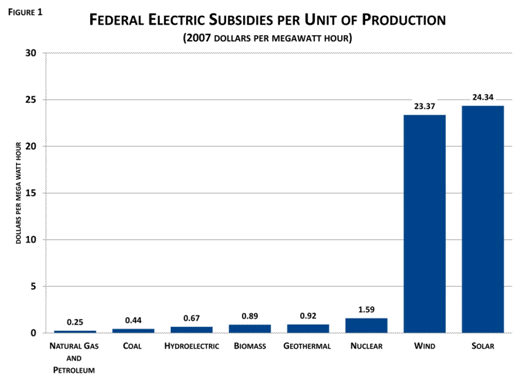
This one graph should end the debate on wind and solar energy

Federal subsidies per unit of electricity

(Click for larger image)

From a U.S. House of Representatives report. (H/T Doug Ross)

Excerpt:

In the fall of 2008, then-candidate Barack Obama made a campaign promise to jumpstart the economy with an influx of green jobs… The President has kept his promise to spend billions of borrowed dollars on green energy, but his promises that such spending would create a new, self-sufficient industry capable of providing millions of jobs for Americans have proven empty.

[…]Two years later, the President’s promise of millions of jobs stands in stark contrast with reality. As a recent report from a Bay-Area news organization made clear, green jobs predictions are “proving a pipe dream.”

[…]Since its introduction in the 2009 stimulus bill, the Department of Energy (DOE) has issued $40 billion in new loan guarantees for private-sector loans for renewable energy projects that might not otherwise have been market-viable. Already, multi-million dollar projects, initially labeled as successes, have failed:

• The first renewable energy loan guarantee recipient, solar start-up Solyndra, received a loan guarantee for $535 million in the fall of 2009, even after repeated warnings from federal financial analysts. In the spring of 2010, it failed to complete its initial public offering after an independent audit questioned the ongoing viability of the firm. Then, in the fall of 2010, the firm closed one of its manufacturing facilities and laid off 180 workers. Finally, the firm declared bankruptcy and laid off 1,100 employees only 15 months after Obama visited a company factory.

• Beacon Power, received a $43 million loan guarantee in July of 2009. Since then, its stock price has dropped by 90 percent – a period during which the NASDAQ exchange on which it is listed has increased by 40 percent. The company has not been in compliance with NASDAQ listing requirements, leading to a delisting determination from the exchange.

• First Wind Holdings, received a $117 million loan guarantee in March of 2010. First Wind withdrew its initial public offering in October of 2010, due to a lack of investor demand. According to the Boston Globe, investors shied away from the company because “First Wind owes more than $500 million, loses money on a steady basis, and reports a negative cash flow.”

Even in the midst of these failures, DOE has been advertising additional loan guarantee recipients, announcing a $1.2 billion loan guarantee to another solar company just one day after the FBI raided Solyndra’s offices. Congressional investigators are initiating a review to examine how many future Solyndras have been already financed by this loan-guarantee program or approved through shoddy review, and how can we prevent future examples of this kind of wasteful federal spending.

Why are we in a recession and bleeding jobs? Because we voted for an anti-science ideologue whose energy policy is designed to 1) pay off his Democrat campaign fundraisers and 2) allow him to put on a show about caring for the planet more than those nasty Republicans. We aren’t going to have a lower unemployment rate and lower consumer prices on energy until we kick out the anti-science crowd. I understand that some people believe in religious nonsense like global warming and Keynesianism. That’s fine – let them keep that in the university classroom. Let the Democrat professors of rhetoric like Christina Romer and Paul Krugman make fine-sounding speeches and build castles in the sky there. But out here in the real world, we have to be more practical than that.

In other news, I note that naturalist High Priest Eugenie Scott is claiming that there is no evidence against Darwinism and global warming. God, save us from being ruled by flat-Earth religious nutcases. I don’t mind if they want to say these things in atheist churches, but the rest of us should NOT have to be ruled by their dangerous religious delusions. There’s a place for blind faith, and it’s not in legislature. They shouldn’t be subsidizing their religion with taxpayer dollars. Separation of church and state.

GOP plan would create 1.2 million new jobs by expanding energy production

From the Pittsburgh Post-Gazette. (H/T Reuben, indirectly)

Excerpt:

Americans are angry and with good reason. They are hurting from unemployment, uncertainty in stock market investments and declining retirement funds. And they are weary of waiting for a real workable plan to get us out of this rut.

This is not a time to try the same failed policies of borrowing, debt and calls for tax increases. So we offer these ideas as President Barack Obama prepares to address Congress Thursday if he really wants to make some major bipartisan moves to get our country moving again.

[…]First, allow U.S. employers to repatriate $1 trillion sitting in overseas banks. The current tax rate of 35 percent is a huge barrier blocking those dollars from being invested in jobs, boosting the stock market and raising the value of retirement funds.

Some companies use armies of attorneys and accountants to find ways to cut those taxes, followed by the Internal Revenue Service tracking them down. Stop the nonsense. Offer a lower tax rate, perhaps 15 percent, for a limited time (maybe even a lower rate if the money is invested in job creation or in purchasing U.S. goods).

[…]Second, freeze the massive number of proposed regulations until Congress can review and approve them. Regulations cost U.S. employers more than $1.75 trillion per year. Federal agencies are moving forward with more than 4,257 new regulations that will add tens of billions in regulatory costs — more than tripling the burden of agency mandates from 2009.Employers are worried how this tsunami of new regulations will overwhelm their businesses so they are holding back on growth and hiring. Unless a regulation is absolutely necessary to protect the public’s health and safety, it should be stopped now. Enactment of House Resolution 10, the REINS Act, would require congressional review and approval for any mandate costing the economy more than $100 million annually.

Third, pass our bipartisan Infrastructure Jobs and Energy Independence Act (H.R. 1861), to expand safe offshore oil and gas exploration, create 1.2 million new jobs annually and launch $8 trillion in economic output. Our bipartisan bill dedicates a portion of up to $3.7 trillion in federal oil and gas revenues from the new exploration for investments in new energy technologies, power generation and grid modernization to help put us on a path to energy independence.

[…]Finally, to preserve a free global market for trade, we must hold foreign nations accountable to abide by international agreements. This year, America will lose its position as the global manufacturing leader to China, in large part because Beijing illegally gives its exports a 20 percent to 40 percent discount by manipulating and devaluing its currency.

Another good idea would be to sign the free trade deals with Panama, South Korea and Colombia. Heritage explains what would happen if we did.

Excerpt:

The Obama Administration—after allowing U.S. free trade agreements (FTAs) with South Korea, Colombia, and Panama to languish unapproved for nearly four years—lately appears eager to push Congress to ratify all three soon. The problem now is that some in Congress are trying to make their approval contingent upon an extension of the Trade Adjustment Act (TAA).

That would be a mistake. The three FTAs are intrinsically worth passing without any strings. Congress should act on them without further delay.

The Korea-U.S. Free Trade Agreement (KORUS) would be America’s largest free trade agreement in Asia. It would increase U.S. exports by an estimated $10 billion annually, increase U.S. gross domestic product (GDP) by $11 billion, and add 70,000 U.S. jobs—all without a dime in federal government spending.[1] The accord would also serve as a powerful statement of the U.S. commitment to East Asia at a time when many perceive declining American interest, presence, and influence in the region. The FTA would strengthen U.S. commercial ties and expand the bilateral relationship with South Korea beyond traditional military ties or the North Korean threat.

[…]Rejecting KORUS would disadvantage U.S. companies by locking in discriminatory trade barriers. During the four years the agreement was held hostage by special interest groups and congressional protectionists, the U.S. lost $40 billion in potential exports. American companies continued to lose market share to foreign competitors. The U.S. used to be South Korea’s largest trade partner, but in less than a decade it has been displaced by China, the European Union, and Japan. As Korea’s market opens further, it will be foreign competitors and not U.S. companies that will benefit.

[…]Until this year, the Obama Administration and congressional leadership took its orders on the U.S.–Colombia FTA from protectionist U.S. labor unions and U.S. anti-globalization groups, joined by far-left allies in the region, who succeeded in delaying congressional approval of the FTA. The cost of delay has been significant. So far, according to the Latin America Trade Coalition’s “Colombia Tariff Ticker,”[2] U.S. companies have paid $3.5 billion (as of this writing) in unnecessary duties to the Colombian treasury in the more than 1,600 days since the FTA was signed.

That $3.5 billion has translated into higher prices in Colombia for U.S. goods and services, which are now at a competitive disadvantage in the Colombian market. It has also meant reduced profits for U.S. companies and lost jobs at home.

There are plenty of good ideas from people who live in the real world where real economic laws apply. Keynesianism has been tried since Pelosi and Reid were elected in 2007. It has failed. We need to move on to what works.