Tag Archives: Energy

Higher gas prices were caused by Obama’s green energy policies

From Investors Business Daily.

Excerpt:

Shell has fought the administration to begin drilling in the Chukchi Sea off Alaska.

The federal government estimates there are 26.6 billion barrels of recoverable oil and 130 trillion cubic feet of natural gas in the Arctic Ocean’s Outer Continental Shelf but repeated safety reviews and designation of much of the region as critical polar bear habitat has slowed development to a crawl.

Only 2.2% of federal offshore land is currently being leased for production.

Then there are the 10 billion barrels locked up in the Arctic National Wildlife Reserve, which would require drilling in just 2,000 acres out of 19 million.

The Obama administration recently rescinded 77 oil and gas leases in Utah and stalled oil shale research and development in Utah, Colorado and Wyoming, where the federal government owns most of the world’s oil shale reserves.

Out West, we may have a “Persia on the Plains.” A Rand Corp. study says the Green River Formation, which covers parts of Colorado, Utah and Wyoming, has the largest known oil shale deposits in the world, holding from 1.5 trillion to 1.8 trillion barrels of crude — most of it locked up by federal edict.

Under President Obama, the American Petroleum Institute notes, leases on federal lands in the West are down 44%, while permits and new well drilling are both down 39% compared to 2007 levels.

After the BP oil spill, President Obama shut down most Gulf of Mexico drilling and there’s been a 57% drop in monthly deepwater permits since 2008, according to the Greater New Orleans Gulf Permit Index.

The demand for oil is increasing as India and China grow their economy. That means there are more people bidding on the supply of oil. In order to keep the price low, the supply would have to increase. But Obama has done everything in his power to reduce the supply. Increased demand and reduced supply means higher gas prices.

And he’s not done yet.

Excerpt:

Despite some green energy failures, such as the bankrupt Solyndra solar panel company and weak-selling Chevy Volt, President Barack Obama said that he wanted to “double down” on green energy spending, and would do what he could even without Congress to subsidize these companies.

Obama’s assertions, at the University of Miami on Thursday, come after numerous reports of green energy firms that received large sums of federal loans and grants but which have either declared bankruptcy or hit financial problems.

[…]CBS News has reported that the administration directed $6.5 billion in taxpayer dollars to a dozen different green companies that now face financial ship. The most notable of these is Solyndra, the solar panel firm that got a $535-million Energy Department loan guarantee before declaring Chapter 11 bankruptcy and being investigated by the FBI.

Among the 12 companies, five others besides Solyndra have filed for bankruptcy. These are Beacon Power of Massachusetts; Evergreen Solar, of Massachusetts; SpectraWatt of New York State; AES’ subsidiary Eastern Energy of New York State and Ener1 of Indiana.

Obama acknowledged that not all companies backed by the federal government will succeed, but said he would not be deterred.

“The payoffs on these public investments don’t always come right away. Some technologies don’t pan out; some companies will fail,” Obama said.

“But as long as I’m president, I will not walk away from the promise of clean energy,” he said.  “I will not cede the wind or solar or battery industry to China or Germany because some politicians in Washington refused to make the same commitment here in America.”

As CNSNews.com earlier reported, the Chevy Volt, touted by Obama as being the future of the government-owned GM and bailed-out Chrysler, was among the biggest market flops in 2011.

Please read this article and share it with your friends. It’s important to understand what Obama’s plan was, and what he did to achieve it. He wanted gas prices to be higher, and that’s what he achieved.

Related posts

Rick Santorum, Mitt Romney and Newt Gingrich’s views on global warming

Rick Santorum does not accept global warming socialism

From WPXI News.

Excerpt:

About 500 people showed up Monday at a local diner in Steubenville, Ohio, to support former Pennsylvania Sen. Rick Santorum as he gave a policy speech.

Santorum said President Barack Obama is pushing a radical environmental agenda that unwisely limits energy production and turns its back on science.

Santorum told voters in Steubenville Monday that science is on the side of those who want to aggressively produce more oil and natural gas in America. He said the notion of global warming is not climate science, but “political science.”

Santorum said Obama and his allies want to frighten people about new oil-exploration technologies so they can get their dollars and turn them over to politicians to win elections “so they can control your lives.”

Here’s Santorum in his own words: “There is no such thing as global warming”

And more Santorum: Global warming is “junk science”

Santorum calls global warming a “hoax” and opposes cap and trade carbon taxes:

Do you think that Rick Santorum would build the Keystone XL pipeline and create the 20,000 jobs? YES HE WOULD.

Mitt Romney accepts global warming socialism

What about Mitt Romney’s view on global warming?

Excerpt:

On the environment, Romney seemed interested in carving out an agenda largely in line with the state’s most fervent activists on the left.

After he took office in 2003, some state employees and activists were nervous about how the new governor would approach the climate-change issue. Massachusetts had already reached an agreement with other Northeastern states and some Canadian provinces on a plan to limit greenhouse gas emissions.

Romney surprised them by taking a hands-on approach, personally helping craft a “Massachusetts Climate Protection Plan” that he unveiled in 2004.

He reorganized the state government to create the Office of Commonwealth Development — with the former president of the liberal Conservation Law Foundation, Douglas Foy, as its head — to better coordinate climate work and sustainable-growth activities among different agencies.

As he worked on the plan, according to people familiar with the process, he even overruled some objections by his chief of staff, who criticized the plan as potentially too left-leaning.

Romney backed incentives for buying efficient vehicles, tougher vehicle emissions rules and mandatory cuts in emissions linked to global warming.

The plan not only called for reducing the state’s overall greenhouse gas emissions to 1990 levels by 2010 and cutting them another 10 percent by 2020, but it said that “to eliminate any dangerous threat to the climate . . . current science suggests this will require reductions as much as 75-85 percent below current levels.”

[…]Beyond the state climate plan, Romney repeatedly pushed to promote clean energy and cut the use of fossil fuels.

In March 2003 he pledged to buy up to $100 million worth of electricity from renewable sources. That month, he declared, “the global warming debate is now pretty much over.”

Here’s Mitt Romney in his own words:

Do you think that Mitt Romney would create the Keystone XL pipeline and create the 20,000 jobs? I say NO HE WOULD NOT.

Newt Gingrich accepts global warming socialism

What about Newt Gingrich’s view on global warming?

Excerpt:

Republican presidential contender Newt Gingrich, as a U.S. House representative from Georgia in 1989, was among the co-sponsors of a sweeping global warming bill that, among other things, called for an international agreement on population growth.

[…]The… Global Warming Prevention Act of 1989 (H.R. 1078) had144 co-sponsors, the majority of which were liberal Democrats such as Rep. Nancy Pelosi (D-Calif.), then-Rep. Barbara Boxer (D-Calif.) and Rep. Barney Frank (D-Mass.) and Rep. John Conyers (D-Mich.). There were only 25 Republican co-sponsors, which included Rep. Gingrich.

The legislation… set a national goal of reducing carbon dioxide levels by at least 20 percent by the year 2000 “through a mix of federal and state energy policies,” as well as “the establishment of an International Global Agreement on the Atmosphere by 1992.”

In addition, the legislation’s summary includes the section “Title XI: World Population Growth.” That section states: “World Population Growth — Declares it is the policy of the United States that family planning services should be made available to all persons requesting them. Authorizes appropriations for FY 1991 through 1995 for international population and family planning assistance. Prohibits the use of such funds for: (1) involuntary sterilization or abortion; or (2) the coercion of any person to accept family planning services.

[…]In 2008, Gingrich appeared alongside Rep. Pelosi (D-Calif.) in a television ad calling for action to address the apparent global warming problem.

Here’s Newt Gingrich in his own words:

Do you think that Newt Gingrich would create the Keystone XL pipeline and create the 20,000 jobs? I say NO HE WOULD NOT.

Which one of these three candidates is the real conservative?

Rick Santorum

Mitt Romney

Environmentalists and protectionists block economic growth in Puerto Rico

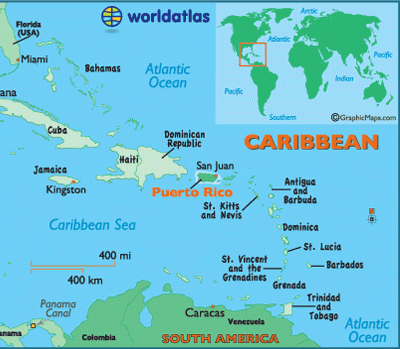
Puerto Rico Map
Puerto Rico Map

Here’s a story from Mary Anastasia O’Grady at the Wall Street Journal. She interviewed Puerto Rican Gov. Luis Fortuño and learned about his plan to boost the island’s economic growth.

Excerpt:

If [Luis Fortuño’s] plan to boost the island’s competitiveness by switching electricity generation from oil to natural gas is to succeed, he’s going to need relief from the pernicious 1920 Jones Act. It prohibits any ship not made in the U.S. from carrying cargo between U.S. ports. There are no liquefied-natural-gas (LNG) tankers made in the U.S. Unless Puerto Rico gets a Jones Act exemption, it cannot take advantage of the U.S. natural gas bonanza to make itself more competitive.

The Jones Act is good if you are a union shipbuilder who doesn’t like competition, or a member of Congress who takes political contributions from the maritime lobby. But it’s bad if you are a low-income Puerto Rican who needs a job. And there are plenty of those.

Puerto Ricans are American citizens but they are significantly poorer than the rest of the country. Per capita income on the island in 2010 was roughly $16,300 compared to just over $47,000 for the nation as a whole.

Life on the island is also expensive, in part because of the high price of electricity, 68% of which is produced using imported oil. The governor’s office says that the price of electricity here went up 100% from 2001 to 2011.

[…][B]ringing down high energy costs remains a fundamental challenge, and one that is exacerbated by new costly federal regulations on emissions that would require the installation of scrubbers on oil-fired electricity plants. To meet those regulations affordably, Mr. Fortuño wants to convert the island’s oil-fired plants to cheaper, cleaner natural gas. To that end, he proposes a pipeline from the southern LNG terminal at Punta Guayanilla across the island to San Juan. The U.S. Army Corps of Engineers has assessed the proposal and said it would produce no significant environmental impact.

It sounds like a plan to help the poor and unemployed. There are only two problems. First, the Sierra Club and local environmentalists have ginned up fears about the project and promised to sue to stop construction. Second, the Jones Act is still in the way.

The governor admits that his administration could have done a better job communicating the pipeline plan to Puerto Ricans, but he also points out that “some of the same groups that have opposed the pipeline have also opposed wind-power and solar projects. They are opposing everything, including waste-to-energy” projects which he maintains are less polluting than landfills.

Mr. Fortuño says that he expects Washington to give him a carve-out for LNG tankers, but he doesn’t have it yet. He also says that a large part of the environmentalist push-back is political, suggesting to me that he ought to be more worried than he is. This kind of politics needs to preserve the status quo of the welfare state. And that implies blocking Mr. Fortuño’s development agenda no matter what it means to the poor.

I thought this article was a neat little way to see how groups of people who understand economics try to pull themselves up out of messes, and who stands in their way. It’s something to think about when you think about poverty – what will really work to lift people out of poverty? And what is the real effect of labor unions and environmentalists on economies?