Tag Archives: Employment

Should young Americans feel confident about their economic prospects?

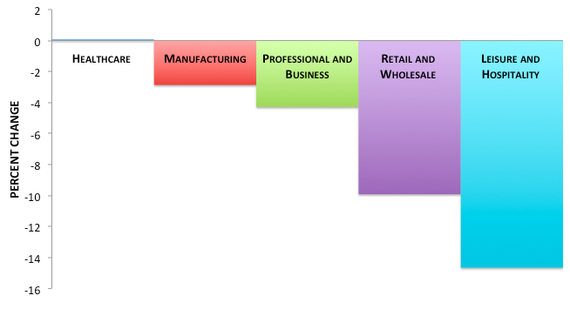
Wages of Young Americans (Source: The Atlantic)

Graph: Young People’s Wages Have Fallen Across Industries Between 2007 and 2013.

Young Americans are taking longer to graduate and graduating with more debt, but that’s not all – they aren’t find jobs, and the jobs they do find typically don’t allow them to pay back their loans.

Here’s an article from The Atlantic, which leans left.

Excerpt:

American families are grappling with stagnant wage growth, as the costs of health care, education, and housing continue to climb. But for many of America’s younger workers, “stagnant” wages shouldn’t sound so bad. In fact, they might sound like a massive raise.

Since the Great Recession struck in 2007, the median wage for people between the ages of 25 and 34, adjusted for inflation, has fallen in every major industry except for health care.

These numbers come from an analysis of the Census Current Population Surveyby Konrad Mugglestone, an economist with Young Invincibles.

In retail, wholesale, leisure, and hospitality—which together employ more than one quarter of this age group—real wages have fallen more than 10 percent since 2007. To be clear, this doesn’t mean that most of this cohort are seeing their pay slashed, year after year. Instead it suggests that wage growth is failing to keep up with inflation, and that, as twentysomethings pass into their thirties, they are earning less than their older peers did before the recession.

The picture isn’t much better for the youngest group of workers between 18 and 24. Besides health care, the industries employing the vast majority of part-time students and recent graduates are also watching wages fall behind inflation. (40 percent of this group is enrolled in college.)

It’s not just that – the Democrats are doing a pretty good job of wrecking other parts of the economy, from energy development to health care to entitlement programs to college tuition, which rises higher as government throws more money into the system. They are doing everything they can to wreck the economy with higher taxes and burdensome regulations.

As a result of our headlong rush towards socialism, the U.S. economy has now fallen to number 2 in the worldbehind China.

Look:

We’re no longer No. 1. Today, we’re No. 2. Yes, it’s official. The Chinese economy just overtook the United States economy to become the largest in the world. For the first time since Ulysses S. Grant was president, America is not the leading economic power on the planet.

It just happened — and almost nobody noticed.

The International Monetary Fund recently released the latest numbers for the world economy. And when you measure national economic output in “real” terms of goods and services, China will this year produce $17.6 trillion — compared with $17.4 trillion for the U.S.A.

As recently as 2000, we produced nearly three times as much as the Chinese.

To put the numbers slightly differently, China now accounts for 16.5% of the global economy when measured in real purchasing-power terms, compared with 16.3% for the U.S.

This latest economic earthquake follows the development last year when China surpassed the U.S. for the first time in terms of global trade.

So things are bad for young people, and it’s going to get worse.

It’s important to check what major you are studying to make sure you get a return on your investment, and don’t be scared to study something you hate if it means that you can make your career work. Your education and career choices are not about fulfillment and thrills. You have to make hard choices in order to make ends meet so that you have freedom to do the things you ought to do, especially if you want to get married and start a family. Those marriage and family plans start the day you step into high school, in my opinion.

UPDATE: 17.7% Teen Unemployment in America – Still Above Rate of 6 Years Ago and Labor Force Participation Remains at 36-Year Low.
Obama’s unemployment: 11,472,000 Americans left the workforce since January 2009

CNS News reports.

Excerpt:

11.4 million Americans age 16 and over have left the workforce since President Obama took office in January 2009, according to data released today from the Bureau of Labor Statistics (BLS).

In July 2014, there were 92,001,000 Americans, 16 and over, who were classified as “not in the labor force,” meaning they not only did not have a job, but they didn’t actively seek one in the last four weeks.

This number has increased by 11,472,000 since January 2009, when the number of Americans not in the labor force was 80,529,000.

The number of Americans not in the labor force dropped slightly in July, down 119,000 from the 92,120,000 Americans not in the labor force in June.

The participation rate, which measures the percentage of the civilian non-institutional population that participated in the labor force by either having a job or actively seeking one, increased from 62.8 percent in June to 62.9 percent in July.

In July, the number of unemployed Americans increased by 197,000 (from 9,474,000 in June to 9,671,000 in July), meaning they did not have a job even though they were actively seeking one.

While the number of unemployed increased in July, so did the number of employed Americans: In June, there were 146,221,000 employed Americans, and that number climbed to 146,352,000 in July, a one-month increase of 131,000.

By contrast, George W. Bush created 8.1 million jobs after his 2003 tax cut.

Excerpt:

Obama and other critics of Bush’s tax cuts argue that they did little to boost economic growth or jobs. But they tend to start their count when Bush signed the first tax cut bill into law in mid-2001.

The problem is that much of that tax plan — including reductions to most of the income tax brackets — wasn’t scheduled to take full effect until 2006.

Bush’s second tax cut, signed in May 2003, accelerated those tax cuts, letting them kick in retroactively to the beginning of that year. The 2003 law also cut taxes on capital gains and dividends.

It turns out that the month after Bush signed that 2003 law, jobs and the economy finally started growing again.

From June 2003 to December 2007, the economy added 8.1 million jobs, according to the Bureau of Labor Statistics. The unemployment rate fell to 5% from 6.3%. Real GDP growth averaged close to 3% in the four-plus years after that, and the budget deficit fell steadily from 2004 to 2007.

And despite Obama’s claim, Bush’s policies did not increase income inequality. In fact, inequality was the same when Bush left office as when he came in, according to theCensus Bureau. A study by University of California economist Emmanuel Saez found that inequality has climbed much faster under Obama.

What’s more, the rich ended up paying a larger chunk of the federal income tax burden after Bush’s tax cuts went into effect, with the share paid by the top 1% rising to 40% by 2007, up from 37% the year before Bush took office, according to IRS data.

The Congressional Budget Office, meanwhile, found that the federal income tax was more progressive in 2007 than it was back in 1979.

Recall that these tax cuts didn’t cost us a thing – the 2007 deficit was $160 billion dollars, which was down from the previous year. Economic growth raised tax revenues.

When you let job creators keep more of their own money, they create jobs. When you tax and regulate job creators more, you destroy jobs. You can’t argue with the Bureau of Labor Statistics numbers. These are the official numbers and they show that Obama failed where Bush succeeded.

Young people who voted for Obama are holding fewer and fewer jobs

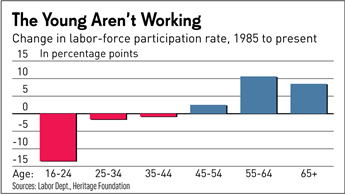
Youth labor force participation

Stephen Moore writes about Investors Business Daily.

Excerpt:

Economists are scratching their heads trying to figure out a puzzle in this recovery: Why are young people not working? People retiring at age 60 or even 55 in a weak economy is easy to understand. But at 25?

The percentage of adult Americans who are working or looking for work now stands at 62.8%, a 36-year low and down more than 3 percentage points since late 2007, according to the Labor Department’s May employment report.

This is fairly well-known. What isn’t so well-known is that a major reason for the decline is that fewer and fewer young people are holding jobs. This exit from the workforce by the young is counter to the conventional wisdom or the Obama administration’s official line.

The White House claims the workforce is contracting because more baby boomers are retiring. There’s some truth to that. About 10,000 boomers retire every day of the workweek, so that’s clearly depressing the labor market. Since 2009, 7 million Americans have reached official retirement age. The problem will get worse in the years to come as nearly 80 million boomers hit age 65.

But that trend tells only part of the story. The chart above shows the real problem: The largest decline in workforce participation has been those under 25.

[…]We do no favors to the young by teaching them that they can consume or have a good time without first earning the money they spend.

I think young people are often brainwashed at a young age to think that bashing the free enterprise system and voting for socialism isn’t going to take away their jobs. But if you vote to tax and regulate the businesses who may employ you later, you’ll find that they are too busy groaning under the strain of big government to employ you.

If young people were serious about getting jobs, they’d be voting to cut subsidies on universities to lower tuition costs, to lower corporate taxes, to cut environmental regulations, to repeal Obamacare, and so on. They would be more concerned that schools teach them actual skills instead of politically correct views, and so they would be voting for school choice and for right-to-work laws, to weaken the teacher unions who are not accountable to them. They should be voting against the minimum wage hikes that will price them out of an all-important first job. They should be voting against the (more than) doubling of the national debt in the 5.5 years under Obama. Job offers are not just there independent of the legal and economic environment. And just reaching a certain age doesn’t mean that you are qualified for a job.