Tag Archives: Employment

Obamacare’s impact on ER wait times and low-wage workers

First, ER wait times. (H/T ECM)

Excerpt:

As the number of insured people goes up while health care reform takes place, the long waits and crowded lobbies at emergency rooms are anticipated to increase as well.

“We’re starting out with crowded conditions and anticipating things will only get worse,” American College of Emergency Physicians president Dr. Angela Gardner told the Associated Press.

Nearly 32 million more people will have health insurance as a result of changing health-care laws, and about 16 million are to be added to the Medicaid system, but that apparently won’t keep them out of the ER, the AP reported.

“Just because we’ve insured people [that] doesn’t mean they now have access,” Dr. Elijah Berg from Boston told the AP. “They’re coming to the emergency department because they don’t have access to alternatives.”

[…]Since 2006, when it began offering government-run health care to its residents, Massachusetts has been considered the test model for the federal health changes, requiring health coverage for everyone, but data has shown visits to the ER have continued to rise since the Massachusetts law took place.

ERs are already overly crowded, with the biggest users being those under the federal Medicaid plan. Many doctors limit the number of Medicaid patients that they see because of the low rate of reimbursement from the government.

Here’s what should have happened. Voters should have looked at Massachusetts and Tennessee and seen what government control of health care does to health care. Universal coverage increases demand, but supply stays the same because of onerous certifications, taxes and regulations that block new entrants. Somewhere along the line there will be a shortage. And that means waiting lists, abortion, denial of care, and eventually euthanasia in order to keep costs down.

But there’s more – from the Heartland Institute.

What about Obamacare’s impact on low-wage workers? (H/T Rob)

Excerpt:

The requirements of President Obama’s new health care regime could penalize low-wage workers and cause a further slowdown of hiring for positions at chain restaurants and other small businesses.

White Castle, a national fast food chain, recently announced it would slow planned expansion in the United States and curtail hiring at its numerous restaurant outlets thanks to Obama’s law, which the chain says will cut its earnings in half.

According to a White Castle representative, the requirement that employers pay a $3,000 fine to the federal government for every employee whose out-of-pocket cost of health insurance exceeds 9.5 percent of their income will destroy their business model.

[…]Diana Furchtgott-Roth, a health care analyst at the Hudson Institute in Washington, DC, says much of this process is out of the employer’s control.

[…]Furchtgott-Roth says this aspect of Obamacare is part of a larger trend toward government pricing low-skilled workers out of the U.S. economy.

“The burden of all these Obamacare provisions is going to fall more on America’s low-skilled workers—the workers at White Castle, Burger King, and so on. Because their labor will become more expensive for companies to use, we’re going to see more mechanized solutions, a trend that is already happening in Europe,” Furchtgott-Roth said.

Well, some of these people who don’t pay income taxes are certainly going to be getting a wake-up call. Larger companies like John Deere, Verizon, Valero, Caterpillar, etc. already announced that they were going to be taking huge hits to their bottom line as a result of Obamacare. All these good intentions and high-minded blabberings don’t amount to any benefits for American working families. Happy-talk wins elections, but it doesn’t pay the bills or feed the children.

Next time, we need to be more diligent at looking at what actually happens in other countries and even in our own states when people try to nationalize health care in order to provide universal coverage. We can have universal coverage – we just need to let people choose what level of coverage they want and we need to make market reforms to the health care industry. Choice and competition works better for consumers. That’s real health care reform.

How economic uncertainty causes businesses to hire fewer workers

Story from center-leftist Fareed Zakaria in the radically leftist Washington Post. (H/T Marathon Pundit)

Excerpt:

But government spending can only be a bridge to private-sector investment. The key to a sustainable recovery and robust economic growth is to get companies investing in America. So why are they reluctant, despite having mounds of cash? I put this question to a series of business leaders, all of whom were expansive on the topic yet did not want to be quoted by name, for fear of offending people in Washington.

Economic uncertainty was the primary cause of their caution. “We’ve just been through a tsunami and that produces caution,” one told me. But in addition to economics, they kept talking about politics, about the uncertainty surrounding regulations and taxes. Some have even begun to speak out publicly. Jeffrey Immelt, chief executive of General Electric, complained Friday that government was not in sync with entrepreneurs. The Business Roundtable, which had supported the Obama administration, has begun to complain about the myriad laws and regulations being cooked up in Washington.

One CEO told me, “Almost every agency we deal with has announced some expansion of its authority, which naturally makes me concerned about what’s in store for us for the future.” Another pointed out that between the health-care bill, financial reform and possibly cap-and-trade, his company had lawyers working day and night to figure out the implications of all these new regulations. Lobbyists have been delighted by all this activity. “[Obama] exaggerates our power, but he increases demand for our services,” superlobbyist Tony Podesta told the New York Times.

Most of the business leaders I spoke to had voted for Barack Obama. They still admire him. Those who had met him thought he was unusually smart. But all think he is, at his core, anti-business. When I asked for specifics, they pointed to the fact that Obama has no business executives in his Cabinet, that he rarely consults with CEOs (except for photo ops), that he has almost no private-sector experience, that he’s made clear he thinks government and nonprofit work are superior to the private sector. It all added up to a profound sense of distrust.

I think this was one of the points that really stood out to me in Amity Shlaes’ book “The Forgotten Man”, a badly-written book on the Great Depression. She spoke at length about how the unpredictable interventionism of statists like Herbert Hoover and Franklin Delano Roosevelt caused businesses to get so flustered that they just stopped all entrepreneurial activity, including hiring, in order to wait the big-government socialists out. It ended up delaying the economic recovery.

And that’s what we see with Obama and his interventions into the free market today. Every dollar spend by the government costs jobs. Every regulation passed to control businesses costs jobs. Every line of anti-capitalist rhetoric costs jobs. Every Obama is doing to oppose businesses costs jobs. At some point, he’s going to realize that the election is over and he needs to stop scaring businesses in order to win the votes. Now is the time for tax cuts on businesses.

The public sector is gaining jobs as the private sector loses jobs

From economist Veronique de Rugy at The Corner (National Review). (H/T Gateway Pundit)

Here’s her graph:

Click for larger version

She writes:

Since the beginning of the recession (roughly January 2008), some 7.9 million jobs were lost in the private sector while 590,000 jobs were gained in the public one.  And since the passage of the stimulus bill (February 2009), over 2.6 million private jobs were lost, but the government workforce grew by 400,000.

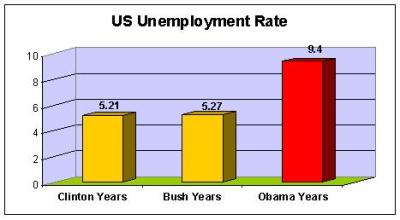
Jim Hoft of Gateway Pundit has this graph of the average unemployment rate under Bush and Obama.

Obama is the worst President ever!

Keep in mind that Democrats were in control of the House and Senate starting in January of 2007. That means that all the spending was theirs from that point on – Bush just had no public support to cut spending and veto things like TARP. If we take out 2008, his unemployment rate would be much lower.

I know that all the young people seem to really like socialism. I hope they also like the taste of leaves and grass. Because that’s all they’ll be able to afford if this keeps up! The poor little lemmings – believing everything their sheltered government-school educators told them about the way the world works. I wonder if the little rascals know who Jimmy Carter is?