
Tag Archives: Employment

What could Stephen Harper teach Michele Bachmann about winning elections?

Michele Bachmann should adopt Stephen Harper's plan

Michele Bachmann is soliciting questions for her townhall meeting on her Facebook page. Please “like” her page and then like my question, so that it will be asked.

The post that she is asking for questions in has this text:

Excited to join Tim Scott for Congress for a town hall live on Facebook from Charleston, SC tomorrow at 7PM ET, where we’ll be taking questions from our community of constitutional conservatives. Have a question? Please ask in the comments below:

My question is reproduced below:

Mrs. Bachmann, in the 2011 Canadian federal election, Stephen Harper, a conservative, managed to win a majority in a country that is only one-third conservative. He did this by creating N-point plans that clearly laid out his plans for each term.

The reason I think this is important is because he was able to neutralize the attacks of the media and the three left-leaning political parties because they were not able to accuse him of having a “hidden agenda”. My question for you is, have you considered laying out a clean, specific N-point plan for what you would do as President of the United States? You could even have 3 plans, one for social issues, one for fiscal issues, and one for foreign policy.

If you like my question, please like the “TeamBachmann” Facebook page, and then go to her post asking for questions, and like my question.

Here are the Harper plans:

2006: (won minority)

  • Cleaning up government by passing the Federal Accountability Act
  • Cutting the GST (the national sales tax)
  • Cracking down on crime
  • Increasing financial assistance for parents
  • Working with the provinces to establish a wait-times guarantee for patients

2008: (won minority)

  • The minister of finance and the Bank of Canada will constantly monitor financial markets and the impact of developments in other countries.
  • The global financial crisis will be discussed at the Canada-European Union Summit, which Harper will attend on Friday.
  • Parliament will be summoned to meet this fall and the minister of finance will table an economic and fiscal update before the end of November.
  • Canada will be represented at the meeting of G-20 finance ministers scheduled for early November in Brazil. Canada has also called for a second meeting of G-7 finance ministers.
  • Government spending will be focused and kept under control as the strategic review of departmental spending — now in the second year of a four year review – continues.
  • Harper will hold a first ministers meeting on the economy to discuss with premiers and territorial leaders a joint approach to the global financial crisis.

2011: (won majority)

  • Creating jobs through training, trade and low taxes.
  • Supporting families through our Family Tax Cut and more support for seniors and caregivers.
  • Eliminating the deficit by 2014-2015 by controlling spending and cutting waste.
  • Making our streets safe through new laws to protect children and the elderly.
  • Standing on guard for Canada by investing in the development of Canada’s North, cracking down on human smuggling and strengthening the Canadian Armed Forces.

Actually, Canadian conservatives are much more liberal than we Republicans are – they are soft on social issues. Harper himself is an evangelical Christian, though, but his hands are tied when it comes to social issues. He tries to support stronger families as a way to reduce abortion and to ensure that children grow up with mothers and fathers. Even Stephen Harper is not able to do anything about same-sex marriage and abortion, which are both legal in Canada.

I think Michele would do well to pretend that she was running for office in Canada, and then create her plans that way. All the conservatives already know that she is a solid evangelical and a Tea party stalwart. What she needs to do is come up with a list of specific smart policies that will win over two-thirds of the independents.

Some things I would like to see: transparency in government, sensible spending cuts, tort reform, cut employer payroll tax to 0%, cut federal funding for abortion/Planned Parenthood, increased tax credits for MARRIED couples, matching grants for states that create voucher programs, etc, a federal right-to-work law, a tax credit, usable at any time in the future, for all salary income earned by young people under the age of 22. Etc.

What happened to Illinois businesses when Democrats raised taxes?

Central United States

How do Illinois businesses respond to Democrat Governor Quinn’s tax increases?

From CBS News. (H/T Marathon Pundit)

Excerpt:

The Chicago area will soon have a few hundred fewer jobs, while Northwest Indiana will have a few hundred more.

As CBS 2’s Susanna Song reports, sources say Modern Forge is moving from Blue Island across the state line to Merrillville, Ind., and the new town is rolling out the its welcome mat for the plant.

[…]On Tuesday, Indiana succeeded as Blue Island-based manufacturer Modern Forge announced it was moving across the state line. CEO Greg Heim said Illinois made it impossible to stay.

“The environment in Illinois, I would say there was no — we did not see any change coming in Illinois,” Heim said. “Illinois continues to stay on a path of not being – for us – a (pro-business) environment and the excitement and energy here in Indiana, that’s very important to us.”

That’s why, after 97 years in Blue Island, Modern Forge is picking up and moving its building and 240 jobs to Indiana.

“It’s a huge thrill for us,” Indiana Gov. Mitch Daniels said.

Daniels didn’t mince words when he said luring business is the Hoosier State’s #1 priority. And there’s no question that Illinois – and companies like Modern Forge – are main targets.

He claimed that “well over a dozen” businesses have moved from Illinois to Indiana in the past few months. “And it’s not like this just started recently,” he added.

In fact, it really ramped up last year when Illinois lawmakers hiked the state’s income tax. Since then, some businesses have bailed and others threatened to do so, citing high taxes, worker’s compensation issues, lack of incentives and an overall lack of encouragement from the Quinn administration.

[…]According to U.S. Labor Bureau statistics, Quinn needs to do something. Statistics show a steady jobs decline beginning in January, shortly after the tax hike passed.

Daniels said he sees tax concerns in Illinois as a potential Indiana win.

“We’ve had a big upsurge in contacts from businesses who want to explore an Indiana location because the arithmetic tells them it’s less expensive to hire people here,” Daniels said.

And more from the Illinois Policy Institute:

In a trend that continues to worsen, more Illinoisans found themselves unemployed in the month of July.

Illinois lost more jobs during the month of July than any other state in the nation, according to the most recent Bureau of Labor Statistics report. After losing 7,200 jobs in June, Illinois lost an additional 24,900 non-farm payroll jobs in July. The report also said Illinois’s unemployment rate climbed to 9.5 percent. This marks the third consecutive month of increases in the unemployment rate.

Illinois started to create jobs as the national economy began to recover. But just when Illinois’s economy seemed to be turning around, lawmakers passed record tax increases in January of this year. Since then, Illinois’s employment numbers have done nothing but decline.

Data released today by the bureau confirms this downward trajectory. When it comes to putting people back to work, Illinois is going backwards. Since January, Illinois has dropped 89,000 people from its employment rolls.

Democrats complain a lot about companies that outsource jobs. And now we see what causes companies to outsource jobs – Democrats.They cause the very thing that they complain about. That’s insane.

Obamanomics: $500,000 stimulus grant to grow trees creates 1.72 jobs

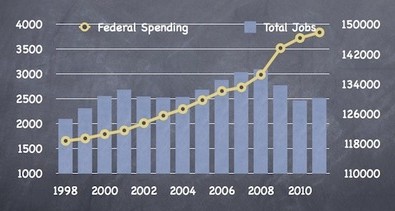
Government Spending Vs Jobs

From Fox News.

Excerpt:

A federal stimulus grant of nearly $500,000 to grow trees and stimulate the economy in Nevada yielded a whopping 1.72 jobs, according to government statistics.

In 2009, the U.S. Forest Service awarded $490,000 of stimulus money to Nevada’s Clark County Urban Forestry Revitalization Project, aimed at revitalizing urban neighborhoods in the county with trees, plants, and green-industry training.

According to Recovery.gov, the U.S. government’s official website related to Recovery Act spending, the project created 1.72 permanent jobs.  In addition, the Nevada state Division of Forestry reported the federal grant generated one full-time temporary job and 11 short-term project-oriented jobs.

[…]Repeated calls by FoxNews.com to the U.S. Forest Service were not returned.

[…]”Looking at the failure of the stimulus to live up to its promises, not just in Nevada, but throughout America, I think the question becomes ‘is there any good use of stimulus money?'” said Douglas Kellogg, communications manager for National Taxpayers Union, in an email to FoxNews.com.

[…]”The president may well propose new stimulus efforts when Congress returns from recess,” said Kellogg, “and those who learn from past stimulus debacles will not be fooled again.”

The Heritage Foundation explains how government spending has never worked to create jobs. Not even when Republicans do it.

Excerpt:

Indeed, President Obama’s stimulus bill failed by its own standards. In a January 2009 report, White House economists predicted that the stimulus bill would create (not merely save) 3.3 million net jobs by 2010. Since then, 3.5 million more net jobs have been lost, pushing the unemployment rate above 10 percent.[1] The fact that government failed to spend its way to prosperity is not an isolated incident:

  • During the 1930s, New Deal lawmakers doubled federal spending–yet unemployment remained above 20 percent until World War II.
  • Japan responded to a 1990 recession by passing 10 stimulus spending bills over 8 years (building the largest national debt in the industrialized world)–yet its economy remained stagnant.
  • In 2001, President Bush responded to a recession by “injecting” tax rebates into the economy. The economy did not respond until two years later, when tax rate reductions were implemented.
  • In 2008, President Bush tried to head off the current recession with another round of tax rebates. The recession continued to worsen.
  • Now, the most recent $787 billion stimulus bill was intended to keep the unemployment rate from exceeding 8 percent. In November, it topped 10 percent.[2]

Why is this? It’s because the government never spends money as efficiently as the private sector. Private sector firms have to stay lean and mean in order to stay afloat – because they have competitors who are always trying to sell better goods and services for less money. In a capitalist economy, the consumer is king – all the businesses fight to earn the customers’ money. But the government has no competitors, and so they neither care about efficiency, nor pleasing their customers.

CBS News reports:

ABC News reports:

And this one features a real economist:

We shouldn’t let the government take money out of the private sector and let the public sector spend it on “stimulus”. Stimulus means taking money away from your boss, or your possible bosses, and spending it on trees. It’s how you lose jobs – and that’s what we have today.

Related posts