Elizabeth Warren will says Christian schools are her enemy
It’s hard to see into the minds of the Democrat party candidates to know what they believe about God. But I think that support for infanticide and opposition to Christian churches, schools and other organizations is a pretty good sign of what they really believe. Elizabeth Warren for example is pretty clearly not a Christian, and has an obvious contempt for the Bible.
On Sunday Sen. Elizabeth Warren shared a HuffPost article on Twitter bashing private Christian schools for having “anti-LGBTQ+ policies.”
The article focused attention on a U.S. Supreme Court case attacking Montana private religious schools and attempting to take away tax credits to individuals who contributed to private schools because the money supports policies that “discriminate against LGBTQ staff and employees.”
Such policies include having bathrooms designated for people according to their biological gender and hiring faculty and staff who abide by Christian marriage values.
“States should focus on funding public schools, not private ones — especially ones that maintain anti-LGBTQ+ policies. We must ensure every kid–especially LGBTQ+ kids–can get a high-quality public education,” Warren tweeted.
The article explains that these Christians schools respect what the Bible teaches in various areas. Some schools expect teaches to be Christians. Others affirm a Biblical view of sexuality – sex allowed only within a heterosexual marriage. Some of them just don’t want men in women’s bathrooms. But none of this is OK with Elizabeth Warren, because she thinks that the hurt feelings of LGBT people are more important than the Constitutional rights of Christians.
Why might Warren be taking this position? Well, Democrats have traditionally enjoyed massive support from public schools. And public schools see private schools as threats to their monopoly. When private schools offer children a better education, public schools prefer to shut them down rather than work harder.
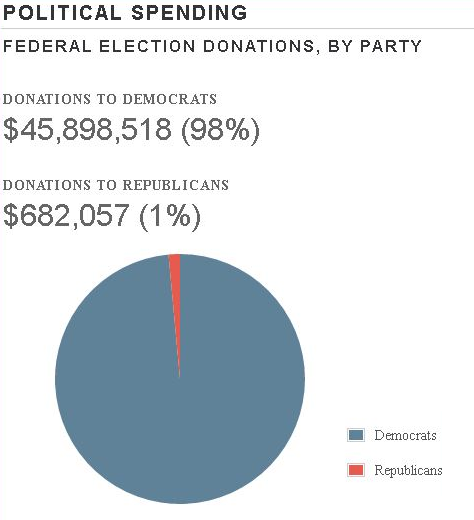
Take a look at these donations by the American Federation of Teachers:
Political contributions by the American Federation of Teachers union
The article notes:
Public school groups have been vocal about their feelings towards the case, claiming that it “could have a devastating effect on education and play a major role in disintegrating the U.S. doctrine of the separation of church and state.”
Randi Weingarten, president of the American Federation of Teachers, said that this case could turn the American understanding of “separation of church and state” upside down, and that “it will basically change over 200 years of practice in the United States,” The Daily Wire reported.
Those in favor of public funding for private schools argue that school choice and voucher programs give lower income students the same opportunities as students from more well-to-do families.
Democrats like to talk about how they don’t take money from “big corporations”. But if you take a look at that graph above, you’ll see that some people have bought themselves a whole lot of influence with the Democrat party. Do these unionized public school teachers and administrators have YOUR interests at heart?
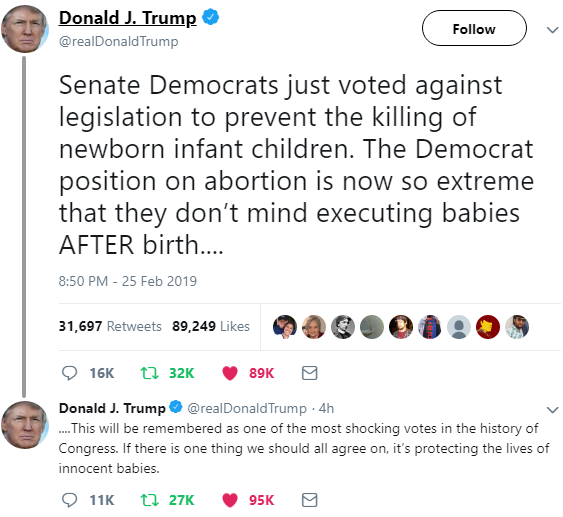
Wil Trump remember how Democrats voted during his re-election campaign?
Republicans introduced a bill in the Senate to require that doctors must provide medical care to babies BORN ALIVE during an abortion. There were 50 Republicans present for the vote. All 50 supported the bill. But 44 out 47 Democrats present voted for infanticide, including 6 who are running for President in 2020.
Here’s how McConnell introduced the bill: (H/T Pulpit & Pen)
But first, in a few hours the Senate will vote on advancing a straight-forward piece of legislation to protect newborn babies.
This legislation is simple. It would simply require that medical professionals give the standard care and treatment to newborn babies who have survived an attempted abortion as any other newborn baby would receive in any other circumstances.
It isnt about new restrictions on abortion. It isn’t about changing options available to women. It’s just about recognizing that a newborn baby is a newborn baby, period.
This Bill would make clear that in the United States of American, in the year 2019, the medical professionals on-hand when a baby is born alive need to maintain their basic ethical and professional responsibilities to that newborn.
It would make sure our laws reflect the fact that the human rights of newborn boys and girls are innate. They don’t come and go based on whatever the circumstances. If that medical professional comes face-to-face with a baby who’s been born alive, they are looking at a human being with human rights, period.
So how did it go? Well, all the Republicans in the Senate voted for it. And none of them voted against it. The bill failed, though. It failed because 44 Democrat senators voted against it, and it needs 60 votes to pass.
What I think is interesting from a strategic point of view is that 6 of the 44 senators who voted against it are running for President.
Here are the 6, maybe 7, Democrat senators running for President:
Cory Booker
Kirsten Gillibrand
Kamala Harris
Amy Klobuchar
Elizabeth Warren
Bernie Sanders
Sherrod Brown (maybe)
If one of those candidates ends up being the Democrat nominee, Trump will be able to use their vote on this infanticide bill in debates and in election ads.
And it’s not just these Democrat Presidential candidates – infanticide is now the mainstream view of most Democrat politicians.
Life News reports that more states are introducing legislation to remove all restrictions on abortion:
New York, Vermont, New Mexico and now Rhode Island politicians are pushing radical pro-abortion legislation that could legalize the killing of unborn babies for basically any reason up to birth in their states.
Earlier this week, Rhode Island lawmakers introduced legislation to keep abortion legal and unrestricted if the U.S. Supreme Court overturns Roe v. Wade, the AP reports.
It was just New York, Virginia, Rhode Island, New Mexico and Vermont at the end of January.
But in February, Illinois can be added to the list:
“The Democratic supermajority’s proposals now pending in the Illinois General Assembly are the most pro-abortion legislative measures of their type in the country,” said Peter Breen, Vice President and Senior Counsel for the Thomas More Society, and former Illinois House Minority Floor Leader. “The barbaric procedures promoted by this legislation are nothing short of infanticide. These bills go well beyond the recent New York law and would turn Illinois into a third-trimester abortion destination and an underage abortion haven.”
Will Democrat voters get on board with infanticide? I think some of their liberal special interest groups will. But think about how independents supported Trump’s opposition to infanticide in his State of the Union speech. I think that the Democrats are being forced to move their party too far to the left to win another election. All it takes is for pro-lifers to introduce legislation, have them vote on it, and then make the appropriate election ads.
No one can win a presidential by appealing only to their base. It comes down to who wins the independents. Trump is now the moderate candidate on social issues. The Democrats are pro-abortion extremists. They won’t win a majority of independents in a general election. They’ve just slid too far to the left.
So, in yesterday’s post, we talked about our current budget of $4 trillion dollars, our $3 trillion of revenues, our $1 trillion annual budget deficit, and our $23 trillion in accumulated national debt. We also talked about how Elizabeth Warren’s health care plan would add $5.2 trillion to our annual budget, and how we only get about $2 trillion in revenue if we take almost everything the wealthiest taxpayers earn.
Warren likes to talk about how her plan will reduce health care costs. She thinks that government workers (think of the DMV and the post office) will be more efficient about increasing quality and reducing costs than the private sector (think of Apple and Amazon) is. Is she correct?
Warren and her defenders will likely try to shift the discussion back to total costs, but that’s just a way of repeating the dodge that has dogged her campaign for much of the year. Warren will no doubt claim that costs would go down under her plan, but there are reasons to doubt this, including an analysis from health care economist Kenneth Thorpe finding that under a Sanders-style plan, more than 70 percent of people who currently have private insurance would see costs increase, as well as an Urban Institute analysis projecting that single-payer plans would raise national health care spending by $7 trillion over a decade.
There isn’t any magic in Warren’s plan that would lover the costs to the point where the middle class would not have to pay for her spending:
Indeed, much of Warren’s plan is based on unlikely, and at times outright fantastical, assumptions about what sort of additional revenue could be raised, what health care costs could be contained, and what might be politically feasible. Among other things, she proposes raising $400 billion by passing comprehensive immigration reform, which, given the politics of immigration policy, is only a little more realistic than planning to pay off your mortgage by winning the lottery. The Washington Examiner‘s Philip Klein has published a useful roundup of Warren’s less plausible ideas; the takeaway is that even if Warren somehow managed to raise the enormous amounts of tax she proposes, it probably would still not be anywhere close to enough to finance her plan. (More on this in a future post.)
In some ways, Warren’s plan amounts to a list of technically sophisticated magic asterisks. It is as much an attempt to obscure the economic and political feasibility of passing and implementing a single-payer health care plan as a good-faith attempt to describe what it would practically require.
Yet in another way, it reveals something about both Warren and the economic reality of single-payer: Despite running a campaign based on wonky academic credentials and detail-oriented policy chops, Warren has, until now, repeatedly refused to directly answer questions about precisely how she would finance Medicare for All and whether she would foist new taxes on the middle class. Turns out she didn’t dodge the question because the answer was complex or hard to explain. She dodged it because the answer was so simple it could be expressed in a single word: yes.
So, let’s just state the obvious. We’re talking about a person who pretended to be an Indian in order to get into Harvard, and who lied about being fired from her teaching job for being pregnant. If we’re looking at her education, we don’t find any evidence that she understands health care policy, or even basic economics. If we’re looking at her work experience, there’s no evidence there that she was ever able to produce results in health care administration. There are people who have been able to reform health care in a way that reduces costs, reduces taxes, improves quality of care, and covers more people. But not Elizabeth Warren.
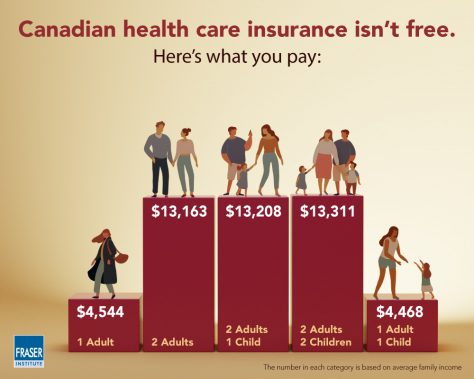
Price of healthcare per Canadian household (Source: Fraser Institute)
What about Canada?
I think it’s worth remembering how much government-run health care costs in countries that have adopted “Medicare for All” plans.
I found two interesting studies from Canada’s Angus Reid Institute describing single payer health care in Canada. I’m very interested in find out what things are like in countries that have true government-run health care. A typical Canadian family pays $13,000+ per year per household for healthcare, or about $585,000 over their working lives. What are they getting for all that money?
The study finds more than 2 million Canadians aged 55 and older face significant barriers when accessing the health care system in their province, such as being unable to find a family doctor or experiencing lengthy wait-times for surgery, diagnostic tests, or specialist visits.
Moreover, most Canadians in this age group have at least some difficulty getting the care they want or need in a timely manner.
The study focuses on the health care experiences of older Canadians, as well as their assessments of the quality of care they receive.
According to the article, 31% of respondents (aged 55 and older) rated access to the government’s healthcare system as “easy”. 48% had “moderate” problems with access, and 21% had “major” problems with access.
This second part of the study finds one-in-six Canadians (17%) in the 55-plus age group – a figure that represents upwards of 1.8 million people – say that they or someone else in their household have taken prescription drugs in a way other than prescribed because of cost.
One-in-ten (10%) have decided to simply not fill a prescription because it was too expensive, and a similar number (9%) have decided not to renew one for the same reason. One-in-eight (12%) have taken steps to stretch their prescriptions, such as cutting pills or skipping doses.
Some 17 per cent of Canadians 55 and older have done at least one of these things, and that proportion rises among those who have greater difficulty accessing other aspects of the health care system.
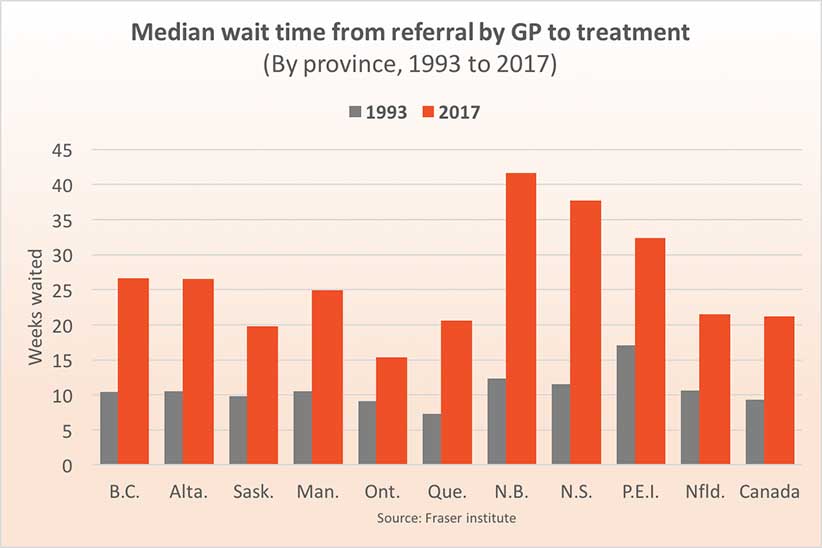
In a previous blog post, I reported on how Canadians have to wait in order to see their GP doctor. If that doctor refers them to a specialist, then they have to wait to see the specialist. And if that specialist schedules surgery, then they have to wait for their surgery appointment. The delays can easily go from weeks to months and even years. The MEDIAN delay from GP referral to treatment is 19.5 weeks.
Wait times in weeks (Source: Maclean’s magazine)
Also, the Canadian system does NOT cover prescription drugs.
Please share this article and yesterday’s because we have an election coming up, and votes need to know the facts.


 WINTERY KNIGHT