Tag Archives: Efficiency

Is government more efficient than the private sector?

When it comes to providing quality services at the lowest cost, private firms are very different from government bureaucracies. A private firm has to compete in an open marketplace where consumers are free to shop around for the best deal. So a private firm has to provide more quality at a lower price or consumers will take their business to a competitor! And the owners and employees share in the profits or losses. They have an incentive to cut costs, raise quality and lower prices. They have a stake in pleasing the customer.

But what about government? Do they have competitors that pressure them lower costs and raise quality? Do the people who run the government benefit financially if they please customers? Do employees of the government benefit if they please customers? Do customers have the freedom to buy from someone else if they are not happy with the price or quality of government services?

Consider this Washington Times story. (H/T John Stossel via ECM)

Excerpt:

An audit of the government’s legal aid program for the poor concluded Monday that the purchase of more than $188,000 worth of imported Italian stone to decorate one of the program’s office buildings in Texas was unnecessary and excessive…

The inspector general of the Legal Services Corp.(LSC) said the stone, which adorns three full stories of a newly remodeled Fort Worth office building, “appears only to be decorative in nature” and does not constitute a “reasonable and necessary” expense.

If a private firm wasted money like this, they would go out of business. The directors and employees who run private firms never waste money like this! If they did, the private firm would go out of business. But the government wastes money like this all the time. It’s not their money, after all – it’s your money. Why should they spend it wisely? What’s in it for them?

And they’re aren’t exactly accountable when they get caught wasting taxpayer money, either.

The inspector general quoted officials involved with the Texas program as defending the purchase, saying the high-end imported stone was selected for its beautiful finish and installed as a decorative flourish.

And this applies to government-run health care, too. Why should be expect government to cut health care costs when they have no incentive to be efficient? Private firms have an incentive – to keep their jobs, to be promoted, to get raises, etc. Government has no incentive to be efficient.
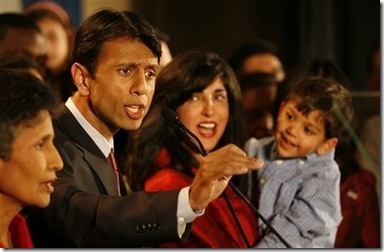
Bobby Jindal explains the right way to lower health care costs

Bobby and Supriya Jindal

Governor Bobby Jindal is a wizard with health care policy!

Here he is writing in the Wall Street Journal about how to cut health care costs without rationing care:

Consumer choice guided by transparency. We need a system where individuals choose an integrated plan that adopts the best disease-management practices, as opposed to fragmented care. Pricing and outcomes data for all tests, treatments and procedures should be posted on the Internet. Portable electronic health-care records can reduce paperwork, duplication and errors, while also empowering consumers to seek the provider that best meets their needs.

Aligned consumer interests. Consumers should be financially invested in better health decisions through health-savings accounts, lower premiums and reduced cost sharing. If they seek care in cost-effective settings, comply with medical regimens, preventative care, and lifestyles that reduce the likelihood of chronic disease, they should share in the savings.

Medical lawsuit reform. The practice of defensive medicine costs an estimated $100 billion-plus each year, according to the American Academy of Orthopaedic Surgeons, which used a study by economists Daniel P. Kessler and Mark B. McClellan. No health reform is serious about reducing costs unless it reduces the costs of frivolous lawsuits.

Insurance reform. Congress should establish simple guidelines to make policies more portable, with more coverage for pre-existing conditions. Reinsurance, high-risk pools, and other mechanisms can reduce the dangers of adverse risk selection and the incentive to avoid covering the sick. Individuals should also be able to keep insurance as they change jobs or states.

Pooling for small businesses, the self-employed, and others. All consumers should have equal opportunity to buy the lowest-cost, highest-quality insurance available. Individuals should benefit from the economies of scale currently available to those working for large employers. They should be free to purchase their health coverage without tax penalty through their employer, church, union, etc.

Pay for performance, not activity. Roughly 75% of health-care spending is for the care of chronic conditions such as heart disease, cancer and diabetes—and there is little coordination of this care. We can save money and improve outcomes by using integrated networks of care with rigorous, transparent outcome measures emphasizing prevention and disease management.

Refundable tax credits. Low-income working Americans without health insurance should get help in buying private coverage through a refundable tax credit. This is preferable to building a separate, government-run health-care plan.

These are conservative solutions – they will preserve out liberty and prosperity.

Bobby Jindal is my pick for Secretary of Health and Human Services in 2012, if he isn’t elected President. So remember his name!