Tag Archives: Economy

Poll: Canadians becoming more conservative

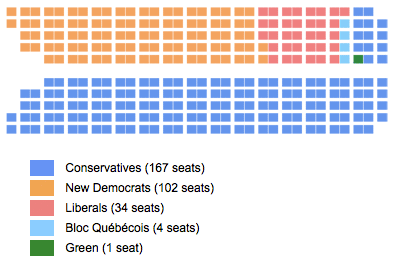
Canada 2011 Federal Election Seats
Canada May 2011 Federal Election Results

Consider this story from the Vancouver Sun. (H/T Andrew)

Excerpt:

Canadian ideals are shifting to the right, being taken over by a “unique strain of conservatism,” a poll from Preston Manning’s Calgarybased think-tank shows, the former Reform party leader said Wednesday.

This was the second year the Manning Centre for Building Democracy conducted the poll, which asked Canadians about their attitudes toward values and policies generally ascribed to Conservatives. Last year’s results indicated similar movements, with more people saying they don’t want government peddling grand views and having its hands in all aspects of society.

The only exception to this opinion is public safety and security policies, Manning said in an interview Tuesday.

Of those surveyed, 65 per cent said government should focus on current issues, and 67 per cent said government should decrease in size to do more.

Canada, it seems, has arrived at a point where its citizens have shifted their expectations for government, said Allan Gregg, the head of Harris Decima, which helped with the polling.

“(Government) is no longer the grand designer,” he said.

But the national shift isn’t necessarily being ascribed to Stephen Harper, who has been prime minister for slightly more than five years.

“This can’t be traced back the last two or three or four years,” said Andre Turcotte, president of Feedback Research Centre, which also helped with polling and interpreting the results. Instead, he said, this is something that has been happening since the late 1980s -around the same time the Reform Party began its rise.

Turcotte couldn’t speculate to whether it was by design or surprise, but he said that in 2008, Harper tapped into what many wanted out of government -being smaller and more focused on specific issues.

“As these conservative values become mainstream values, people will less and less identify them with Conservatives. People will just say these are Canadian values,” Manning said.

The poll was conducted from May 4 to 11, almost immediately after the election. A total of 1,000 interviews were conducted with randomly selected Canadians, resulting in a margin of error of 3.1 percentage points 19 times out of 20.

I blogged recently about how Canada’s economic numbers are vastly superior to the American numbers. I think the Canadians are learning what works by comparing what they’ve been doing (e.g. – corporate tax cuts down to half of our rate) compared to what we’ve been doing, (e.g. – massive bailouts and government spending). They know that they are better off than we are, and they know that conservative policies work – they’ve lived through it. That’s why a country that used to be liberal is now trending conservative. Prime Minister Stephen Harper gave them a five-year economics course and they gave him rave reviews as a professor, and a BIG promotion.

Tim Pawlenty lays out bold, conservative tax plan to create jobs

Remember on Sunday when I recommended some policies?

Excerpt:

Let me add this tort reform law (loser pays) to the other list of policies we need at the national level:

  • National right-to-work law
  • National photo ID required for voting
  • National voucher system for education
  • National voucher for health care
  • Nation cap on damages for lawsuits
  • allow Opt-out of Social Security
  • allow Opt-out of Medicare
  • allow Opt-out of Medicaid
  • allow Opt-out of unemployment insurance
  • Flat income tax at 10% below 50,000 and 25% over 50,000, with no deductions except for charity and retirement contributions
  • Zero capital gains tax, phased in over four years
  • Tax-free savings accounts with no restrictions on withdrawals, limit $5,000 per year

In the comments, I added that the limit would be $100,000 for married couples, in response to a challenge from a commenter. And I should have mentioned that I wanted corporate taxes cut to 25%.

Well, guess what Tim Pawlenty went and did?

Excerpt:

Former Minnesota Gov. Tim Pawlenty will propose significant reductions in the corporate and individual tax rates Tuesday while calling for deep spending cuts that could see the federal government abandon its role delivering the mail or backstopping home loans.

The proposals are part of an economic plan Mr. Pawlenty will unveil later today in remarks at the University of Chicago. The plan, according to excerpts provided by Mr. Pawlenty’s campaign, is tailored to the business community and fiscal conservatives as he seeks the Republican presidential nomination, but its impact on the deficit is unclear, given the potential drop in tax revenue.

Mr. Pawlenty wants to reduce the corporate tax rate from 35% to 15% and create just two tax brackets for individuals and families: a 10% rate on the first $50,000 of income for individuals – or $100,000 for married couples – and a 25% rate for all other income. In addition, he will call for the elimination of taxes on capital gains, dividends, interest income and inheritance.

Hey, some of that sounds familiar!

And there’s more:

In order to offset any lost tax revenue — and to tackle the deficit — Mr. Pawlenty calls for something called “The Google Test” to determine whether the government should be involved in a program.

“If you can find a good or service on the Internet, then the federal government probably doesn’t need to be doing it,” Mr. Pawlenty says. “The post office, the government printing office, Amtrak, Fannie [Mae] and Freddie [Mac], were all built in a time in our country when the private sector did not adequately provide those products. That’s no longer the case.”

He calls on Congress to freeze spending at current levels and impound 5% of spending until the budget is balanced. “If they won’t do it … I will,” he plans to say.

The former governor will call for terminating all federal regulations, unless Congress votes to keep them individually.

I feel that I must make clear that the Wintery Knight is not Tim Pawlenty. However, he may be reading the Wintery Knight. One can’t know for sure.

OK, so right now I am still favoring Bachmann overall, with Cain in second place, and Pawlenty in third place. Feeling better about Pawlenty now. Three strong conservative candidates! WOOHOO!!! I would be happy with ANY of these three candidates.

You can read excepts of Pawlenty’s speech right here on his web site. Awesome stuff!


Texas requires losing parties of frivolous lawsuits to pay their own costs

From the Wall Street Journal, some good news on tort reform.

Excerpt:

This week, Texas Gov. Rick Perry signed a law that will help free Lone Star State businesses from the threat of frivolous lawsuits by enacting “loser-pays” tort reform. Prior to the legislation, litigants faced a no-lose situation, while defendants stood to lose everything—even for the most outrageous, bizarre and wrongful accusations.

Even when defendants won, the legal fees associated with protecting themselves could add up to tens of thousands of dollars. As a result, many pre-emptively settled out of court, as the settlement payment would be less than the legal fees. Under Texas’s new legislation, however, litigants will be forced to pay for the defendant’s attorney fees if the case is determined groundless. This will compel would-be litigants to consider the practicality of their complaint before taking legal action, and it will protect defendants from the dire financial impact of frivolous cases.

The Texas legislation should serve as a national model, especially as we recover from the Great Recession. America has the most expensive civil-justice system in the world, costing $255 billion in 2008, or nearly 2% of gross domestic product, according to a 2009 study by the firm Towers Perrin (now Towers Watson). That’s more than twice as much as any other industrialized nation as a percent of the GDP.

Small businesses—the engines of our economy and the creators of 64% of American jobs—are usually the target of frivolous lawsuits. In fact, small businesses paid 81% of business tort liability costs in 2008. On average, a small business earning $1 million must spend $20,000 annually on lawsuits—money they could have otherwise spent on product development or new job creation.

Softening the threat of frivolous lawsuits sparks economic activity. In 2003, for example, Texas put limits on non-economic damages in medical malpractice cases. Since then, the number of doctors applying to practice in the Lone Star State has jumped by 60%. The same can be expected of businesses that no longer have to fear the financial impacts of civil-lawsuit abuse.

One of the reasons why we are in an economic mess is because we have not reined in the excesses of the trial lawyers. And the Democrats will never be able to rein them in because they are the core of the Democrat party, along with labor unions, teacher unions, word-smithing academics, criminals, welfare recipients and Hollywood celebrities. The sheltered, non-productive segments of society, who have never had to run a business or make payroll.

Let me add this tort reform law (loser pays) to the other list of policies we need at the national level:

  • National right-to-work law
  • National photo ID required for voting
  • National voucher system for education
  • National voucher for health care
  • Nation cap on damages for lawsuits
  • allow Opt-out of Social Security
  • allow Opt-out of Medicare
  • allow Opt-out of Medicaid
  • allow Opt-out of unemployment insurance
  • Flat income tax at 10% below 50,000 and 25% over 50,000, with no deductions except for charity and retirement contributions
  • Zero capital gains tax, phased in over four years
  • Tax-free savings accounts with no restrictions on withdrawals, limit $5,000 per year

I hope the Republicans will campaign on these ideas.