Tag Archives: Economy

Arthur Brooks: Europe’s core problems are demographic, not economic

AEI President Arthur C. Brooks writes about Europe’s most pressing problem in the far-left New York Times, of all places.

He writes:

According to the United States Census Bureau’s International Database, nearly one in five Western Europeans was 65 years old or older in 2014. This is hard enough to endure, given the countries’ early retirement ages and pay-as-you-go pension systems. But by 2030, this will have risen to one in four. If history is any guide, aging electorates will direct larger and larger portions of gross domestic product to retirement benefits — and invest less in opportunity for future generations.

Next, look at fertility. According to the Organization for Economic Cooperation and Development, the last time the countries of the European Union were reproducing at replacement levels (that is, slightly more than two children per woman) was the mid-1970s. In 2014, the average number of children per woman was about 1.6. That’s up a hair from the nadir in 2001, but has been falling again for more than half a decade. Imagine a world where many people have no sisters, brothers, cousins, aunts or uncles. That’s where Europe is heading in the coming decades. On the bright side, at least there will be fewer Christmas presents to buy.

There are some exceptions. France has risen to exactly two children per woman in 2012, from 1.95 in 1980, an increase largely attributed to a system of government payments to parents, not a change in the culture of family life. Is there anything more dystopian than the notion that population decline can be slowed only when states bribe their citizens to reproduce?

Finally, consider employment. Last September, the United States’ labor force participation rate — the percentage of adults who are either working or looking for work — reached a 36-year low of just 62.7 percent.

Yet as bad as that is, the United States looks decent compared with most of Europe. Our friends across the Atlantic like to say that we live to work, while they work to live. That might be compelling if more of them were actually working. According to the most recent data available from the World Bank, the labor force participation rate in the European Union in 2013 was 57.5 percent. In France it was 55.9 percent. In Italy, just 49.1 percent.

[…]It is true that good monetary and fiscal policies are important. But the deeper problems in Europe will not be solved by the European Central Bank. No matter what the money supply and public spending levels, a country or continent will be in decline if it rejects the culture of family, turns its back on work, and closes itself to strivers from the outside.

Either people keep their own money and run their own lives, or bureaucrats take their money and make the decisions about social programs. In America, we used to prefer the former, but Europe has been preferring the latter for decades. Would I get married and have kids in a society run by European bureaucrats? Do I want secular leftist public schools to tell my children what to believe? It doesn’t sound very exciting to me. And I’ll bet it doesn’t sound very exciting to a lot of men in Europe. Men don’t want to be taxed, so that they can be replaced by the state’s social programs. We want to chart our own course, and guide our own families. But that’s not OK with people who want to replace men with government social programs.
Should young Americans feel confident about their economic prospects?

Wages of Young Americans (Source: The Atlantic)

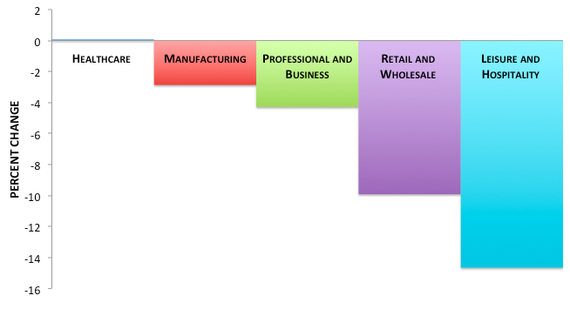
Graph: Young People’s Wages Have Fallen Across Industries Between 2007 and 2013.

Young Americans are taking longer to graduate and graduating with more debt, but that’s not all – they aren’t find jobs, and the jobs they do find typically don’t allow them to pay back their loans.

Here’s an article from The Atlantic, which leans left.

Excerpt:

American families are grappling with stagnant wage growth, as the costs of health care, education, and housing continue to climb. But for many of America’s younger workers, “stagnant” wages shouldn’t sound so bad. In fact, they might sound like a massive raise.

Since the Great Recession struck in 2007, the median wage for people between the ages of 25 and 34, adjusted for inflation, has fallen in every major industry except for health care.

These numbers come from an analysis of the Census Current Population Surveyby Konrad Mugglestone, an economist with Young Invincibles.

In retail, wholesale, leisure, and hospitality—which together employ more than one quarter of this age group—real wages have fallen more than 10 percent since 2007. To be clear, this doesn’t mean that most of this cohort are seeing their pay slashed, year after year. Instead it suggests that wage growth is failing to keep up with inflation, and that, as twentysomethings pass into their thirties, they are earning less than their older peers did before the recession.

The picture isn’t much better for the youngest group of workers between 18 and 24. Besides health care, the industries employing the vast majority of part-time students and recent graduates are also watching wages fall behind inflation. (40 percent of this group is enrolled in college.)

It’s not just that – the Democrats are doing a pretty good job of wrecking other parts of the economy, from energy development to health care to entitlement programs to college tuition, which rises higher as government throws more money into the system. They are doing everything they can to wreck the economy with higher taxes and burdensome regulations.

As a result of our headlong rush towards socialism, the U.S. economy has now fallen to number 2 in the worldbehind China.

Look:

We’re no longer No. 1. Today, we’re No. 2. Yes, it’s official. The Chinese economy just overtook the United States economy to become the largest in the world. For the first time since Ulysses S. Grant was president, America is not the leading economic power on the planet.

It just happened — and almost nobody noticed.

The International Monetary Fund recently released the latest numbers for the world economy. And when you measure national economic output in “real” terms of goods and services, China will this year produce $17.6 trillion — compared with $17.4 trillion for the U.S.A.

As recently as 2000, we produced nearly three times as much as the Chinese.

To put the numbers slightly differently, China now accounts for 16.5% of the global economy when measured in real purchasing-power terms, compared with 16.3% for the U.S.

This latest economic earthquake follows the development last year when China surpassed the U.S. for the first time in terms of global trade.

So things are bad for young people, and it’s going to get worse.

It’s important to check what major you are studying to make sure you get a return on your investment, and don’t be scared to study something you hate if it means that you can make your career work. Your education and career choices are not about fulfillment and thrills. You have to make hard choices in order to make ends meet so that you have freedom to do the things you ought to do, especially if you want to get married and start a family. Those marriage and family plans start the day you step into high school, in my opinion.

UPDATE: 17.7% Teen Unemployment in America – Still Above Rate of 6 Years Ago and Labor Force Participation Remains at 36-Year Low.

White House threatens veto of bipartisan small businesses tax cut bill

It’s actually for research and experimentation, and small businesses.

Investors Business Daily reports on the story.

Excerpt:

The White House move this week to torpedo a deal between House Republicans and Senate Democrats to extend dozens of expiring tax breaks suggests that the executive action legalizing 5 million unauthorized immigrants may have been no fluke: Compromise appears to be near the bottom of President Obama’s agenda for his last two years in office.

Despite — or perhaps because of — the Republican wave election that capsized Democrats’ Senate majority, Obama is tugging his party further left, which could make it harder for the GOP to govern effectively. A shift away from the center might seem counterintuitive, but it’s consistent with the Democrats’ post-mortem election analysis that put the blame on the party’s failure to focus enough on its economic agenda.

The White House’s veto threat, which apparently surprised dealmakers, was “really pretty stunning” considering that soon-to-be-demoted Majority Leader Harry Reid was its quarterback, said Chris Krueger, political analyst at Guggenheim Partners’ Washington Research Group.

In blowing apart the deal, estimated to cost $440 billion over 10 years, the White House lined up behind liberal Massachusetts Sen. Elizabeth Warren, who attacked it as “a massive handout to big corporations” that asks “working families to pick up the tab.”

The Obama administration used the same justification in explaining its threat to veto the bill if it reached the president’s desk: “It would provide permanent tax breaks to help well-connected corporations while neglecting working families.”

The centerpiece of the deal is a $160 billion provision to make permanent and expand a research and experimentation tax credit, an idea that the administration has supported. The next two biggest pieces, both about $73 billion over 10 years, would make permanent the American Opportunity tuition tax credit and an allowance for small businesses to write off capital investments permanently.

Individuals would be able permanently to deduct sales taxes instead of income taxes, important for residents of states like Florida and Texas, at a cost of $34 billion. Controversial wind production taxes would be extended but phased out over two years, costing $20 billion.

Other smaller pieces include extending a financial-crisis related provision to shield the value of written-down mortgage principal from taxation; making permanent an expanded deduction for users of mass transit; and making permanent tax-free charitable contributions from tax-protected retirement accounts.

That last point about being able to give away your retirement plan tax-free is huge for me, because that’s what I planned to do with my 401K when I retire, since it doesn’t look like I am going to ever get married. If that tax break on charitable deductions from retirement accounts is ever revoked, it would be bad news for the apologists and Christian scholars I donate to. But it’s in keeping with the leftist idea that individuals like me are only good for earning money, but it takes a big secular government to know how to spend it. They have other plans for my money, like free abortions, IVF and sex changes. Yay, big government!