“The present government has done absolutely nothing during the last 12 months to speed up privatizations, reduce the public sector or open up closed professions,” Athanasios Papandropoulos, a leading economic analyst, told me recently in an interview. “In these 12 months it has not fired even one civil servant. The only thing it is doing is trying to tax the private sector out of existence. Why should we believe that they will do something different now?”
One commentator writing in the newspaper Kathimerini this week made the point even more forcefully: “Whereas more than 1,000 Greeks were losing their jobs in the private sector every day in August, the government was assuring civil servants with lifetime tenure that their job privileges were not in danger.”
Structural reforms have been repeatedly announced by Greek officials during the past. Yet nothing has happened. Greece’s plans tend to resemble Soviet Five Year Plans: They look good on paper but have absolutely no bearing on reality. Anyone in the government who tries to point this out is forced to resign. Economist Stella Balfousia, the head of the Greek Parliament budget office, had to tender her resignation after her office published a report contradicting the government’s official forecasts on debt and deficit.
Privatization is a case in point. Greece will have to raise some €1.7 billion by the end of September from the privatization program and €5 billion by the end of the year from the medium-term fiscal strategy program. Yet in the past year and a half not a single privatization has taken place. The explanation given for this is the low share prices of the listed companies. The real reason is probably that Greek politicians are loath to give up the system of spoils that they have long run through these enterprises, which are staffed by the party faithful in exchange for votes.
Would you like to know who has been running Greece lately? The current party in power is called the “Panhellenic Socialist Movement”. They won a majority in 2009. Surprised? Socialism never works.
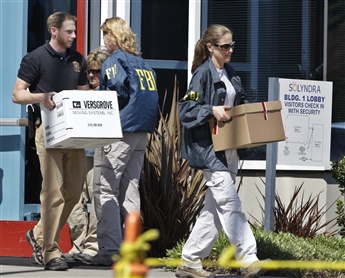
FBI agents remove evidence from Solyndra Headquarters
Here’s the latest from the radically leftist New York Times.
Excerpt:
Republican lawmakers, escalating the political furor over the collapse of a solar equipment manufacturer that received a $528 million government loan, released excerpts from Obama administration e-mails on Wednesday suggesting that the White House pressed federal officials to wrap up their review of the loan quickly for political purposes.
In the e-mails, officials at the Office of Management and Budget expressed frustration that they were being put under time pressure to sign off on the loan to the company, Solyndra, two years ago so that Vice President Joseph R. Biden Jr. could announce its approval at a groundbreaking for a factory. The White House wanted an announcement that would show progress on job creation.
The disclosure became a focus of a House Energy and Commerce subcommittee hearing on Wednesday about the loan to Solyndra, which has developed into a political headache for the Obama administration. The administration used the company as a prime example of stimulus bill dollars creating “green jobs.” But Solyndra recently filed for bankruptcy protection and closed its factory, and its headquarters was raided by the Federal Bureau of Investigation, apparently in connection with the loan.
The bankruptcy filing and the raid “clearly show that the committee was more than justified in its scrutiny of the deal,” said the panel’s chairman, Representative Fred Upton, Republican of Michigan. “Why did the administration think Solyndra was such a good bet?”
[…]Suspicions that the administration might have pushed the loan for political reasons have centered on the fact that a major investor in the company is a charitable foundation associated with George B. Kaiser, a billionaire from Tulsa, Okla., who raised $50,000 to $100,000 as a “bundler” for President Obama’s 2008 presidential campaign.
Logs show that Mr. Kaiser visited the White House on several occasions during the spring and summer of 2009, while the loan to Solyndra was being considered. Among the officials he met with were the chief of staff, Rahm Emanuel, and Pete Rouse and Valerie Jarrett, both senior advisers to Mr. Obama.
[…]While Mr. Kaiser’s connection to the Obama campaign and to Solyndra, based in Fremont, Calif., have helped draw attention to the loan, he was not a major topic of discussion at the hearing on Wednesday. Republicans did, however, press those testifying on whether the Solyndra bankruptcy offered proof that the government should not be lending to companies that have trouble raising money from private investors.
“In this time of record debt, I question whether the government is qualified to act as a venture capitalist, picking winners and losers in speculative ventures and shelling out billions of taxpayer dollars to keep them afloat,” Mr. Upton said.
The company’s solar panel factory was heralded as a centerpiece of the president’s green energy plan — billed as a way to jump start a promising new industry. And internal emails uncovered by investigators for the House Energy and Commerce Committee that were shared exclusively with ABC News show the Obama administration was keenly monitoring the progress of the loan, even as analysts were voicing serious concerns about the risk involved. “This deal is NOT ready for prime time,” one White House budget analyst wrote in a March 10, 2009 email, nine days before the administration formally announced the loan.
“If you guys think this is a bad idea, I need to unwind the W[est] W[ing] QUICKLY,” wrote Ronald A. Klain, who was chief of staff to Vice President Joe Biden, in another email sent March 7, 2009. The “West Wing” is the portion of the White House complex that holds the offices of the president and his top staffers. Klain declined comment to ABC News.
I think people need to get very clear on what “stimulus” spending is. Stimulus spending is nothing more and nothing less than taking money from the private sector job creators (“tax the wealthiest Americans”) and giving it to the people who got the socialists elected (“rebuilding our crumbling roads”).
In light of the Solyndra bankruptcy, terms like “economic stimulus package” and “green jobs” now appear to be Team Obama code words for “kickbacks to political supporters so huge they would make a third-world despot green with envy.”
Solyndra is (or, more accurately, was) a California solar energy company that was the crown jewel of Obama’s first economic stimulus package, which cost $787 billion. Solyndra’s chief investor, George Kaiser, was also a bundler for Obama’s 2008 campaign, gathering over $50,000 in campaign contributions. Kaiser, together with Solyndra executives and board members, donated $87,050 to Obama’s campaign.
As part of the economic stimulus, Obama’s Department of Energy (DOE) fast-tracked a loan of $535 million (at the lowest interest rate granted by the DOE program) to Solyndra in 2009 to create green jobs. All other energy companies that received loans are paying an interest rate three to four times higher, and Solyndra got this amazing deal despite a Dun & Bradstreet credit rating that was only “fair.”
About a year later, Solyndra wasn’t making the payments and needed refinancing. In 2011, Solyndra’s CEO communicated with members of Congress, claiming that the company was on sound financial footing and would be able to repay a refinanced loan. DOE had a man attending Solyndra’s meetings, so they should have known whether the CEO was telling the truth. DOE arranged for refinancing.
Just a few months later, Solyndra laid off nearly all of its 1,100 workers and declared bankruptcy. Just a few days after that, agents of the FBI and the inspector general were raiding Solyndra headquarters and the homes of the CEO and two other executives, with search warrants.
That means that criminal charges are possible. But in the bankruptcy, DOE allowed Kaiser and other investors to recover their investments first, before DOE attempted to recover the $535 million in taxpayers’ money. What a sweetheart deal. America’s taxpayers have been left holding the bag.
Mark Levin took a call from a Solyndra worker who says that “everyone already knew that China had developed a more inexpensive way to manufacture these solar panels. Everyone knew that the plant wouldn’t work. But they still did it. They still built it.”
Americans are angry and with good reason. They are hurting from unemployment, uncertainty in stock market investments and declining retirement funds. And they are weary of waiting for a real workable plan to get us out of this rut.
This is not a time to try the same failed policies of borrowing, debt and calls for tax increases. So we offer these ideas as President Barack Obama prepares to address Congress Thursday if he really wants to make some major bipartisan moves to get our country moving again.
[…]First, allow U.S. employers to repatriate $1 trillion sitting in overseas banks. The current tax rate of 35 percent is a huge barrier blocking those dollars from being invested in jobs, boosting the stock market and raising the value of retirement funds.
Some companies use armies of attorneys and accountants to find ways to cut those taxes, followed by the Internal Revenue Service tracking them down. Stop the nonsense. Offer a lower tax rate, perhaps 15 percent, for a limited time (maybe even a lower rate if the money is invested in job creation or in purchasing U.S. goods).
[…]Second, freeze the massive number of proposed regulations until Congress can review and approve them. Regulations cost U.S. employers more than $1.75 trillion per year. Federal agencies are moving forward with more than 4,257 new regulations that will add tens of billions in regulatory costs — more than tripling the burden of agency mandates from 2009.Employers are worried how this tsunami of new regulations will overwhelm their businesses so they are holding back on growth and hiring. Unless a regulation is absolutely necessary to protect the public’s health and safety, it should be stopped now. Enactment of House Resolution 10, the REINS Act, would require congressional review and approval for any mandate costing the economy more than $100 million annually.
Third, pass our bipartisan Infrastructure Jobs and Energy Independence Act (H.R. 1861), to expand safe offshore oil and gas exploration, create 1.2 million new jobs annually and launch $8 trillion in economic output. Our bipartisan bill dedicates a portion of up to $3.7 trillion in federal oil and gas revenues from the new exploration for investments in new energy technologies, power generation and grid modernization to help put us on a path to energy independence.
[…]Finally, to preserve a free global market for trade, we must hold foreign nations accountable to abide by international agreements. This year, America will lose its position as the global manufacturing leader to China, in large part because Beijing illegally gives its exports a 20 percent to 40 percent discount by manipulating and devaluing its currency.
Another good idea would be to sign the free trade deals with Panama, South Korea and Colombia. Heritage explains what would happen if we did.
Excerpt:
The Obama Administration—after allowing U.S. free trade agreements (FTAs) with South Korea, Colombia, and Panama to languish unapproved for nearly four years—lately appears eager to push Congress to ratify all three soon. The problem now is that some in Congress are trying to make their approval contingent upon an extension of the Trade Adjustment Act (TAA).
That would be a mistake. The three FTAs are intrinsically worth passing without any strings. Congress should act on them without further delay.
The Korea-U.S. Free Trade Agreement (KORUS) would be America’s largest free trade agreement in Asia. It would increase U.S. exports by an estimated $10 billion annually, increase U.S. gross domestic product (GDP) by $11 billion, and add 70,000 U.S. jobs—all without a dime in federal government spending.[1] The accord would also serve as a powerful statement of the U.S. commitment to East Asia at a time when many perceive declining American interest, presence, and influence in the region. The FTA would strengthen U.S. commercial ties and expand the bilateral relationship with South Korea beyond traditional military ties or the North Korean threat.
[…]Rejecting KORUS would disadvantage U.S. companies by locking in discriminatory trade barriers. During the four years the agreement was held hostage by special interest groups and congressional protectionists, the U.S. lost $40 billion in potential exports. American companies continued to lose market share to foreign competitors. The U.S. used to be South Korea’s largest trade partner, but in less than a decade it has been displaced by China, the European Union, and Japan. As Korea’s market opens further, it will be foreign competitors and not U.S. companies that will benefit.
[…]Until this year, the Obama Administration and congressional leadership took its orders on the U.S.–Colombia FTA from protectionist U.S. labor unions and U.S. anti-globalization groups, joined by far-left allies in the region, who succeeded in delaying congressional approval of the FTA. The cost of delay has been significant. So far, according to the Latin America Trade Coalition’s “Colombia Tariff Ticker,”[2] U.S. companies have paid $3.5 billion (as of this writing) in unnecessary duties to the Colombian treasury in the more than 1,600 days since the FTA was signed.
That $3.5 billion has translated into higher prices in Colombia for U.S. goods and services, which are now at a competitive disadvantage in the Colombian market. It has also meant reduced profits for U.S. companies and lost jobs at home.
There are plenty of good ideas from people who live in the real world where real economic laws apply. Keynesianism has been tried since Pelosi and Reid were elected in 2007. It has failed. We need to move on to what works.

 WINTERY KNIGHT