Tag Archives: Economy

Is Obama’s economy as good as the mainstream media are telling us?

This article from CNS News was tweeted by GOP presidential candidate Carly Fiorina.
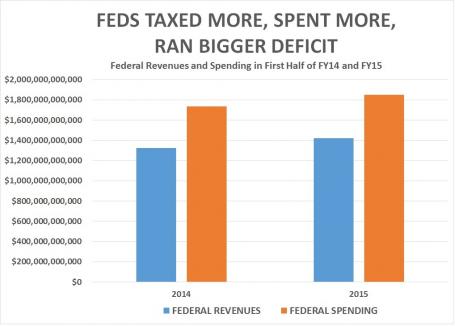
The economy is not good
This economy is not good (click for larger image)

It says:

The federal government taxed away more money, spent more money and ran a bigger deficit in the first half of fiscal 2015 than it did in the first half of fiscal 2014, according to the Congressional Budget Office.

“The federal government ran a budget deficit of $430 billion for the first half of fiscal year 2015, CBO estimates–$17 billion more than the shortfall recorded in the same span last year,” the CBO said in its Monthly Budget Review for March 2015, which was published April 8. “Both revenues and outlays were about 7 percent higher than the amounts recorded in the first six months of fiscal year 2014.”

Keep in mind that these deficit numbers are for half a year. In 2007, George W. Bush was running a deficit of $160 billion for an entire year.

And we’re being taxed more, too:

The biggest source of additional tax revenue for the federal government was the individual income tax. In the first six months of fiscal 2014, Americans paid the federal government approximately $585,000,000,000 in individual income taxes. In the first six months of fiscal 2015, Americans paid $642,000,000,000 in individual income taxes—an increase of $57 billion (or 9.7 percent) from fiscal 2014.

What’s the long-term forecast?

The Wall Street Journal has it:

Question: “How close are we from seeing entitlement programs like Medicare, Medicaid, and Social Security come into direct conflict with defense spending priorities? Defense spending is almost 20% of the Fed budget and nearly 60% of discretionary spending. Current cost of health care and an aging population are strong indicators this could happen sooner than later.”

Zumbrun: “I’d say we’re already seeing it now. As Nick noted above, the CBO projects that mandatory spending and spending on interest will climb, but that defense and nondefense discretionary spending will be squeezed. Anyone who doesn’t want to see that happen in the next decade needs some combination of higher revenue, much faster economic growth, or cuts to entitlement programs.

“The budget deal known as sequestration squeezed down both defense and non-defense discretionary spending. If, instead, everyone agreed it was okay to cut entitlements (which they obviously don’t), you wouldn’t have needed to squeeze that down. So I think it’s fair to say these things are already in conflict.”

Question: “Debt as long as partnered with productivity is no problem. From the looks of it, the U.S. might fall as an economy, but is now the time?”

Timiraos: “That’s a good point. One thing that’s a little bit troubling, however, is that estimates of the potential output of the U.S. economy have been revised down. What does that mean exactly? Instead of growing at a 2.7% rate from 2014-18, it now says the economy will grow at a 2.5% rate. That doesn’t sound too bad, but over time, it adds up.”

Question: “The U.S. has so far been capable of keeping its cost of borrowing at a remarkably low level. What about in the long term where it seems likely that servicing the debt will eat up a larger and larger percentage of government expenditures in an age of slowing growth?”

Zumbrun: “There’s actually decent reason to believe that if the economy slows down a lot then interest rates will stay very low. That’s basically the situation in Japan, right? They’re mired in decades of low growth, driven by aging demographics and a central bank that was really timid for a long time, but as a result of their permanently stagnant economy, interest rates are incredibly low. In the U.S., one scenario like this is known as secular stagnation.

Wow, if our economy starts to look like Japan, that will not be good. They have massive deficits, zero economic growth and a looming demographic crisis (few young workers, many older retirees). It’s a very bad situation that’s being masked by low interest rates and massive, massive borrowing.

The Brookings Institute agrees

Lest you think that this is just the conservative take on this, here’s the leftist Brookings Institute, writing about it just last week.

They say:

Debt figures tell part of the story. When the Great Recession hit, the federal debt was equal to about 40 percent of GDP. But to fight the recession, Congress enacted an $800 billion dollar stimulus bill. Stimulus spending, combined with already enacted spending and tax policy, resulted in four years of trillion dollar deficits. As a result, the debt ballooned to 78 percent of GDP in 2013, almost twice the pre-recession level. The annual deficit is now declining at a stately pace, but by 2016 it will begin increasing again, and by 2020 under CBO’s alternative fiscal scenario, we will once again return to annual deficits above a trillion dollars, thereby once again greatly increasing the national debt.

Oh come on – Obama says that he saved the economy, and everyone in the mainstream media agrees.

Did he?

What’s the word for our fiscal situation? Stunning? Shocking? Desperate? In recent testimony before the Senate Budget Committee, Boston University Economics Professor Laurence Kotlikoff, in effect, told the Committee that all of these terms are pathetically inadequate to describe our true fiscal situation. In compelling testimony, Kotlikoff argues that the federal fiscal situation is much worse than the CBO estimates let on. The reason is that CBO’s debt estimates do not take into account the full financial obligations the government is committed to honor, especially for future payments of Social Security, Medicare, and interest on the debt. He asserts that the federal government should help the public understand the nation’s true fiscal situation by using what economists call “the infinite-horizon fiscal gap,” defined as the value of all projected future expenditures minus the value of all projected future receipts using a reasonable discount rate.

If you’re going to be retirement age around 2030, you’d better do two things right now – first, don’t expect any help from the Federal government. I don’t care if you paid into their Ponzi scheme redistribution programs – there is no money for you there. Second, if you’re working till you’re retired, then expect the government to raise taxes even more on you.

Would you expect secularists to care about the next generation when this is the only life they have? I would not. Ideas have consequences.

Right-to-work states gained jobs three times faster than forced union states

Gallup poll on right-to-work, August 2014

This is from economist Stephen Moore writing in Investors Business Daily.

He writes:

Wisconsin is poised this week to become the 25th “right-to-work state,” ending forced unionization and allowing individual workers to decide if they want to join a union or not.

The Wisconsin Senate just recently passed right-to-work, and our sources in Madison say that the House, which is controlled by Republicans, will enact a similar law in the days ahead.

Republican Gov. Scott Walker, a leading presidential candidate, is sure to sign the bill when it gets to his desk. “This isn’t anti-union,” insists Walker. “It restores worker rights and brings jobs back to Wisconsin.”

Some 3,000 liberal protesters stormed the Capitol in Madison over the weekend to reverse the momentum for the new law. This isn’t Walker’s first dust-up with union bosses. Four years ago, nearly 100,000 activists grabbed nationwide headlines when they protested his reforms in Wisconsin’s collective bargaining process with public employee unions.

If the new law passes, Wisconsin would join two other blue-collar, industrial Midwestern states — Michigan and Indiana — to recently adopt right-to-work. “If you had told me five years ago that right-to-work would become law in Indiana, Michigan and Wisconsin, I wouldn’t have thought it was even remotely possible,” says economist Arthur Laffer.

Laffer and I have conducted substantial economic research showing three times the pace of jobs gains in right-to-work states than in the states with forced union rules that predominate in deep blue states such as California, New York and Illinois.

In the 2003-13 period, jobs were up by 8.6% in right-to-work states, and up only 3.7% in forced union states. Most of the southern states, with the exception of Kentucky, are right-to-work

Many auto jobs in recent decades have moved out of Michigan and Ohio and into states such as Texas, Alabama and South Carolina, due in part to right-to-work laws in Dixie.

But as union power recedes in the Midwestern states, many of the region’s governors see factory jobs returning to their backyards. “Right to work is already lowering unemployment in Indiana and causing a manufacturing revival here,” says Gov. Mike Pence.

Companies are more attracted to right-to-work states, and that means more jobs become available.

Here is Congressional testimony from James Sherk, senior policy analyst in labor economics at The Heritage Foundation. I really recommend bookmarking this article. Even though it is very long, it is up-to-date and comprehensive. I am linking to it because he responds to objections to right-to-work laws raised by unions.

Do right-to-work laws hurt the middle class?:

Union Strength and the Middle Class. Unions and their supporters frequently claim the opposite: that unions helped build the middle class and weaker unions hurt all workers—not just union members. To make this point they often juxtapose the decline of union membership since the late 1960s with the share of income going to the middle class. The Economic Policy Institute did exactly this when criticizing the possibility of RTW in Wisconsin. These comparisons suffer from two problems. First, the absolute standards of living for middle-class workers have risen substantially over the past generation. Inflation-adjusted market earnings rose by one-fifth for middle-class workers between 1979 and 2011. After-tax incomes rose at an even faster pace. Middle-class workers today enjoy substantially higher standards of living than their counterparts in the 1970s.

Secondly, these figures conflate correlation with causation. During the time period EPI examined union membership correlates well with their measure of middle-class income shares. Extending the graph back another two decades eliminates this correlation. U.S. union density surged in the late 1930s and during World War II. It peaked at about a third of the overall economy and private-sector workforce in the mid-1950s. During this time period America had few global competitors. From the mid-1950s onward global competition increased and U.S. union membership steadily declined. Between 1954 and 1970 union density dropped from 34.7 percent to 27.3 percent. Unions lost over a fifth of their support in just over a decade and a half.

During this period middle-class income and living standards grew rapidly. No one remembers the 1950s and 1960s as bad for the middle class, despite the substantial de-unionization that occurred. Over a longer historical period changes in U.S. union strength show little correlation with middle-class income shares. Liberal analysts come to their conclusion by looking only at the historical period in which the two trends align.

Do right-to-work states have lower wages?:

Unions Argue RTW Hurts Wages. In the same vein, unions argue that RTW laws lower wages. As the Wisconsin AFL-CIO recently claimed:

These anti-worker Right To Work laws just force all working families to work harder for lower pay and less benefits, whether they’re in a union or not. The average worker makes about $5,000 less and pensions are lower and less secure in Right to Work states.

This statement contains a degree of truth: average wages in right-to-work states are approximately that much lower than in non-RTW states. This happens because right-to-work states also have below-average costs of living (COL). Virtually the entire South has passed RTW, but no Northeastern states have passed an RTW law. The Northeast has higher COL and higher average wages; the South has lower living costs and lower wages.

[…]All but one right-to-work state has living costs at or below the national average. All ten of the states with the highest COL have compulsory union dues. Analyses that control for these COL differences have historically found that RTW has no deleterious effects on workers’ real purchasing power.

Recently the Economic Policy Institute has claimed that workers in RTW states make 3 percent less than workers without RTW protection, even after controlling for living costs. Heritage replicated this analysis and found that EPI made two major mistakes: it included improper control variables and did not account for measurement error in their COL variables. These mistakes drive their results. Correcting these mistakes shows that private-sector wages have no statistically detectable correlation with RTW laws. The supplement and the appendices to this testimony explain the technical details of this replication. Properly measured, RTW laws have no effect on wages in the private sector.

Although the history of unions shows that unions were a valuable and necessary check on the power of greedy corporations in times past, today unions are using the dues they collect from workers to elect Democrats. The vast majority of political contributions made by the big unions go to Democrats.

Here’s one example, using the Service Employees International Union numbers:

Service Employees International Union

(Click for larger image)

So if you oppose what Democrat politicians are doing, it makes sense to free workers from being forced to pay union dues for causes that are against their values. The average rank-and-file member of a union does not share Democrat values on things like abortion and gay marriage, in my opinion. Why should they be forced to pay union dues that go to elect politicians who oppose their values?

New study: EPA carbon emission regulations eliminate 586,000 manufacturing jobs

Why don’t we build anything in America any more?

Well, we do build many things, but if the question is changed to “why aren’t we building more?” then the answer is that the costs of building things in America are much higher than building them elsewhere. One reason is that we have the highest corporate tax rate in the world. Another reason is that we pass regulations that make it expensive to make anything here.

Here is a report from the Daily Signal about a new study by the Heritage Foundation.

They write:

A new study predicts that more than a half million manufacturing jobs will be eliminated from the U.S. economy as a result of the Obama administration’s proposed regulations to curb carbon dioxide emissions.

“Every state would experience overwhelming negative impacts as a result of these regulations, but especially those with higher-than-average employment in manufacturing and mining,” said Nick Loris, a co-author of study, which was completed by energy experts at The Heritage Foundation—the parent organization of The Daily Signal.

The researchers projected how many manufacturing jobs would be eliminated in each state and congressional district as a consequence of the carbon plan, which is the centerpiece of President Obama’s effort to combat climate change.

The results show that 34 states would lose three to four percent of manufacturing jobs by 2023, and nine other states would lose more.

In Ohio alone, 31,747 jobs would be lost.

The study predicts that the Midwest would be hit the hardest, with Illinois, Indiana, Michigan, Ohio and Wisconsin losing more than 20,000 jobs each.

[…]The analysis comes just months before the Environmental Protection Agency is set to finalize its carbon regulations covering new, existing and modified/reconstructed power plants by mid summer of 2015.

Heritage’s study looked at the totality of the Obama administration’s efforts to limit carbon dioxide emissions—from motor vehicles and power plants, both new and existing.

The EPA’s plan forces states to cut power-industry emissions by 30 percent in 2030 from 2005 levels.

We have to save the planet!!!1!!

Meanwhile, in Boston:

It's global warming! The EPA must save us!
It’s global warming! The EPA must save us!

So, the next time anyone asks you why we don’t build anything anymore, tell them it’s because they voted for Democrats, and how this resulted in higher taxes and more burdensome regulations. Higher taxes and more regulation causes companies to close down here at home and move elsewhere, or they just scale back here and expand elsewhere. Democrats cause American jobs to go overseas, raising the unemployment rate. That’s why our labor force participation hasn’t been this low for decades. It’s basic economics.