Does Barack Obama’s knowledge of policy match his confidence?
Now, many American voters like to think that if the President expresses concern about things like poverty and income inequality, then that means that whatever he does to “fix” it will automatically work to benefit the poor. Is it true?
Here is an article from Investors Business Daily, which talks about a study from the respected, leftist Brookings Institute.
Excerpt:
President Obama’s upbeat assessment of the economy is not likely to sit well with low-income families living in major urban or metro areas. For them, economic decline is a harsh reality, not “fiction.”
In his State of the Union speech, Obama declared that “anyone claiming that America’s economy is in decline is peddling a fiction.”
But a new report from the liberal-leaning Brookings Institution finds that incomes among the poorest fifth of households was significantly lower than it was in 2007. Of the 100 cities it examined, incomes fell an overall average of 12%, according to the report’s data. In some, the drop was huge — 34% in Stockton, Calif., 31% in New Haven, Conn., and 30% in Lakeland, Fla.
At the other end of the spectrum, the top 5% of households saw incomes climb, but not by much. The average income for this group was basically unchanged over those years.
As a result, income inequality has increased, but not — as Obama, Bernie Sanders and the chorus of liberal Democrats would have you believe — because the rich are getting richer.
“It’s really about the poor losing ground rather than these upper-class households pulling away,” Brookings senior fellow Alan Berube told AP.
[…]Added to this, many of the cities that saw the biggest increases in income inequality — like Boston; New Orleans; Providence, R.I.; New Haven, Conn.; San Francisco, Washington, D.C. — have been bastions of “spread the wealth around” liberalism.
Another example of this would be Obamacare. Obama got up in front of his teleprompters and told everyone that he was going to make changes to health care policy. He promised that it would not add one dime to the deficit, that we could keep our doctors, that we could keep our health plans and that our health insurance premiums would go down. Every single one of those promises were lies.
We don’t know if Obama knows that he is lying when he says these things. I prefer to think that he is just too stupid to know what he is talking about. He says things that make him feel good. Things that would have pleased his professors in college. But since he has no practical experience of achieving results in any of these areas, he fails again and again. He is confident because he assumes a knowledge of how to obtain results that he does not actually have, owing to his lack of experience. And yet we elected him, then re-elected him.
He is in his own little world, where the people around him carefully insulate him from a reality where all his confident prescriptions have failed to produce what he intended.
Could it be that the free enterprise system of economics that was “built in” to America at the founding actually works better than the failed systems of socialism and communism that Obama was taught in college? Could it be that if we just stuck with the free enterprise system that made us the most powerful economy in the world, that things would be better for the poor than in places where capitalism is rejected for socialism?
We don’t have to guess at what the economic policies of the left produce. You can see it with your own eyes in socialist countries like Venezuela, Cuba, North Korea, Argentina, and so on.
Investors Business Daily has some good news for us. The Democrat Party of Venezuela has been CRUSHED in a recent election.
Excerpt:
Venezuela’s voters delivered a sledgehammer blow to the country’s ruling Chavista socialists Sunday, winning a likely supermajority in the National Assembly. It’s a great awakening from a 17-year nightmare.
Given the past two decades of near-victories, electoral fraud, chicanery and fractious political opposition mistakes, many Venezuelans are still in disbelief at the scale of the victory in the nation’s legislative elections, which have decisively handed one of Venezuela’s leading governing bodies over to the democratic, pro-free-market opposition.
As this was written, the opposition, known by its Spanish initials MUD, had declared a 112-seat, or two-thirds, supermajority in the National Assembly as a result of Sunday’s vote. The Chavistas won just 46 seats.
It’s total victory in legislative terms and will enable the legislature to throw out politicized Supreme Court justices and appoint honest ones.
The new Congress can also boot corrupt election officials and appoint fair ones. And they will even be able to declare President Nicolas Maduro — the late dictator Hugo Chavez’s hand-picked successor — mentally unstable and unfit for office, or remove him for incompetence. They can also stop his executive orders dead.
The Congress also will have the power to free the 71 or so political prisoners now rotting in Chavista dungeons without trial, including top opposition leader Leopoldo Lopez. And Venezuela’s central bank will stop destroying the country’s money, now nearly worthless.
[…]Most important, the leftist government’s mismanagement of the economy — through currency controls that prevented imports of spare parts, created shortages of basics such as toilet paper and devastated the health care system — and the central bank’s infamous money-printing spree, which has pushed Venezuelan inflation to near 700%, made ordinary life for Venezuelans hellish. There also was corruption, with as much as 1 trillion dollars in oil earnings stolen or misappropriated over the years by high-living Chavista elites, whose lavish lifestyles mocked ordinary, poor Venezuelans.
Top it with the monstrous infiltration of the country by the drug lords, and the likelihood of an electoral housecleaning was perfectly clear.
Still, an element of disbelief remains, given how dirty the Chavista rulers have played their democracy game.
They have broken election rules, violated ballot secrecy, shut voters out and banned popular candidates from running. Many of those dirty tricks were evident in this election, too — the Chavistas illegally extended voting hours and campaigned at polling stations, to cite just a couple of examples.
But the opposition won anyway — with turnout so high, at 74.5%, and margins of victory so wide that the election was impossible to steal.
It helped that the the opposition had the wind at its back with the disastrous result of socialism. But it also helped that MUD had improved its electoral game over the years, learning from each near-miss election.
It also helped that MUD had strong leaders such as Maria Corina Machado and put out strong candidates with a clear, unified message — often summed up as “Down with the left.” And with all the pain of 17 years, it helped most of all that they never lost heart.
There is literally no different between the socialists of Venezuela and the Democrat Party in the United States. They are in lock step on every issue. Should the Democrat Party continue to hold power in America, we can look forward to a reckoning like this one in the future.
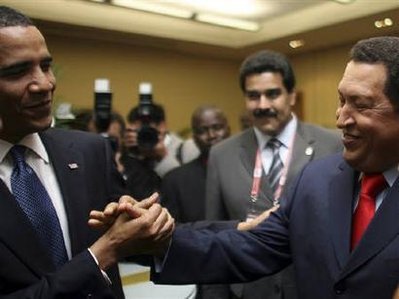
Two socialists shake hands: Barack Obama and Hugo Chavez
The Wall Street Journal says that the whole country is basically in the grip of ignorant socialists at every level, so there is lots to do.
Excerpt:
Pulling out of that death spiral, economists say, will require a series of painful and unpopular adjustments, rolling back more than a decade of populist and statist policies. Among the measures needed is raising the price of the world’s cheapest gasoline—which goes for less than one U.S. penny a gallon—overhauling a cumbersome and inefficient foreign-exchange system, and cutting generous social programs on which Venezuela’s poor depend.
[…]The government still controls more than 20 governorships, hundreds of mayors, the judiciary, much of the press and all auditing agencies. It will be up to Mr. Maduro whether to take steps to stabilize the economy, like loosening currency or price controls.
It’s not just Venezuela that has hit bottom under socialism. Recently, the people of Argentina also threw out their socialists after years and years of disastrous leftist policies.
The Chicago Tribune reports on last month’s election in Argentina.
Excerpt:
Under the current president, Cristina Fernandez, Argentina has become an international financial pariah. The country defaulted on debt last year in a long-running feud with hedge funds — remarkably, that was the eighth default in Argentina’s history.
Fernandez refused to settle. That’s left the country to squeak by in isolation, using protectionism and capital controls in a quixotic battle with globalism. The economy is stagnant, foreign currency reserves are dwindling and the inflation rate is around 30 percent. Last week, American Airlines said it stopped accepting pesos for ticket sales because it was tired of collecting revenue it couldn’t convert to dollars.
At times Argentina has embraced trade and economic openness, only to slip back into bad habits thanks to populist Peronistas like Fernandez. Macri, a conservative, wants to re-establish free market principles, but there are a lot of details he didn’t fully explain before his November victory because they will require some short-term pain, and he wanted to win the election.
Everything Macri is talking about makes sense. He says he will lift the capital controls that have wrecked the peso’s credibility. Like other backwaters it shouldn’t resemble, Argentina has a thriving black market because the government insists the peso is worth a lot more than its actual value. Freeing the currency would devalue it, a first step toward making Argentina more competitive.
The next big step would be to negotiate a settlement with the hedge funds that bought up Argentina’s debt after its previous default in 2002 and demand repayment. Fernandez got political mileage from attacking the “vultures,” but Macri seems to understand Argentina can’t get unstuck when it’s essentially shut out of international capital markets. He sounds like he wants to do a deal.
Macri’s got a tremendous balancing act to pull off: He’ll need to cut spending and reduce taxes without destroying the country’s big social safety net, while walking the country through a devaluation.
This is how countries that are ruled for a prolonged period by the political left eventually end up. I know so many of you lose heart and think that there is no hope, but there is hope. Even in countries where the left is running everything from the universities, to the judiciaries, to the mainstream media, there is hope.
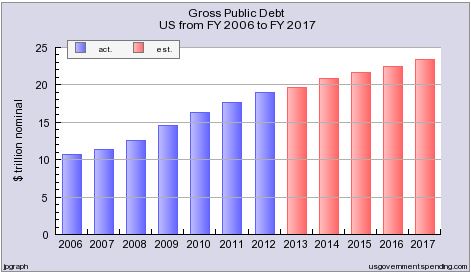
Over the last 7 years, Obama added $10 trillion to the national debt. And although few of his Democrat low-information voters know about that, they will be able to tell the difference between prosperity and poverty when the United States reaches the Venezuela / Argentina tipping point. There comes a time when there are no more bailouts for the economics deniers. Reality wins in the end.
Has the economy been doing well lately? When I ask Democrats that question, they often point me to the stock market. I know that the stock market has done very well in the last 8 years. But I really question which Democrat policies have been responsible for this winfall.
Certainly, policies like Obamacare, Dodd-Frank, green energy subsidies, blocking Keystone XL, creating a student loan bubble, and even loosening mortgage lending again to create another housing bubble, cannot cause any economics growth. My personal opinion is that all the growth came from adding over $10 trillion dollars to the debt – a process that started with the election of Nancy Pelosi and Harry Reid to the House and Senate majorities, respectively, in 2007.
Look at the national debt:
Gross public debt, Democrats control spending starting in 2007
If you add $10 trillion to the national debt in 8 years then OF COURSE the stock prices will go up. You would look richer too if you took your credit card balance from $8,500 to $18,500. But what is behind all this consumer spending and government spending? Just trillions of dollars of new debt.
I think a better measure of how the economy is doing is to ask job creators how it is doing. For example, we can ask small businesses, since they are responsible for so much of the job creation in this economy.
Here’s an article from the Daily Signal about that.
It says:
More than five years after the end of the “Great Recession,” only 21 percent of small businesses* say they have fully recovered. During the recession, lack of sales ranked as the top problem small business faced. Taxes placed second, and “government regulations and red tape” placed third. And since 2012, at least one in five small business owners identify government regulations as their most important problem.
The reason for this is simple—small business owners directly feel the impact of federal regulation in the daily life of their businesses. The small business owner is often the main person in a business who bears the burden of complying with regulations and paperwork requirements. According to a 2010 study, small businesses spend $10,585 per employee on regulation, which amounts to 36 percent more per employee than larger companies spend.
With that as a backdrop, it is easy to see how small business owners continue to wonder why Washington just does not get it when it comes to regulation. For decades, Congress has sought to solve societal problems through mandates on business. Too many Americans without health insurance? Congress tries to solve that by requiring businesses to provide health insurance to their employees (regardless of whether or not they can afford it) or pay hefty penalties. Too many Americans unable to care for a sick relative? Congress seeks to address that by mandating that a business keep a position open three months out of every year for qualified employees, using a cumbersome reporting system.
Always entrepreneurial, with a keen focus on the bottom line, the American small business owner looks for ways to minimize the time and money spent on things other than running his or her business. Since many of these regulations wisely exempt the smallest of small businesses, some employers purposefully do not increase hiring because they do not want to have to comply with the regulatory regimes that await businesses that expand to 10, 15, and 50 or more employees.
This might be why the labor force participation rate is at a 38-year low.
A record 94,031,000 Americans were not in the American labor force last month — 261,000 more than July — and the labor force participation rate stayed stuck at 62.6 percent, a 38-year low, for a third straight month in August, the Labor Department reported on Friday, as the nation heads into the Labor Day weekend.
[…]In August, according to BLS, the nation’s civilian noninstitutional population, consisting of all people 16 or older who were not in the military or an institution, reached 251,096,000. Of those, 157,065,000 participated in the labor force by either holding a job or actively seeking one.
The 157,065,000 who participated in the labor force equaled only 62.6 percent of the 251,096,000 civilian noninstitutional population — the same as it was in July and June. Not since October 1977, when the participation rate dropped to 62.4, has the percentage been this low.
So… do you still think that the economy is in good shape? Any economy is going to look better if you take an $8.5 trillion debt and run it up to $18.5 trillion. But if you look a little closer, you see that small businesses are hard-pressed, and it’s affected the real unemployment rate.


 WINTERY KNIGHT