
Tag Archives: Economics

Conservative Party of Canada on track to deliver budget surplus in 2015

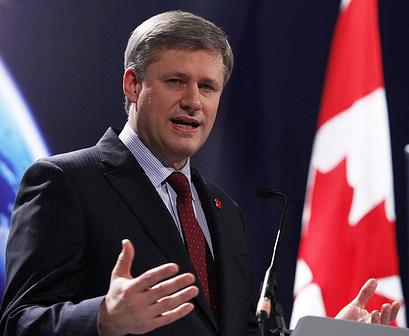
Prime Minister Stephen Harper
Prime Minister Stephen Harper (Conservative Party)

Story from Yahoo News about the results delivered by the Conservative Party of Canada.

Note: To understand the numbers in the article, simply multiple the numbers by 10 to compare with American numbers – Canada’s economy is about 1/10 the size of ours. For example, our GDP is $15.7 trillion and theirs is $1.8 trillion. Our national debt is $17 trillion, while their’s is $1.2 trillion.

Excerpt:

Canada’s Conservative government looks set to comfortably balance its books in 2015 or even sooner, its latest budget showed on Tuesday, with cuts in spending on the public service more than offsetting a series of modest new expenditures.

The low-key spending plan leaves Prime Minister Stephen Harper well-positioned to offer tax breaks and other initiatives in the runup to an election scheduled for October next year.

“Some people will say this budget is boring,” Finance Minister Jim Flaherty told reporters ahead of the budget speech. “Boring is good.”

The budget shows a deficit of C$2.9 billion ($2.63 billion)in the 2014-15 fiscal year, up from the previous estimate of C$5.5 billion. That balance includes a C$3 billion contingency fund, which in fact reveals an underlying surplus that year.

Flaherty acknowledged the budget would be narrowly balanced this coming year without the contingency fund, but said he preferred to have a “nice clean surplus next year”.

The government estimates a bigger-than-expected C$6.4 billion surplus in 2015-16. In the year ending March 31 of this year, the deficit is pegged at C$16.6 billion.

[…]Flaherty, who is 64 and battling a rare skin disease, has staked his reputation on eliminating Canada’ small deficit, equivalent to about 1 percent of gross domestic product (GDP), and restoring the reputation the country had before the global financial crisis as having the strongest fiscal record in the Group of Seven major economies.

Germany is currently the only G7 country running a surplus, but Canada’s ratio of debt to GDP is substantially less and it is one of a handful of countries with a triple-A rating from rating agencies.

Canada is beating us in debt to GDP:
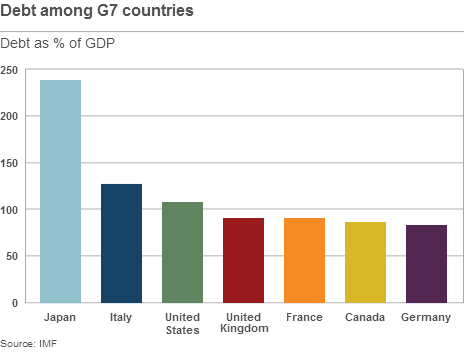
G7 Debt to GDP as of 2013
G7 % Debt to GDP as of 2012 (lower is better)

Canada is beating us in economic growth:
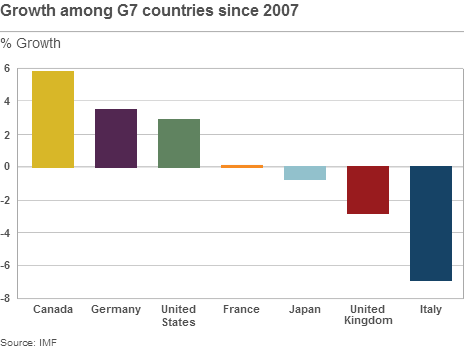
G7 GDP growth for 2013
G7 % GDP growth from 2007 to 2012 (higher is better)

Source: BBC Business

The next Canadian election is in 2015. I know that the Liberal Party is currently leading in the polls, but I found some good news. The Canadians just redistricted after their census, and there are 30 new electoral districts. If the same turnout occurs in 2015 which occurred in the 2011 election, then the Conservative Party of Canada would get 22 out of 30 of those new seats. However, I am concerned. I want Harper to keep his majority, as he and Tony Abbott (Australia) are two bright conservative stars who show people what conservatives can do. 

Treasury Department threatens private companies for responding to Obamacare incentives

Investors Business Daily reports on how the Treasury Department is threatening private companies who lay off employees because of the costs imposed on them by Obamacare.

Excerpt:

In what may be considered an ObamaCare loyalty oath, the Treasury Department orders employers to attest that any employee layoffs are not due to its imposed costs under penalty of perjury.

The first rule of business is to stay in business, something which is accomplished by doing what government is incapable of doing — controlling costs and making a profit by giving customers a product or service they need or want.

ObamaCare is obviously a product neither business nor the individual wants, so coercion is necessary under penalty of law.

Enforced by the Internal Revenue Service, individuals must enroll in government-approved plans or be fined.

Individuals are not allowed, despite presidential promises, to keep the plans and doctors they like and can afford.

Instead, they must accept plans they don’t like and can’t afford, some getting subsidies extracted from other taxpayers or China. They must grin and bear their reduced health care choices and higher costs.

Even though ObamaCare’s employer mandate has once again been illegally and unconstitutionally extended by the president who would be king, business still faces ObamaCare’s punitive cost increases down the road and its own form of government coercion.

Layoffs are an unfortunate but sometimes necessary means for a business to control costs and stay in business.

On Monday, a Treasury Department unconcerned with the necessities of the free market said that businesses will need to “certify” that they are not shedding full-time workers simply to avoid the mandate and its costs.

Officials said employers will be told to sign a “self-attestation” on their tax forms affirming this, under penalty of perjury.

What happens when a government passes regulations that make it harder for employers to lay off workers if they are forced to? Well, companies stop hiring workers, and expand their operations elsewhere. That’s exactly what has happened in countries like France, where the government makes it nearly impossible to get rid of workers, even when circumstances warrant it. So the net effect of policies that reduce the freedom to hire/fire as needed is to raise unemployment.

Here’s the economist Aparna Mathur of the American Enterprise Institute to explain.

Excerpt:

Labor market regulations often take the form of employment protection rules that govern the hiring and firing of workers. These were originally introduced to enhance workers’ welfare; for instance, by reducing unfair dismissals. The same provisions that protect employees, however, translate into cost for employers, leading an employer to think twice (at least) before hiring a new employee.

Theoretical economic models have shown that, in general, the effect of such laws is to reduce job flows (broadly, the sum of jobs created and jobs destroyed). In my paper, I show that these reduced job flows could have negative effects on investments in education because they reduce the expected returns on a job search; and they lower the value of education as a signaling device.

Under rigid labor market regulations, employers have a stronger disincentive to create new jobs, so there are fewer available jobs on the market. As a result, one’s likelihood of earning a productive wage is reduced. Moreover, firings under a system of strong labor market regulations are less frequent than they would be otherwise, so even workers with jobs expect to face fewer opportunities to search for re-employment. As a result, they will have less use of education as a signaling device to secure their next job.

With flexible labor markets and higher job mobility, these conditions are reversed. Job flows are higher, leading to more vacancies per unemployed worker. This yields a higher expected return on a job search for educated workers since the likelihood of finding a job is higher. Further, workers are either fired or they quit more frequently (i.e., job destruction is higher), leading to a greater use (or need) of education as a signaling device.

Put simply, imagine a developing country with rigid labor markets leading to few vacancies. For a low-income worker, the cost of getting educated may outweigh the prospective benefits since the likelihood of finding a job in this scenario is fairly low. On the other hand, for the same worker, if the likelihood of finding a job goes up when labor market restrictions are removed, the incentive to invest in education may be higher since the returns to investing in this costly activity are higher. Countries such as France, Germany, and Italy, which consistently have strict labor regulations, would do well to heed these results (see figure). It is also true in general that developing countries have stricter labor regulations than the OECD economies.

All these regulations sound so good, but we have to think beyond stage one in order to see the real results of the happy-sounding speeches. These things are understood by economists, but we didn’t elect an economist.

State department: not building the Keystone XL pipeline could increase greenhouse gas emissions

From CNS News.

Excerpt:

Not building the 875-mile Keystone XL Pipeline could result in the release of up to 42 percent more greenhouse gases than would be released by building it, according to the State Department.

Not building the pipeline “is unlikely to significantly impact the rate of extraction in the [Canadian] oil sands or the continued demand for heavy crude oil at refineries in the United States,” the department noted in a long-awaited environmental report released January 31st.

But the “No Build” option is likely to result in an increased number of oil spills, six more deaths annually, and up to 42 percent higher greenhouse gas (GHG) emissions, the State Department concluded.

The proposed 36-inch pipeline would transport 830,000 barrels of crude oil each day from western Canada through the Bakken oil fields of Montana and South Dakota before connecting to an existing pipeline in Nebraska on its way to Gulf Coast refineries.

The project will create an estimated 42,100 jobs and add $3.4 billion to the U.S. economy.

This report follows last week’s report showing that the pipeline would have no major environmental impact.

Excerpt:

The long-delayed Keystone XL oil pipeline cleared a major hurdle toward approval Friday, a serious blow to environmentalists’ hopes that President Barack Obama will block the controversial project running more than 1,000 miles from Canada through the heart of the U.S.

The State Department reported no major environmental objections to the proposed $7 billion pipeline, which has become a symbol of the political debate over climate change. Republicans and some oil- and gas-producing states in the U.S. — as well as Canada’s minister of natural resources — cheered the report, but it further rankled environmentalists already at odds with Obama and his energy policy.

Now the State Department is one of the most liberal departments in the government. Unfortunately, this has not appeased the great climate science experts in Hollywood, who donate so much money to Democrat election campaigns. So long as the money keeps flowing from the high school drop-out celebrities, don’t expect this pipeline to get built. For the Democrats, it’s all about staying in power.

Related Posts