
Tag Archives: Economics

What is the purpose of capital punishment? Does it deter crime?

I have a key that will unlock a puzzling mystery

Why do some people support the death penalty? Because research conducted by multiple teams of scholars at multiple universities have shown that the death penalty deters crime.

Excerpt:

“Science does really draw a conclusion. It did. There is no question about it,” said Naci Mocan, an economics professor at the University of Colorado at Denver. “The conclusion is there is a deterrent effect.”

A 2003 study he co-authored, and a 2006 study that re-examined the data, found that each execution results in five fewer homicides, and commuting a death sentence means five more homicides. “The results are robust, they don’t really go away,” he said. “I oppose the death penalty. But my results show that the death penalty (deters) — what am I going to do, hide them?”

Statistical studies like his are among a dozen papers since 2001 that capital punishment has deterrent effects. They all explore the same basic theory — if the cost of something (be it the purchase of an apple or the act of killing someone) becomes too high, people will change their behavior (forego apples or shy from murder).

And specifically:

• Each execution deters an average of 18 murders, according to a 2003 nationwide study by professors at Emory University. (Other studies have estimated the deterred murders per execution at three, five and 14).

• The Illinois moratorium on executions in 2000 led to 150 additional homicides over four years following, according to a 2006 study by professors at the University of Houston.

• Speeding up executions would strengthen the deterrent effect. For every 2.75 years cut from time spent on death row, one murder would be prevented, according to a 2004 study by an Emory University professor.

In case anyone is wondering what sort of crimes are deterred by the death penalty, you can read this graphic description of a recent death-penalty crime.

What sort of crimes are eligible for the death penalty?

Here’s an example of a death-penalty eligible crime from the Hartford Courant. (WARNING: graphic!)

Excerpt:

A Superior Court jury today sentenced Steven Hayes to death for the murders of Jennifer Hawke-Petit and her daughters, Hayley and Michaela, during a seven-hour home invasion, robbery and arson at their Cheshire home in July 2007.

Outside the courthouse after the verdicts, Hawke-Petit’s father, the Rev. Richard Hawke, said “There are some people who do not deserve to live in God’s world.”

Asked what he had in his heart, Dr. William Petit Jr. struggled with his answer. “….Probably many of you have kids,” he said, pausing to choke back tears. “Michaela was an 11-year-old little girl…tortured and killed in her own bedroom, surrounded by her stuffed animals….”

Petit then talked about his daughter Hayley’s bright future and her strength and the children that his wife, Jennifer, helped.

“So, I was really thinking of the tremendous loss” during the verdict, Petit said, adding that he was pleased with it, but “mostly I was sad for the loss we have all suffered.”

Asked if he thought there’d be closure now, Petit said, “There’s never closure. There’s a hole…. with jagged edges…that may smooth out with time, but the hole in your heart and the hole in your soul” remains.

“This isn’t about revenge,” Petit said. “Vengeance belongs to the Lord. This is about justice.”

[…]The jury sentenced Hayes to death on six counts: killing Hawke-Petit and Michaela and Hayley in the course of a single action; killing a child under the age of 16; killing Hawke-Petit in the course of a kidnapping; killing Hayley in the course of a kidnapping; killing Michaela in the course of a kidnapping; and killing Hawke-Petit in the course of a sexual assault.

[…]Hayes, 47, of Winsted, was convicted Oct. 5 of breaking into the Petit home, beating Petit, tying up and torturing the family as Hayes and another man ransacked the home for cash and valuables and tortured the family for seven hours. Testimony during Hayes’ trial showed that at one point in the break-in, Hayes forced Hawke-Petit to go to the bank to withdraw money. During that time, according to testimony, Komisarjevsky sexually assaulted Michaela Petit, 11.

When Hawke-Petit and Hayes returned from the bank, Hayes raped and strangled Hawke-Petit. The house was doused with gasoline and set on fire as the intruders fled, testimony showed. Hayley, 17, and Michaela died of smoke inhalation.

[…]Prosecutors used the words of Hayes’ younger brother Matthew to counter testimony that home-invasion crime was an aberration in Hayes otherwise troubled but basically nonviolent life.

Matthew Hayes portrayed his brother as a conniving, sadistic, violent thief who saw Matthew take countless beatings from his brutal father for Steven Hayes’ misdeeds. At one point, Steven Hayes held a gun to Matthew’s head, according to the statement, which was given to state police after the home invasion.

Examples of Hayes’ sadistic behavior toward his brother included hooking Matthew to the garage door by his belt and raising the door up and down, and holding Matthew’s hand to a red-hot burner. Matthew said his brother’s life of crime was not a result of bad parenting or poor childhood. He said Hayes never learned to take responsibility for his actions.

Sometimes, I think that we have stopped judging others because we do not want to be judged ourselves. We hope that by not judging anyone, that we will somehow escape being judged by anyone – especially by God himself. The opposition to punishing the guilty is, I think, really just a way of expressing our desire to do away with the idea that we will finally face judgment.We seem to be able to ignore the victim’s needs and act as if the criminal is the victim. We act as if deterring a crime with punishment has no impact on the decision making of people who are considering whether to commit the crime. But crime isn’t some random action – criminals do consider what will happen to them if they are caught. We send potential killers a message by being willing to punish the ones we catch. But if we treat them like victims, then others watching are not going to be deterred from committing crimes.
Should Christians be committed to small government conservatism?

I found a paper (PDF) on the University of Washington web site that makes the case for why Christians ought to care about more than just social issues.

Here’s the abstract:

What accounts for cross-national variation in religiosity as measured by church attendance and non-religious rates? Examining answers from both secularization theory and the religious economy perspective, we assert that cross-national variation in religious participation is a function of government welfare spending and provide a theory that links macro-sociological outcomes with individual rationality. Churches historically have provided social welfare. As governments gradually assume many of these welfare functions, individuals with elastic preferences for spiritual goods will reduce their level of participation since the desired welfare goods can be obtained from secular sources. Cross-national data on welfare spending and religious participation show a strong negative relationship between these two variables after controlling for other aspects of modernization.

Here’s the conclusion:

It is quite apparent that there is a strong statistical relationship between state social welfare spending and religious participation and religiosity. Countries with higher levels of per capita welfare have a proclivity for less religious participation and tend to have higher percentages of non-religious individuals. People living in countries with high social welfare spending per capita even have less of a tendency to take comfort in religion, perhaps knowing that the state is there to help them in times of crisis.34 As laid out in the theory above, there is likely a substitution effect for some individuals between state-provided services and religious services. Religion will still be there to serve the spiritual needs of people seeking answers to the philosophic mysteries of life, but those who value those spiritual goods less than the tangible welfare benefits churches provide will be less likely to participate in religious services once secular substitutes become available. Given that religious practice and values are often passed down from generation to generation, the weakening of practice in one generation will likely translate into weaker practice in subsequent generations. Does this mean that secularization theory is correct in its prediction that religion will gradually fade away? Doubtful. Realizing that there is still a yearning among many people to understand the mysteries of life, religion is not likely to dissipate at any time soon. Government simply cannot offer credible substitutes for these less tangible, supernatural goods. The explosion in spirituality once religion was made legal in former Soviet bloc countries lends credence to this assertion (Greeley 1994). As religious markets become more deregulated in various parts of the world, it is likely that new religious movements will take advantage of increased liberty and discover ways to expand.

Perhaps one of the most important lessons from the findings above is that the religiosity of a society is not simply determined by sociological factors. Government policy can play an important role in shaping the religiosity of a nation. Policies aimed at regulating the activities of religious organizations — from tax laws to zoning regulations — have important effects on the firms that supply religious goods and services. Many of these policies are designed consciously to promote or inhibit religious practice. Alternatively, welfare policy has been shown here to unintentionally affect the demand for religious services, likely over the course of generations. And, finally, since an extensive welfare state is considered by many to be a hallmark of modernized societies, the microfoundational analysis presented above provides a way of incorporating a component part of the secularization thesis (which relies heavily on notions of modernization) into the religious economy perspective.

Have you ever heard a sermon that addresses the size of government and individual liberty and prosperity? I haven’t. You’d have to be reading Wayne Grudem or Jay Richards to find that. The typical church you attend either praises big government or says nothing about it. After all, we can keep making withdrawals on the liberties we have right now without ever worrying about having to make any deposits, right? Everything will be fine, and it’s easier not to have to think about what’s down the road to serfdom, so long as the scenery is nice for us right now. Religion is primarily about comfort, not truth. Right?

The funny thing is that when I talk to most Christians about this, especially non-Americans, they simply don’t have the knowledge of economics to understand how big government affects liberty, prosperity and security. There is no one reading F.A. Hayek and Thomas Sowell in Europe, and there are not that many people reading them here at home either.

Good news: Venezuelan President complains that fracking is “flooding” oil markets

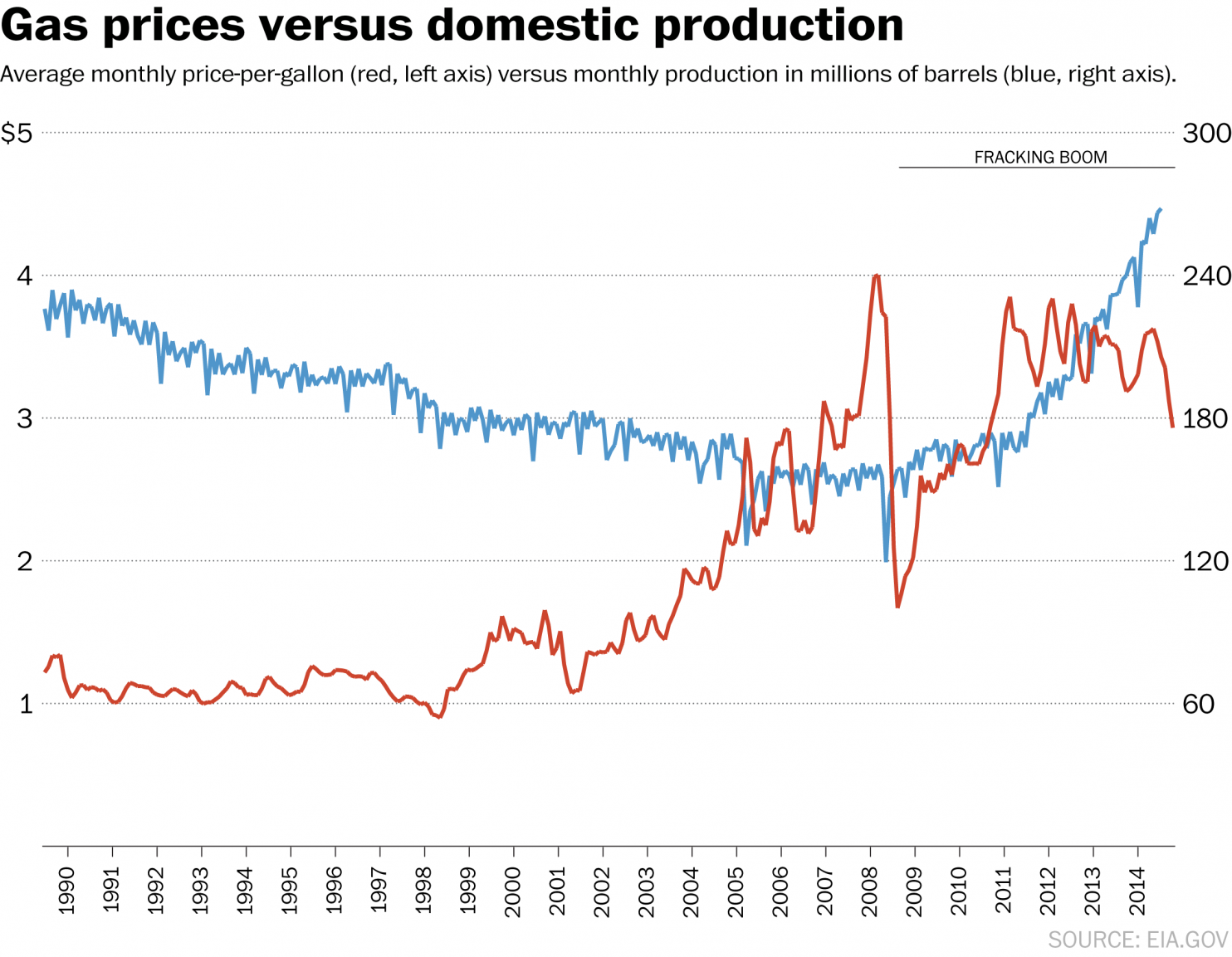
Gas prices vs domestic oil production

(Click for larger image. Source)

Why are gas prices so low all of a sudden?

Well, let’s ask the communist President of Venezuela:

The broadcast networks may not want to give credit to hydraulic fracturing for increasing U.S. oil production and lowering global oil prices, but at least one angry world leader did just that.

Venezuelan President Nicolas Maduro complained that fracking in the U.S. has “flooded” the world market and contributed to lower oil prices, a connection that broadcast networks’ evening news reports barely made recently.

“The oil they’re taking from (shale deposits) and the gas. They’ve flooded the international market to batter the Russian economy …, Iran and to hurt us, Venezuela,” Maduro said in a broadcast on VTV, a state-run TV channel in Venezuela, according to Fox News Latino.

Fracking has been one cause of increased oil production in the U.S. That increased production helped lower oil prices by more than 30 percent since September 29. The decline in oil prices since June has severely impacted Venezuela, since oil exports were a major source of government income. “Some estimates put the break-even price for Venezuela to balance its budget at around $121 a barrel,” CNBC reported on December 7. That’s more than double current oil prices. Oil closed at $59.15-per-barrel on December 11.

As of January 2014, Venezuela’s state-run oil company brought in 96 percent of foreign earnings, according to The Economist. Maduro announced on December 2 that the government would cut spending by 20 percent.

[…]Venezuela was experiencing particular difficulties. That economy was on the verge of collapsing, CNBC said on Dec. 1. If low oil prices continued, Venezuela may face a “game over” situation and “barbarity and people looting.”

Do you know who else is hurt by this? Russia. I sure hope they don’t do anything aggressive to their neighbors while their economy feels the pinch of lower gas prices.

It’s a good thing when villains shake their fists at us, but it’s a better thing when consumers pay less for gas:

Thanks in part to the widespread use of technologies like hydraulic fracturing and horizontal drilling, global oil prices plummeted in 2014. Energy experts even predicted the U.S. could be the top oil producer in the next several years.

[…]Fracking and other advanced technologies helped the U.S. nearly double its average daily output of oil, from 5 million barrels in 2008 to an expected 9.42 million barrels in 2015. The huge supply increase was one factor sending crude oil prices down. Crude fell by more than 32 percent, from $93 to $63 just since Sept. 29. This already drove gas prices down to a national average of $2.66 for regular on Dec. 9, according to AAA.

This is great news for consumers and businesses which could save as much as $1.3 trillion worldwide because of lower oil prices, according to Julian Jessop, chief global economist at Capital Economics in London. Here in the U.S., Americans could save $230 billion if prices remain low for the next year, The Washington Post said on Dec. 1.

The only bad side to this story is that fracking is an expensive way of drilling, so as the price of oil drops, energy companies will be scaling back fracking until it becomes profitable again.

I think this story is important, because it helps to explain what the people who oppose the Keystone XL pipeline are concerned about. They know that there are two results to allowing that pipeline to be built. First, a hell of a lot of jobs will be created, reducing dependency on government. Second, the price of gas at the pump will go down further. That’s what the environmentalists (and their Democrat allies in Washington) are seeking to avoid. They want more government dependency, and higher gas prices.