
Tag Archives: Economics

How Christianity shaped Margaret Thatcher’s conservative politics

Margaret Thatcher and Ronald Reagan

This is from the Daily Signal, and is really recommended for Christians who are tempted by the policies of the left.

Check it:

Few people are aware that former British Prime Minister Margaret Thatcher, one of the foremost politicians of the 20th century, was a lay Methodist preacher before she entered politics.

There has been very little examination into the role that her Christian faith played in her politics.

“Economics is the method; the object is to change the soul,” Thatcher once declared, revealing that the way she conceived her free-market ideology was as much about transforming values as about improving Britain’s ailing GDP.

More profoundly, there was a strong religious basis to Thatcher’s politics—one that stemmed from her strict Methodist upbringing and, more specifically, the chief influence in her life, her father, who was a greengrocer, councilor, and Wesleyan lay preacher.

In sourcing the origins of her free-market ideology, it is not in the pages of Frederick von Hayek’s “Road to Serfdom” or Milton Friedman’s monetarist theory where we find the answer, but in the sermon notes of her father, Alf Roberts.

Contained within his sermons, one finds the theological basis of what would later become the cornerstones of Thatcherism: an individualistic interpretation of the Bible, a nod to the spiritual dangers of avarice, praise of the Protestant work ethic, virtues of thrift and self-reliance, and finally, a divine justification for individual liberty and the free market.

In short, Thatcherism always owed more to Methodism than to Monetarism.

Thatcher herself was a preacher before she formally entered politics while a student at Oxford University. Even though she later transferred this missionary energy from the pulpit to the podium, her religious values remained an underlying core.

Indeed, on becoming leader of the Conservative Party in 1975, Thatcher (much like Ronald Reagan) saw it as her chief mission to completely undermine the moral credibility of socialism and communism and reconnect the broken link between Protestant and capitalist values in Britain.

Preaching from the pulpit on several occasions, Thatcher unashamedly asserted the Biblical case for the sovereignty of individual liberty and the “invisible hand.”

“Do not be tempted to identify virtue with collectivism,” she preached from the pulpit of St. Lawrence Jewry Church in London in 1978. “I wonder whether the State services would have done as much for the man who fell among the thieves as the Good Samaritan did for him.” According to Thatcher, “[i]t was to individuals that the Ten Commandments were addressed.” She continued, “We are called on to repent our own sins, not each others’.”

“What mattered,” in her words, “was Man’s relationship to God.”

Thatcher’s interpretation was that as Christianity was a call to men individually, so it should follow that political choices reside with the citizen rather than the state.

“The Road to Serfdom” and “Free to Choose” are two of my favorite economics books, and very suitable for laymen. If an understanding of the free enterprise system isn’t yet part of your Christian worldview, it might be a good idea to get studying! After all, Christians are not concerned with policies that make us feel good regarding the poor. We are concerned with policies that actually do good for the poor. There is a big difference.
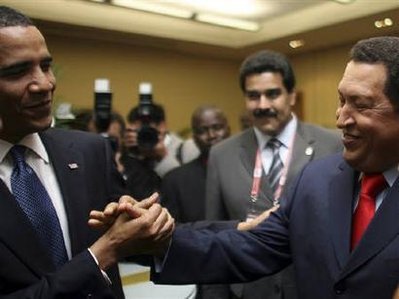
How well are Democrat Party economic policies working out in Venezuela?

I think that when we discuss economics, we should try to identify where specific policies have been tried and then we should observe the consequences to the people who tried them. Often, in college and university classrooms, one view of economics is sold to students by professors as the “nice” view. The professors, many of whom have never worked in the private sector in their entire lives, tell the students that socialism is the “nice” point of view, and anyone who disagrees is “mean”. Is that the right approach to teaching young people what to believe about economics?

Are Barack Obama and Hugo Chavez very different?

Let’s take a look at this article from Yahoo News about socialist dictator Hugo Chavez’s country of Venezuela, a country much admired by people on the socialist left.

It says:

All the lady wanted was some chicken. But in shortage-plagued Venezuela, she waited in line five hours, only to go home empty-handed.

“I got here at 5:30 am and came away with nothing! It is just not fair that you have to work so hard — and then put up with these lines,” said an exasperated Lileana Diaz, a 49-year-old receptionist at a hospital emergency room.
Venezuelans have been enduring shortages of the most basic goods, such as toilet paper, for more than a year.

In Caracas, a cottage industry has emerged with people who will wait in line for you — at a price.

But things are even worse outside the capital.

The problems are staggering here in Valencia, an industrial city west of the capital of this oil-rich country.

Valencia has big factories that produce food and other essentials. Still, the list of goods in short supply is long.

It includes coffee, cooking oil, cornmeal, soap, detergent, you name it.

Chicken is one of the most coveted.

Frustrated shoppers like Diaz are legion.

One tells the story of people who climbed over a fence to get a good place in line outside a store, prompting police to intervene and stop scuffles that broke out.

Another lady shopper shows off a nasty bruise on her right leg, thanks to a fight she got into as she tried to buy disposable diapers.

In recent weeks, the lines of people waiting hopefully outside supermarkets and stores have grown longer in cities away from the coast, such as Maracaibo, Puerto Ordaz and Cumana.

Venezuelan media have reported situations of nerves running very, very high and shoppers coming close to looting.

At times it has gotten that bad, in fact. In late January, one person died and dozens were arrested in the chaos of a looting outbreak at stores in the town of San Felix in the southern state of Bolivar.

[…]In another supermarket in Valencia, a line 50 meters (yards) long snakes away from the entrance.

“We call these ‘holding out hope lines,’ because once you get inside, there is nothing on the shelves,” said Oscar Oroste, a 53-year-old chef.

Oroste said that until recently, people would wait in line knowing what was available to buy. “Now, people are in line but do not even know what they will be sold.”

Venezuelans go from supermarket to supermarket, and store to store, clamoring for basic necessities which have prices regulated by the leftist government.

But some buy just to resell at a handsome profit, and economists say that is another source of the shortages.

Egne Casano, a 28-year-old homemaker, said things are a bit better in Caracas. “I went there not long ago and saw that there is a better supply,” she said.

[…]In the long lines, people digest their woes with a mix of humor, resignation and anger.

At another supermarket in Valencia, a whopping 600 people stood in line under a blazing sun to buy powdered milk.

Graciela Duran, a retiree, got a kilo of it after waiting for four hours.

“I was lucky today, Sometimes I come and there is nothing,” she said.

“Waiting in huge lines is what we do all day, every day,” said Duran, shielding herself from the sun with an umbrella.

A dozen police were stationed at the entrance of the store and around the parking lot through which the queue moved.

A truck drove by and the driver shouted out sarcastically: “Homeland, homeland, beloved homeland.”

That comes from a song that late president Hugo Chavez used to sing and is heard often on government-run media and at official events.

If you’re interested in real statistics on Venezuela, I recommend this recent article from The Economist, which is as far left as Venezuela is, and endorsed Barack Obama.

In socialism, the main purpose of policies is to make the leftist leaders at the top receive applause. They say things that will get them applause from the people. The policies are not intended to lift people out of poverty, otherwise Zimbabwe, North Korea, Cuba, Venezuela, etc. would all be rich and prosperous. The policies are intended to make the leaders feel good about themselves. “If you like your doctor, you can keep your doctor”. “If you like your health plan, you can keep your health plan”. It’s not true, it’s just meant to make economically-illiterate people applaud.

So why do we keep voting for socialism, when we know it doesn’t work?

Related posts

Who’s better at managing money – Republicans or Democrats?

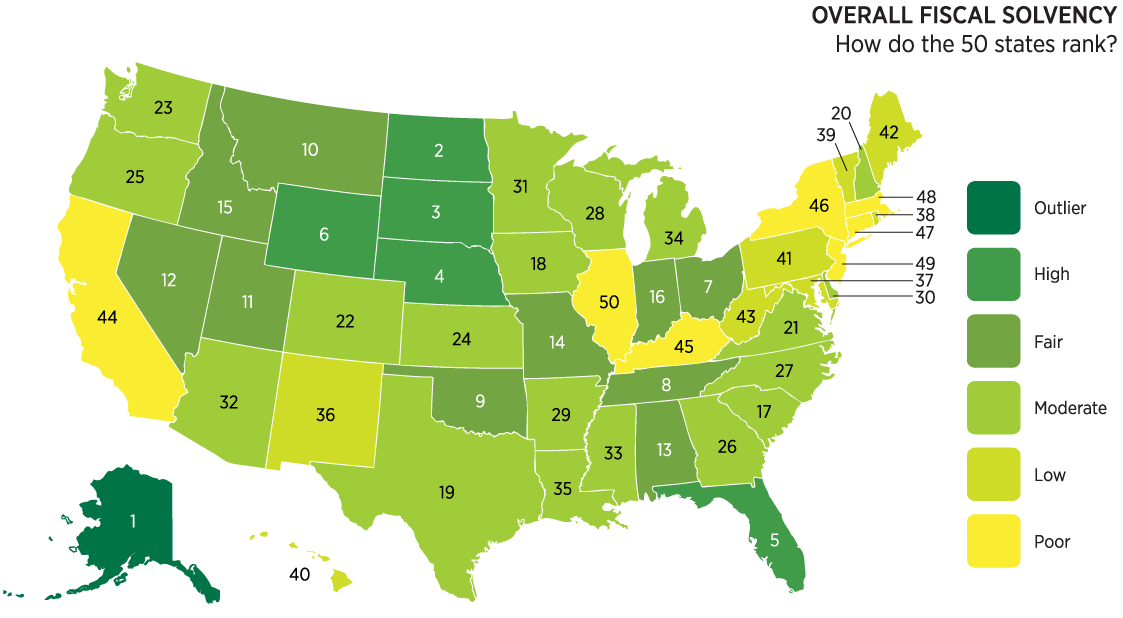
One of the best jobs for managing money is being governor of a state. So, let’s take a look at the 50 states and see which ones have the best governors for managing money.

Here’s a new report from George Mason University, and it’s written up in Investors Business Daily.

IBD says:

A new report from George Mason University’s Mercatus Center ranks all 50 states based on 14 measures designed to determine whether states can pay their short-term bills and meet their long-term obligations — debt, pension liabilities and such. The data go through 2013.

The best-run states have enough cash to pay its current bills, enough revenue coming in to meet its fiscal year needs, a cushion for economic shocks, and management long-term liabilities.

The worst states, in contrast, have “tens, if not hundreds, of billions of dollars in unfunded liabilities — constituting a significant risk to taxpayers in both the short and the long term.”

[…]There’s only one factor these fiscal winners and losers share in common. And that’s their political leanings. Of the top 10 states in the Mercatus ranking, just two — Florida and Ohio — voted for the Democratic presidential candidate in the past four elections, and just one — Montana — has a Democratic governor. Even if you look at the 25 best-performing states, only three could be considered reliably liberal.

At the other end of the list, just two of the 10 lowest-ranked states — Kentucky and West Virginia — have voted for the Republican in the past four presidential elections. And while four of them have Republican governors, they all are in solid blue states and all were elected to clean up messes left by their Democratic predecessors.

It’s also worth noting that these same states consistently show up at the top and bottom of other lists that measure business friendliness, tax burden and economic freedom.

In fact, six of the 10 worst-performing states in the Mercatus ranking — California, New York, Illinois, New Jersey, Massachusetts, and Connecticut — are also states with the heaviest tax burdens and rated the least business friendly, according to rankings from the Tax Foundation and Chief Executive magazine.

It would appear, then, that abiding by a philosophy of limited government, lower taxes and fewer regulations leads to growth, prosperity and fiscal soundness.

Here’s the full map from the George Mason University study:

George Mason University study on fiscal solvency

At the state-level, everyone understands that Republican governors know what they are doing, because they understand economics. So then why do we forget that and elect a community organizer when it comes to the Presidency? Do we just not care about the debts we are piling onto our children when we elect wastrels and profligates?