
Tag Archives: Economics

Liberal Party has made Ontario’s economy a disastrous failure

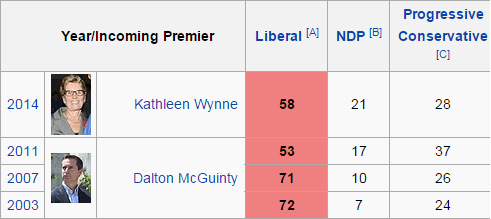
Liberal Party has dominated Ontario since 2003

I like to follow the economic situations in the most liberal Canadian provinces to see how bad things can get when liberals are in charge. This article is by Joe Oliver, who I have mentioned before on this blog.

Here’s the article from the Financial Post:

The numbers tell the story. Ontario is the largest sub-national debtor in the entire world, just one alarming distinction. Its debt is more than twice that of California, a state with three times the population and one that has its own severe fiscal problems. Its debt is $294 billion, or over $21,000 per capita. Net debt to GDP is up 48 per cent in the past 10 years to almost 40 per cent, second only to Quebec. Last year’s interest obligations totalled $11.4 billion, about the same as the cost of community and social services. I doubt many Ontarians realize how much they are paying just in interest on the provincial debt. It averages $840 per person every year and rising. Not surprisingly, Standard and Poor’s downgraded Ontario’s bond credit from AA- to A+, citing a very high debt burden and very weak budgetary performance

The energy sector is nationalized in Ontario – there is no free market competition, it’s all government-run. Consumers have one choice when they want to purchase electricity – the provincial government. How well has nationalizing the energy sector (“Ontario Hydro”) worked out?

Some of its biggest problems are self-inflicted. Recently, we received a stunning revelation from Bonnie Lysyk, the province’s Auditor-General. In the past eight years, electricity cost $37 billion above market price. Even more staggering, it will pay a further $132 billion above market by 2032. The by-now infamous Green Energy Act guaranteed the price for wind and solar, so that they cost double and 3.5 times the U.S. market price respectively. As a result, energy costs have skyrocketed by 70 per cent, a regressive tax that hurts lower income earners disproportionately and depresses personal consumption. Higher energy costs also render businesses less competitive, which discourages job-creating capital investment.

Surprise! Green energy doesn’t lower electricity bills. But that hasn’t stopped the Liberal government from jumping into it with both feet.

There is no respect for the taxpayer in Ontario… every dollar earned there is seen by the ruling elite as more fuel for her vote-buying schemes. They want to spend their way to prosperity, as if spending money in the right way will cause economic growth. Well, here’s the truth: the government can never cause the people who start businesses and create value to produce more by taking more from them. The more the government takes from job creators, the more job creators scale back their productivity.

We should learn from the failure of socialism in other countries so that we don’t repeat their mistakes here.

Related posts

Does the free market work to reduce poverty?

Economist Walter Williams

From Investors Business Daily.

Excerpt:

There has never been a purely free market economic system, just as there has never been a purely communist system. However, we can rank economies and see whether ones that are closer to the free market end of the economic spectrum are better than ones that are closer to the communist end.

Let’s try it.

First, list countries according to whether they are closer to the free market or the communist end of the economic spectrum. Then rank countries according to per capita gross domestic product. Finally, rank countries according to Freedom House’s “Freedom in the World” report.

People who live in countries closer to the free market end of the economic spectrum have far greater income than people who live in countries toward the communist end — and enjoy far greater human rights protection.

According to the 2012 “Economic Freedom of the World” report by James Gwartney, Robert Lawson and Joshua Hall, nations ranking in the top quartile with regard to economic freedom had average per capita GDP of $37,691 in 2010 compared with $5,188 for those in the bottom quartile.

In the freest nations, the average income of the poorest 10% of their populations was $11,382. In the least free nations, it was $1,209.

Remarkably, the average income of the poorest 10% in the economically freer nations is more than twice the average of those in the least free nations.

Free market benefits aren’t only measured in dollars and cents.

Life expectancy is 79.5 years in the freest nations and 61.6 years in the least free.

Political and civil liberties are considerably greater in the economically free nations than in unfree nations.

Leftists might argue that the free market doesn’t help the poor. That argument can’t even pass the smell test.

Imagine that you are an unborn spirit and God condemned you to a life of poverty but gave you a choice of the country in which to be poor. Which country would you choose?

To help with your choice, here are facts provided by Robert Rector and Rachel Sheffield in their report “Understanding Poverty in the United States: Surprising Facts About America’s Poor.”

  • Eighty percent of American poor households have air conditioning.
  • Nearly three-fourths have a car or truck, and 31% have two or more.
  • Almost two-thirds have cable or satellite TV.
  • Half have one or more computers.
  • Forty-two percent own their homes.
  • The average poor American has more living space than the typical non-poor person in Sweden, France and the U.K. Ninety-six percent of poor parents stated that their children were never hungry; in other words, they could afford food.

The bottom line is that there is little or no material poverty in the U.S.

At the time of our nation’s birth, we were poor, but we established an institutional structure of free markets and limited government and became rich.

This might be a good article send along to people who want to bash our free-market system. It’s easy for them to make assertions that we have to do this or that policy to redistribute wealth. But the real solution to helping the poor is not to take from one and give to another, it’s to put into place a system that causes wealth to be created for all. That’s what happened in the United States, and you can see how it happened in other capitalist economies like Chile, Hong Kong and Singapore. Capitalism turns poor nations into rich nations.

Thomas Sowell: does affirmative action help minorities to get ahead?

Economist Thomas Sowell
Economist Thomas Sowell – the best economist in the world

My favorite economist, Thomas Sowell has an article in Investors Business Daily that explains what affirmative action really does to minorities.

Excerpt:

Affirmative action is supposed to benefit black and other minority students admitted with lower academic qualifications than some white students who are rejected.

[…]Despite much media spin, the issue is not whether blacks in general should be admitted to higher-ranked or lower-ranked institutions.

The issue is whether a given black student, with given academic qualifications, should be admitted to a college or university where he would not be admitted if he were white.

Much research over the years has confirmed… that admitting black students to institutions for which their academic preparation is not sufficient can be making them worse off instead of better off.

I became painfully aware of this problem more than 40 years ago when I was teaching at Cornell University and discovered that half the black students there were on some form of academic probation.

These students were not stupid or uneducable. On the contrary, the average black student at Cornell at that time scored at the 75th percentile on scholastic tests. Their academic qualifications were better than those of three-quarters of all American students who took those tests.

Why were they in trouble at Cornell, then? Because the average Cornell student in the liberal arts college at that time scored at the 99th percentile. The classes taught there — including mine — moved at a speed geared to the verbal and mathematical level of the top one percent of American students.

The average white student would have been wiped out at Cornell. But the average white student was unlikely to be admitted to Cornell in the first place. Nor was a white student who scored at the 75th percentile.

That was a “favor” reserved for black students. This “favor” turned black students who would have been successful at most American colleges and universities into failures at Cornell.

None of this was peculiar to Cornell. Black students who scored at the 90th percentile in math had serious problems trying to keep up at MIT, where other students scored somewhere within the top 99th percentile.

Nearly one-fourth of these black students with stellar qualifications in math failed to graduate from MIT, and those who did graduate were concentrated in the bottom tenth of the class.

There were other fine engineering schools around the country where those same students could have learned more, when taught at a normal pace, than at a breakneck speed geared to students with extremely rare abilities in math.

[…]Mismatching students with educational institutions is a formula for needless failures.

The book “Mismatch” by Sander and Taylor is a first-rate study of the hard facts. It shows, for example, that the academic performances of black and Hispanic students rose substantially after affirmative action admissions policies were banned in the University of California system.

Instead of failing at Berkeley or UCLA, these minority students were now graduating from other UC campuses. They were graduating at a higher rate, with higher grades, and now more often in challenging fields like math, science and technology.

[…]Does the actual fate of minority students not matter to the left as much as their symbolic presence on a campus?

Now, you might ask yourself on what basis Sowell makes all these assertions, so here are a few of his academic publications about affirmative action, which are state-of-the-art:

Now, I was recently talking to a friend who has empirically false views on a number of topics. He is opposed to capital punishment, opposed to gun ownership, supports affirmative action, and so on. When I ask him why he believes these things, he doesn’t point to any evidence. I offered to give him studies showing that capital punishment has a deterrent effect on crime, that concealed carry laws reduce violent crime rates, that affirmative action laws harm minorities, etc.

If we really want to help minorities, we have to do what makes sense according the evidence. We have to aim to do good, not just feel good.