
Tag Archives: Downgrade

Moody’s downgrades credit rating of 26 Italian banks, Spain is next

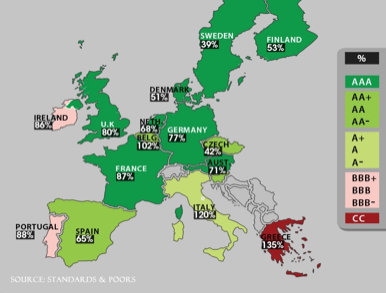
European Debt to GDP and Credit Rating

From Yahoo News.

Excerpt:

Moody’s Investors Service has downgraded the ratings on 26 Italian banks as they struggled with the effect of government austerity measures.

The rating agency said Monday that the banks are suffering because Italy is back in recession and government austerity measures are cutting demand for loans.

The banks are struggling with more loan losses, limited access to funding and weaker profits.

Moody’s noted that support of the European Central Bank lowered the default risk of many banks.

Its outlook for all 26 banks is negative.

From the Wall Street Journal.

Excerpt:

The ratings for Italian banks are now among the lowest within advanced European countries, reflecting these banks’ susceptibility to the adverse operating environments in Italy and Europe, Moody’s said in a statement. Two of the country’s largest institutions, UniCredit SpA (UCG.MI, UNCFF) and Intesa Sanpaolo SpA (ISP.MI, ISNPY), were included.

Moody’s move came hours after the firm raised an alarm on Spain, arguing the country’s banks remain vulnerable even after Madrid moved to increase the banks’ cushions against potential losses from real-estate loans.

[…]Italy, saddled with EUR1.9 trillion ($2.44 trillion) debt, has signed onto the EU’s fiscal compact that sets strict limits on the country’s deficit levels. In recent weeks, Mr. Monti has begun pressing Germany to give Italy more fiscal slack to stimulate its economy and create jobs. Mr. Monti has recently proposed that the EU create special exemptions to the budget rules when countries target their public spending on projects like broadband investments and infrastructure.

Moody’s downgrades come after the ratings firm in February placed various ratings of 114 financial institutions in 16 European countries on review for possible downgrade, highlighting the region’s banks’ vulnerability to the euro-zone sovereign debt crisis.

Moody’s is expected to follow the downgrade of Italian banks by cutting the ratings of Spanish banks. By the end of June, more than 100 European banks, as well as Wall Street giants like Bank of America Corp. (BAC) and Citigroup Inc. (C), are likely to have ratings that are at least one notch lower.

[…]Moody’s also alluded to J.P. Morgan Chase & Co.’s (JPM) recent disclosures of more than $2 billion in trading losses as a reminder of potential problems lurking at some European banks.

“Recent events highlight the risks for creditors from potential weaknesses in governance, controls and risk management, especially at some smaller, privately-held banks,” Moody’s said in its news release.

Moody’s says it will conclude its reviews by the end of June. In coming weeks, major U.S. financial institutions, Bank of America Corp., Citigroup Inc., Goldman Sachs and Morgan Stanley are likely to face downgrades.

Banks in Austria and Sweden are expected to see downgrades after Spain.

Italy’s debt is $2.44 trillion, ours is nearly $16 trillion.

United States receives another credit downgrade under Obama’s leadership

From Breitbart. (H/T ECM)

Excerpt:

Credit rating agency Egan Jones downgraded the United States Thursday on concern over the sustainability of public debt. Egan Jones is one of the most important ratings firms in the world; they lowered our credit level from AA+ to AA. The firm reduced America from AAA to AA+ in July 2011, just before Standard & Poor’s did the same.

Egan Jones warned. “Without some structural changes soon, restoring credit quality will become increasingly difficult . . . without some structural changes soon, restoring credit quality will become increasingly difficult.” They added that there was a 1.2% probability of U.S  default in the next 12 months.  The company cited the fact that the US’s total debt, which now equals its total GDP, is rising and soon will eclipse the national GDP; the company sees the debt rising to 112% of the GDP by 2014.

The debt grew 23.6% the first two years of Obama’s presidency. When the debt is more than 100% of the GDP, treasury notes fall, which is a problem because they are used for transactions between financial institutions. This, in turn, could raise rates on mortgages and other loans, which would discourage growth in the economy, as well as state and local governments feeling the pinch, which could eliminate more services.

Paul Ryan has offered a debt reduction plan which would reduce the current six federal income tax rates to just 2 — 10% and 25%. His plan would also reduce the federal corporate income tax rate from 35% to 25%, the same rate as the international average. Because of the additional revenue accrued from economic growth as a result of the tax reductions, federal revenues could double over the next 10 years; the added revenue  would be more than the entire GDP of almost every other country in the world.

Meanwhile, President Obama continues to vilify Ryan’s ideas, saying they are, “a Trojan horse, disguised as deficit-reduction plans . . . thinly veiled social Darwinism.” And White House projections show the federal debt’s ratio to gross domestic product growing to a record 124 percent in 2050 under Obama’s plan.

He just wants to keep spending and spending and spending money we don’t have. Money that he didn’t earn. Money that people not even born have not yet earned.

Merril Lynch analyst: U.S. credit rating likely to be downgraded again

From Reuters. (H/T Reason to Stand)

Excerpt:

The United States will likely suffer the loss of its triple-A credit rating from another major rating agency by the end of this year due to concerns over the deficit, Bank of America Merrill Lynch forecasts.

The trigger would be a likely failure by Congress to agree on a credible long-term plan to cut the U.S. deficit, the bank said in a research note published on Friday.

A second downgrade — either from Moody’s or Fitch — would follow Standard & Poor’s downgrade in August on concerns about the government’s budget deficit and rising debt burden. A second loss of the country’s top credit rating would be an additional blow to the sluggish U.S. economy, Merrill said.

“The credit rating agencies have strongly suggested that further rating cuts are likely if Congress does not come up with a credible long-run plan” to cut the deficit, Merrill’s North American economist, Ethan Harris, wrote in the report.

“Hence, we expect at least one credit downgrade in late November or early December when the super committee crashes,” he added.

The bipartisan congressional committee formed to address the deficit — known as the “super committee” — needs to break an impasse between Republicans and Democrats in order to reach a deal to reduce the U.S. deficit by at least $1.2 trillion by November 23.

If a majority of the 12-member committee fails to agree on a plan, $1.2 trillion in automatic spending cuts will be triggered, beginning in 2013.

What I am hearing from my sources is that the debt super-committee is not doing well at all on deciding on the cuts that everyone agreed were needed to raise the debt ceiling. I really do not feel good about the defense cuts, given what I am hearing about new Russian and Chinese 4th generation fighters. This is going to put a lot of pressure on our military if things go badly in Afghanistan and Iraq.