
Tag Archives: Deficit

Obamanomics: a closer look at the economic achievements of Barack Obama

From Investors Business Daily.

Full text:

May’s weak jobs report further confirms the president’s policies are failing to help the economy. This is, indeed, the worst recovery since the Depression.

Negative superlatives associated with this presidency keep piling up. The toll so far:

  • The share of Americans who’ve been out of work a long time — now at 42% of the unemployed — is the highest since the Great Depression (source: Labor Department).
  • The proportion of the civilian working-age population actually working, at 58%, is the smallest since the Carter era (Labor Department).
  • Growth in nonfarm payroll jobs since the recovery began in June 2009 is the slowest of any comparable recovery since World War II (Hoover Institution).
  • The rate of new business startups — the engine of job growth — has plunged to an all-time low of 7.87% of all businesses (Census Bureau).
  • 3 in 10 young adults can’t find jobs and live with their parents, highest since the 1950s (Pew Research).
  • 54% of bachelor’s degree-holders under the age of 25 are jobless or underemployed, the highest share in decades (Northeastern University).
  • Black teen unemployment, now at 37%, is near Depression-era highs (Labor Department).
  • Almost 1 in 6 Americans are now poor — the highest ratio in 30 years — and the total number of poor, at 49.1 million, is the largest on record (Census).
  • The share of Hispanics in poverty has topped that of blacks for the first time, 28.2% to 25.4% (Census).
  • The number of Americans on food stamps — 45 million recipients, or 1 in 7 residents — also is the highest on record (Congressional Budget Office).
  • Total government dependency — defined as the share of Americans receiving one or more federal benefit payments — is now at 47%, highest ever (Hoover).
  • The share of Americans paying no income tax, at 49.5%, is the highest ever (Heritage Foundation, IRS).
  • The national homeownership rate, now at 65.4%, is the lowest in 15 years (Census).
  • The 30-point gap between black and white Americans who own their own homes is the widest in two decades and one of the widest on record (Census).
  • Federal spending, now at 23.4% of GDP, is the highest since WWII (CBO).
  • Excluding defense and interest payments, spending is the highest in American history, at 17.6% of the economy (First Trust Economics).
  • The federal debt, at 69% of GDP, is the highest since just after WWII (CBO).
  • The U.S. budget deficit, now at 9.5% of the economy, is the highest since WWII (CBO).
  • U.S. Treasury debt has been downgraded for the first time in history, meaning the U.S. government no longer ranks among risk-free borrowers (S&P).

This is what Obamanomics has wrought. Fiscal promiscuity. Trickle-up poverty. Shared misery.

Here’s the Obama legacy in two charts:
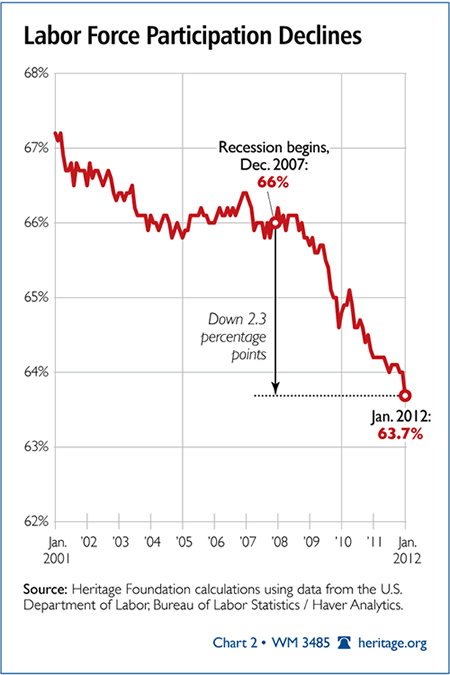
US Labor Force Participation down 4.9 million people

The updated labor force participation is actually lower now than in January.

And:
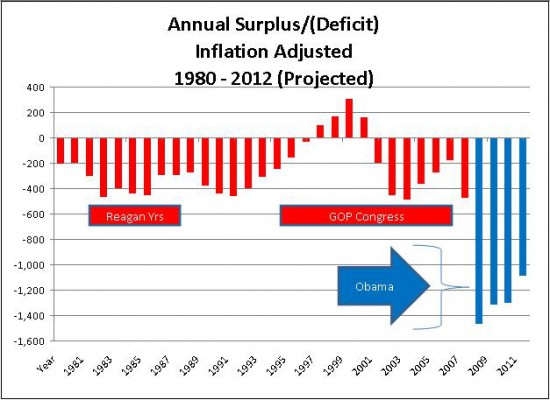
Barack Obama: Budget Deficits

What I find alarming is that Obama is still polling competitively with his Republican rival.

New jobs report: unemployment rises and 70% chance of recession

James Pethokoukis of the American Enterprise Institute explains:

The May jobs report was a complete and utter disaster for the economy and, perhaps, President Obama’s chances for reelection.

Employers created just 69,000 jobs last month, the Labor Department said on Friday. That’s the fewest since May of last year. Economists had been expecting nonfarm payrolls to increase by 150,000. (In fact, the result was lower than what any economist polled by Reuters had predicted.)

Moreover, companies added 49,000 fewer jobs than previously estimated in March and April. Talk about a slowdown. The average monthly gain was 226,000 in first quarter vs. an average of just 73,000 in April and May.

Oh, and the U-3 unemployment rate rose to 8.2% from 8.1%. The broader U-6 gauge, which also measures underemployment, rose to 14.8% from 14.5%. The labor force participation rate did, finally, tick up to a still-low 63.8%, lending credence to the idea that the shrinking workforce reflects discouraged workers and not just demographics.

And here’s the forecast: WE’RE DOOMED.

So what is the true state of the labor market?

– If the size of the U.S. labor force as a share of the total population was the same as it was when Barack Obama took office—65.7% then vs. 63.8% today—the U-3 unemployment rate would be 10.9%. (Now, this doesn’t take into account the aging of the Baby Boomers, which should lower the participation rate due to rising retirements. But is that still a valid assumption given the drop in wealth since 2006?)

–  If you take into account the aging of the Baby Boomers, the participation rate should be trending lower. Indeed, it has been doing just that since 2000. Before the Great Recession, the Congressional Budget Office predicted what the participation rate would be in 2012, assuming such demographic changes. Using that number, the real unemployment rate would be 10.5%.

– Of course, the participation rate usually falls during recessions. Yet even if you discount for that and the aging issue, the real unemployment rate would be 9.5%.

– We continue to be stuck in the longest period of 8% unemployment or higher since the Great Depression, 40 consecutive months.

– And, as the above chart shows — originally from Obama economists Christina Romer and Jared Bernstein in January 2009 –the current 8.2% unemployment rate is 2.5 percentage points above where Team Obama predicted it would be right now if Congress passed his trillion-dollar stimulus plan.

–  The median duration of unemployment rebounded to 20.1 weeks in May, and 42.8% were unemployed for longer than a half year.

– Total hours worked fell 0.2% on weakness in the work week.

– Average hourly earnings rose just 0.1%. Coupled with a very stable overall inflation rate, real wages were likely flat in May.

The big question now: Does this report suggest the U.S economy is heading into recession, especially given the sharp slowdown in global economic activity from Europe to India to, perhaps most worrisome, China?

Consider this: Last year, the U.S. grew at just a 1.7% pace. Research from the Federal Reserve finds that that since 1947 when year-over-year real GDP growth falls below 2 percent, recession follows within a year 70 percent of the time. We are firmly within the Recession Red Zone.

Facebook friend WGB pointed me to this story in CNS News:

The number of American women who are unemployed was 766,000 individuals greater in May 2012 than in January 2009, when President Barack Obama took office, according to data released today by the Bureau of Labor Statistics.

In January 2009, there were approximately 5,005,000 unemployed women in the United States,according to BLS. In May 2012, there were 5,771,000.

[…]The number of women employed in the United States peaked at 68,102,000 in April 2008, according to BLS.  The number of women employed in the United States today is 1,216,000 less than that.

Remember, the Democrats got control of Congress in January 2007, and had control of spending in the 2008 fiscal year. My take is that the hiring is still going on in places like Canada and Chile and Sweden, where government isn’t taxing and regulating job creators into oblivion. Companies are still hiring and expanding and drilling for oil – just not here.

CBO: each job created by stimulus cost between $4.1 million and $540,000

Here’s the latest Congressional Budget Office report. (H/T American Enterprise Institute)

When [the American Recovery and Reinvestment Act] was being considered, the Congressional Budget Office (CBO) and the staff of the Joint Committee on Taxation estimated that it would increase budget deficits by $787 billion between fiscal years 2009 and 2019. CBO now estimates that the total impact over the 2009–2019 period will amount to about $831 billion.

By CBO’s estimate, close to half of that impact occurred in fiscal year 2010, and more than 90 percent of ARRA’s budgetary impact was realized by the end of March 2012. CBO has estimated the law’s impact on employment and economic output using evidence about the effects of previous similar policies and drawing on various mathematical models that represent the workings of the economy. …

On that basis CBO estimates that ARRA’s policies had the following effects in the first quarter of calendar year 2012 compared with what would have occurred otherwise:

– They raised real (inflation-adjusted) gross domestic product (GDP) by between 0.1 percent and 1.0 percent,

– They lowered the unemployment rate by between 0.1 percentage points and 0.8 percentage points,

– They increased the number of people employed by between 0.2 million and 1.5 million,

– They increased the number of full-time-equivalent jobs by 0.3 million to 1.9 million. (Increases in FTE jobs include shifts from part-time to full-time work or overtime and are thus generally larger than increases in the number of employed workers.)

We spend $831 billion taxpayer dollars to create between 200,000 to 1.5 million jobs. That works out to a cost-per-job number of between $4.1 million and $540,000.

Go socialism! Our children can afford to pay for our generation’s irresponsible wastefulness, right? I mean the ones we don’t abort, of course.