
Tag Archives: Deepak Chopra

Do TSA gropings mean that Obama is serious about national security?

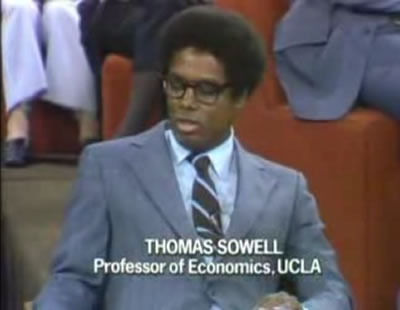
Young Thomas Sowell

Let’s see what Tom Sowell says about it.

Excerpt:

As for the excuse of “security,” this is one of the least security-minded administrations we have had. When hundreds of illegal immigrants from terrorist-sponsoring countries were captured crossing the border from Mexico– and then released on their own recognizance within the United States, that tells you all you need to know about this administration’s concern for security.

When captured terrorists who are not covered by either the Geneva Convention or the Constitution of the United States are nevertheless put on trial in American civilian courts by the Obama Justice Department, that too tells you all you need to know about how concerned they are about national security.

The rules of criminal justice in American courts were not designed for trying terrorists. For one thing, revealing the evidence against them can reveal how our intelligence services got wind of them in the first place, and thereby endanger the lives of people who helped us nab them.

Not a lot of people in other countries, or perhaps even in this country, are going to help us stop terrorists if their role is revealed and their families are exposed to revenge by the terrorists’ bloodthirsty comrades.

What do the Israeli airport security people do that American airport security do not do? They profile. They question some individuals for more than half an hour, open up all their luggage and spread the contents on the counter– and they let others go through with scarcely a word. And it works.

Meanwhile, this administration is so hung up on political correctness that they have turned “profiling” into a bugaboo. They would rather have electronic scanners look under the clothes of nuns than to detain a Jihadist imam for some questioning.

Will America be undermined from within by an administration obsessed with political correctness and intoxicated with the adolescent thrill of exercising its new-found powers? Stay tuned.

So if Obama isn’t sincere about national security, then why is he approving these expensive scanners instead of adopting the Israeli techniques that are known to work?

Excerpt:

President Obama rallied to the defense of the Transportation Security Administration’s X-rated airport x-ray scanners Saturday with the insistence that the intrusive machines were needed in response to last year’s attack by failed underwear bomber Umar Farouk Abdulmutallab. “Since the explosive device that was on Mr. Abdulmutallab was not detected by ordinary metal detectors, it has meant that TSA has tried to adapt to make sure that passengers on planes are safe,” Mr. Obama said. Unfortunately, the administration’s policies appear to be motivated more by business as usual in Washington than true security concerns.

For his extravagant trip to India earlier this month, Mr. Obama invited a number of corporate leaders, including Deepak Chopra, the chief executive of OSI Systems Inc. Through its Rapiscan Systems subsidiary, Mr. Chopra’s firm sells whole-body imaging systems to the TSA. It is also an administration ally. Mr. Chopra and his executive vice presidents, Alan I. Edrick and Ajay Mehra, each cut separate checks for the maximum legal amount to Mr. Obama’s presidential campaign on Oct. 24, 2008. Given the $2.4 billion in public money the administration plans to dole out over the life of the pornographic scanner program, those donations may have been a wise investment.

Democrats cannot, and never will be, serious about national security. Democrats are more like Code Pink and Cindy Sheehan.

Is anything that Deepak Chopra says remotely logical?

I say “NO”. It’s just happy-clappy jibba-jabba!

Here, look at this post from CARM.

Excerpt:

Logic is the backbone of critical thinking. Logic is extremely useful for uncovering error and establishing truth. There are principles of logic and I would like to introduce you to the first three laws of logic. These are very important.

  1. The Law of Identity
  2. The Law of Non-Contradiction
  3. The Law of Excluded Middle

The law of identity states that A is A. An Apple is an Apple. In other words, something is what it is. If something exists, it has a nature, an essence. For example, a book has a front and back cover with pages. A car has four wheels, seats, doors, windows, etc. A tree has branches, leaves, a trunk, and roots. This also means that anything that exists has characteristics. We recognize what something is by observing its characteristic. You know that a tree is a tree because you see its branches, it’s leads, its trunk, etc.
Furthermore, if something has an identity, it has a single identity. It does not have more than one identity. In other words, if something exists it has a set of attributes that are consistent with its own existence. It does not have a set of attributes that are inconsistent with itself. Therefore we can easily conclude that a cat is not a parachute. An Apple is not a race car. A tree is not a movie.

The law of non-contradiction tells us that A cannot be both A and not A at the same time and in the same sense. In other words, something (a statement) cannot be both true and false at the same time and in the same way. We use the law of non-contradiction constantly in discussions and debates because we are naturally able to recognize when someone is contradicting himself. If I were to tell you that yesterday I went shopping and then later I told you that yesterday I did not go shopping, you would be correct in saying there was a contradiction. A contradiction occurs when one statement excludes the possibility of another and yet both are claimed to be true. Since we know that both cannot be true, we see a contradiction. From this principle, we can conclude that truth is not self-contradictory. This is a very important concept. Let me repeat it. Truth is not self-contradictory.

The law of excluded middle says that a statement is either true or false. For example, my hair is brown. It is either true or false that my hair is brown. Another example: I am pregnant. The statement is either true or false. Since I am a male, it is not possible for me to be pregnant. Therefore, the statement is false. If I were a female, it would be possible for me to be pregnant (given normal bodily conditions). A woman is not “kind-of” pregnant. She either is or is not pregnant – there is no middle position. The law of excluded middle is important because it helps us deal in absolutes. This is particularly important in a society where relativism is promoted and truth statements are denied.

Please review these three laws and become familiar with them. They are extremely important when developing critical thinking skills.

Deepak Chopra says what feels good to him. But we have to test his words using the laws of logic. If his words pass that test, then we go on to empirical validation against the external world.

US lawmakers urge India to protect Christians from Hindu militants

Story from Agence France Presse.

Excerpt:

US lawmakers urged authorities in India’s eastern state of Orissa to prosecute perpetrators of violence against Christians, saying the nation’s reputation for tolerance was at stake.

In a letter to the state’s Chief Minister Navin Patnaik released Friday, the lawmakers voiced concern that many perpetrators of last year’s violence were still at large and intimidating their victims.

More than 100 Christian were killed and thousands more left homeless between August and October 2008 following the murder of a revered Hindu holy man, which was blamed on Christians.

While praising recent statements by India’s central government, the lawmakers said that local authorities have sometimes turned away victims seeking redress.

“Such attacks on the fundamental freedom of religion threaten not only India’s reputation for religious diversity, but also the very stability of India’s secular democracy,” the 21 lawmakers, led by Republican Trent Franks, wrote in the letter sent late last month.

“Given the recent experience with religiously inspired terrorism, we are concerned that if Hindu extremists can act with impunity toward religious minorities in India, these extremists and their ideologies will begin to affect international security as well.”

Christians account for 2.3 percent of the billion-plus population in India, which is majority Hindu but officially secular.

The US Commission on International Religious Freedom, a bipartisan official advisory panel, in August placed India on its watch list, citing violence against Christians in Orissa and Muslims in the western state of Gujarat.

The move brought swift condemnation from India, an emerging US ally, which said the nation had an independent judiciary and vigilant media to pursue any aberrations from its secular, multi-religious principles.

It may be useful to listen to the recent debate between Hindus and Christians that I summarized, in which two Hindus explain their view of human rights and how religious minorities should be treated. In some parts of India, if you do not accept the Hindu concept of polytheism, then you are opening yourself up to violence from Hindu extremists. On the other hand, the election of the Congress Party and the rejection of the BJP Party was a good sign that the bulk of Indians are more tolerant that the militant Hindus.

Deepak Chopra and intolerance for Christianity

In a related story, Hugh Hewitt had a post up about Deepak Chopra, who often writes against Bible-believing Christians.

Excerpt:

Still more Chopra invective surfaced in The Washington Post this September, again targeting [Rick] Warren and reflecting the charm of the Left. “The abuse delivered by right-wing Christians is such an old story that we are long past irony,” Chopra wrote, before moving on to his favorite target.

“The Rev. Rick Warren has a record for trying to smooth the waters, but he also flirts with intolerance — toward gay marriage, for instance — and since his rationale is that a ‘loving’ God shares the same prejudices, what’s to stop others with worse tempers from following the same logic? When your God hates, you have permission to hate,” Chopra wrote.

When your guru hates, I guess that gives you permission to hate as well?

I think it’s encouraging that the bulk of Hindus seem to be moving away from the view of intolerant extremists like Deepak Chopra and the Hindu militants in Orissa.