
Tag Archives: Debt Crisis

Bank run in socialist Europe begins

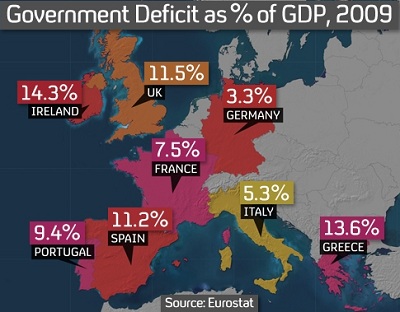
Europe: Annual Budget Deficit as % of GDP

From CNBC.

Excerpt:

Money-market funds in the United States have quite dramatically slammed shut their lending windows to European banks. According to the Economist, Fitch estimates U.S. money market funds have withdrawn 42 percent of their money from European banks in general.

And for France that number is even higher — 69 percent. European money-market funds are also getting in on the act.

Bond issuance by banks has seized up because buyers have gone on strike.

From the Economist’s Free Exchange Blog:

In the third quarter bonds issues by European banks only reached 15 percent of the amount they raised over the same period in the past two years, reckon analysts at Citi Group. It is unlikely that European banks have sold many more bonds since.

Corporate depositors are also pulling their cash.

Free Exchange:

“We are starting to witness signs that corporates are withdrawing deposits from banks in Spain, Italy, France and Belgium,” an analyst at Citi Group wrote in a recent report. “This is a worrying development.”

And there are troubling signs that banks are even running out of collateral to back their borrowings from the European Central Bank .

So far the liquidity of the European Central Bank (ECB) has kept the system alive. Only one large European bank, Dexia, has collapsed because of a funding shortage. Yet what happens if banks run out of collateral to borrow against?

And from the leftist New York Times.

Excerpt:

The flight from European sovereign debt and banks has spanned the globe. European institutions like the Royal Bank of Scotland and pension funds in the Netherlands have been heavy sellers in recent days. And earlier this month, Kokusai Asset Management in Japan unloaded nearly $1 billion in Italian debt.

At the same time, American institutions are pulling back on loans to even the sturdiest banks in Europe. When a $300 million certificate of deposit held by Vanguard’s $114 billion Prime Money Market Fund from Rabobank in the Netherlands came due on Nov. 9, Vanguard decided to let the loan expire and move the money out of Europe. Rabobank enjoys a AAA-credit rating and is considered one of the strongest banks in the world.

American money market funds, long a key supplier of dollars to European banks through short-term loans, have also become nervous. Fund managers have cut their holdings of notes issued by euro zone banks by $261 billion from around its peak in May, a 54 percent drop, according to JPMorgan Chase research.

This is really disturbing. I wonder if any of my economics-minded commenters can explain to me what happens when there is a run on banks. I am guessing that there will be some rioting over benefits as austerity measures are imposed, and interest rates will go up.

A closer look at the budget deal

Here’s a good article in the Wall Street Journal about the budget deal struck by the House, Senate and White House on the weekend.

Excerpt:

The big picture is that the deal is a victory for the cause of smaller government, arguably the biggest since welfare reform in 1996. Most bipartisan budget deals trade tax increases that are immediate for spending cuts that turn out to be fictional. This one includes no immediate tax increases, despite President Obama’s demand as recently as last Monday. The immediate spending cuts are real, if smaller than we’d prefer, and the longer-term cuts could be real if Republicans hold Congress and continue to enforce the deal’s spending caps.

The framework (we haven’t seen all the details) calls for an initial step of some $900 billion in domestic discretionary cuts over 10 years from the Congressional Budget Office (CBO) baseline puffed up by recent spending. If the cuts hold, this would go some way to erasing the fiscal damage from the Obama-Nancy Pelosi stimulus.

[…]The second phase of the deal is less clear cut, though it also could turn out to shrink Leviathan. Party leaders in both houses of Congress will each appoint three Members to a special committee that will recommend another round of deficit reduction of between $1.2 trillion and $1.5 trillion, also over 10 years. Their mandate is broad, and we’re told very little is off the table, but at least seven of the 12 Members would have to agree on a package to force an up-or-down vote in Congress.

If the committee can’t agree on enough deficit reduction, then automatic spending cuts would ensue to make up the difference to reach the $1.2 trillion minimum deficit-reduction target. One key point is that the committee’s failure to agree would not automatically “trigger” (in Beltway parlance) revenue increases, as the White House was insisting on as recently as this weekend. That would have guaranteed that Democrats would never agree to enough cuts, and Republicans were right to resist.

Instead the automatic cuts would be divided equally between defense and nondefense. So, for example, if the committee agrees to deficit reduction of only $600 billion, then another $300 billion would be cut automatically from defense and domestic accounts (excluding Medicare beneficiaries) to reach at least $1.2 trillion.

One reason to think tax increases are unlikely, however, is that the 12-Member committee will operate from CBO’s baseline that assumes that the Bush tax rates expire in 2013. CBO assumes that taxes will rise by $3.5 trillion over the next decade, including huge increases for middle-class earners. Since any elimination of those tax increases would increase the deficit under CBO’s math, the strong incentive for the Members will be to avoid the tax issue. This increases the political incentive for deficit reduction to come from spending cuts.

Mr. Obama’s biggest gain in the deal is that he gets his highest priority of not having to repeat this debt-limit fight again before the 2012 election. The deal stipulates that the debt ceiling will rise automatically by $900 billion this year, and at least $1.2 trillion next year, unless two-thirds of Congress disapproves it. Congress will not do so.

I don’t like the deal because I wanted Obama to have to face this problem with this again in May of 2012, but it may be the best deal we could get with control of only the House.

Jim Demint introduces bill to halt funding for European bailouts

Senator Jim Demint

The Wall Street Journal reports on the Republican effort to halt taxpayer-funded bailouts for socialist European nations.

Excerpt:

A group of Republican senators plan to renew their attempts at stopping the U.S. from funding International Monetary Fund loans to Greece and other countries after the Senate failed to vote on their proposal last week.

A spokesman for Sen. Jim DeMint (R., S.C.), who is leading the effort, said the GOP senators plan to soon introduce stand-alone legislation that would direct the U.S. Treasury to vote against any IMF assistance to European Union nations for the foreseeable future. If enacted into law, it could halt U.S. participation in any future IMF attempts to stabilize the sovereign debt crisis in Europe.

The proposal comes as finance ministers work towards a political agreement committing to provide financing to meet a growing gap in Greece’s funding needs beyond the current EUR110 billion, which in turn would allow the IMF to release a delayed tranche of cash in early July.

[…]Attempts by GOP lawmakers to block IMF loans failed to gain traction in Congress last year. And President Barack Obama has asserted in a signing statement after a House vote on an IMF provision that he doesn’t recognize Congress’ ability to tell the administration how to vote at the IMF.

Greece embraced socialism, and now they have to face the music.