Tag Archives: Credit Rating

Ratings agency Moody’s downgrades 15 banks, some by two notches

From Yahoo News.

Excerpt:

Ratings agency Moody’s downgraded many of the world’s biggest banks on Thursday, lowering credit ratings of 15 companies by one to three notches.

Morgan Stanley, one of the most closely watched firms, had its long-term debt rating lowered by just two notches, one level less than had been expected, and its stock rose in after-hours trading. The downgrade left Morgan Stanley more highly rated than Bank of America Corp and Citigroup but a step below Goldman Sachs Group.

Credit Suisse , which last week was warned about weak capital levels by Switzerland’s central bank, was the only bank in the group to suffer a three-notch downgrade. But its new A1 deposit and senior debt ratings, however, rank higher than many of its peers.

[…]In addition to Morgan Stanley, downgraded by two notches were Barclays , BNP Paribas , Royal Bank of Canada , Citigroup, Goldman Sachs Group, JPMorgan Chase , Credit Agricole , Deutsche Bank , and UBS .

Falling one notch were Bank of America, HSBC Holdings , Royal Bank of Scotland and Societe Generale.

Nomura and Macquarie were included in an original list of global banks, but have already been downgraded.

I don’t think that the Obama administration should be so concentrated on legalizing gay marriage and subsidizing green energy right now. I also think that if you are going off to college, you would do well to study a STEM field. There’s a storm coming.
United States receives another credit downgrade under Obama’s leadership

From Breitbart. (H/T ECM)

Excerpt:

Credit rating agency Egan Jones downgraded the United States Thursday on concern over the sustainability of public debt. Egan Jones is one of the most important ratings firms in the world; they lowered our credit level from AA+ to AA. The firm reduced America from AAA to AA+ in July 2011, just before Standard & Poor’s did the same.

Egan Jones warned. “Without some structural changes soon, restoring credit quality will become increasingly difficult . . . without some structural changes soon, restoring credit quality will become increasingly difficult.” They added that there was a 1.2% probability of U.S  default in the next 12 months.  The company cited the fact that the US’s total debt, which now equals its total GDP, is rising and soon will eclipse the national GDP; the company sees the debt rising to 112% of the GDP by 2014.

The debt grew 23.6% the first two years of Obama’s presidency. When the debt is more than 100% of the GDP, treasury notes fall, which is a problem because they are used for transactions between financial institutions. This, in turn, could raise rates on mortgages and other loans, which would discourage growth in the economy, as well as state and local governments feeling the pinch, which could eliminate more services.

Paul Ryan has offered a debt reduction plan which would reduce the current six federal income tax rates to just 2 — 10% and 25%. His plan would also reduce the federal corporate income tax rate from 35% to 25%, the same rate as the international average. Because of the additional revenue accrued from economic growth as a result of the tax reductions, federal revenues could double over the next 10 years; the added revenue  would be more than the entire GDP of almost every other country in the world.

Meanwhile, President Obama continues to vilify Ryan’s ideas, saying they are, “a Trojan horse, disguised as deficit-reduction plans . . . thinly veiled social Darwinism.” And White House projections show the federal debt’s ratio to gross domestic product growing to a record 124 percent in 2050 under Obama’s plan.

He just wants to keep spending and spending and spending money we don’t have. Money that he didn’t earn. Money that people not even born have not yet earned.

Bank run in socialist Europe begins

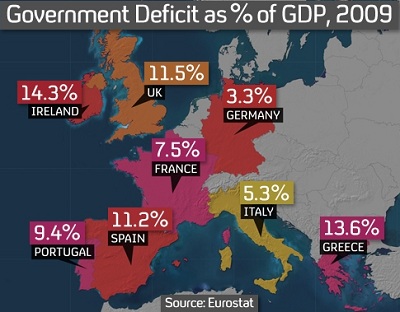
Europe: Annual Budget Deficit as % of GDP

From CNBC.

Excerpt:

Money-market funds in the United States have quite dramatically slammed shut their lending windows to European banks. According to the Economist, Fitch estimates U.S. money market funds have withdrawn 42 percent of their money from European banks in general.

And for France that number is even higher — 69 percent. European money-market funds are also getting in on the act.

Bond issuance by banks has seized up because buyers have gone on strike.

From the Economist’s Free Exchange Blog:

In the third quarter bonds issues by European banks only reached 15 percent of the amount they raised over the same period in the past two years, reckon analysts at Citi Group. It is unlikely that European banks have sold many more bonds since.

Corporate depositors are also pulling their cash.

Free Exchange:

“We are starting to witness signs that corporates are withdrawing deposits from banks in Spain, Italy, France and Belgium,” an analyst at Citi Group wrote in a recent report. “This is a worrying development.”

And there are troubling signs that banks are even running out of collateral to back their borrowings from the European Central Bank .

So far the liquidity of the European Central Bank (ECB) has kept the system alive. Only one large European bank, Dexia, has collapsed because of a funding shortage. Yet what happens if banks run out of collateral to borrow against?

And from the leftist New York Times.

Excerpt:

The flight from European sovereign debt and banks has spanned the globe. European institutions like the Royal Bank of Scotland and pension funds in the Netherlands have been heavy sellers in recent days. And earlier this month, Kokusai Asset Management in Japan unloaded nearly $1 billion in Italian debt.

At the same time, American institutions are pulling back on loans to even the sturdiest banks in Europe. When a $300 million certificate of deposit held by Vanguard’s $114 billion Prime Money Market Fund from Rabobank in the Netherlands came due on Nov. 9, Vanguard decided to let the loan expire and move the money out of Europe. Rabobank enjoys a AAA-credit rating and is considered one of the strongest banks in the world.

American money market funds, long a key supplier of dollars to European banks through short-term loans, have also become nervous. Fund managers have cut their holdings of notes issued by euro zone banks by $261 billion from around its peak in May, a 54 percent drop, according to JPMorgan Chase research.

This is really disturbing. I wonder if any of my economics-minded commenters can explain to me what happens when there is a run on banks. I am guessing that there will be some rioting over benefits as austerity measures are imposed, and interest rates will go up.